Guo Tiantian, Zou Liqing, Ni Jianjiao, Chu Xiao, Zhu Zhengfei
Department of Radiation Oncology, Fudan University Shanghai Cancer Center, Shanghai, China.
Department of Oncology, Shanghai Medical College.
Transl Lung Cancer Res. 2020 Oct;9(5):2097-2112. doi: 10.21037/tlcr-20-511.
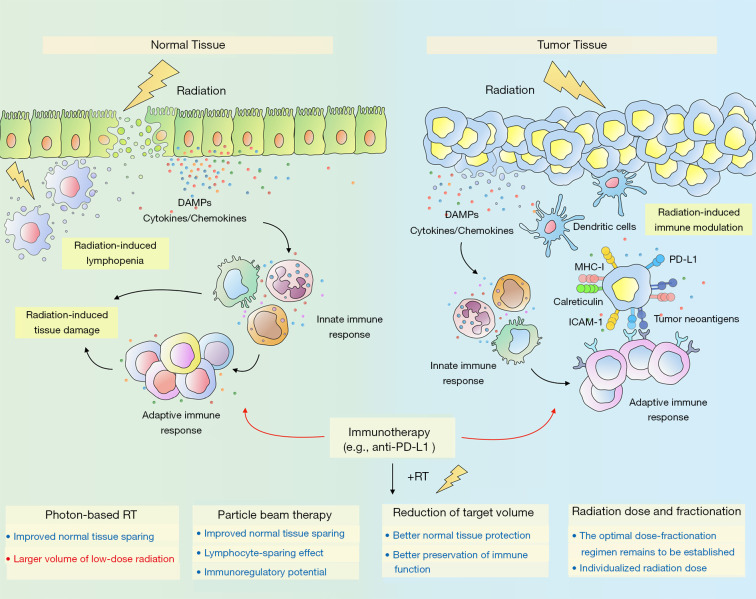
Significant recent advances have occurred in the use of radiation therapy for locally advanced non-small cell lung cancer (LA-NSCLC). In fact, the past few decades have seen both therapeutic gains and setbacks in the evolution of radiotherapy for LA-NSCLC. The PACIFIC trial has heralded a new era of immunotherapy and has raised important questions for future study, such as the future directions of radiation therapy for LA-NSCLC in the era of immunotherapy. Modern radiotherapy techniques such as three-dimensional (3D) conformal radiotherapy and intensity-modulated radiotherapy (IMRT) provide opportunities for improved target conformity and reduced normal-tissue exposure. However, the low-dose radiation volume brought by IMRT and its effects on the immune system deserve particular attention when combing radiotherapy and immunotherapy. Particle radiotherapy offers dosimetric advantages and exhibits great immunoregulatory potential. With the ongoing improvement in particle radiotherapy techniques and knowledge, the combination of immunotherapy and particle radiotherapy has tremendous potential to improve treatment outcomes. Of particular importance are questions on the optimal radiation schedule in the settings of radio-immunotherapy. Strategies for the reduction of the irradiated field such as involved-field irradiation (IFI) and omission of clinical target volume (CTV) hold promise for better preservation of immune function while not compromising locoregional and distant control. In addition, different dose-fractionation regimens can have diverse effects on the immune system. Thus, prospective trials are urgently needed to establish the optimal dose fractionation regimen. Moreover, personalized radiotherapy which allows the tailoring of radiation dose to each individual's genetic background and immune state is of critical importance in maximizing the benefit of radiation to patients with LA-NSCLC.
局部晚期非小细胞肺癌(LA-NSCLC)放射治疗的应用近年来取得了重大进展。事实上,在LA-NSCLC放射治疗的发展过程中,过去几十年既有治疗上的进步,也有挫折。PACIFIC试验开创了免疫治疗的新时代,并提出了一些未来研究的重要问题,比如在免疫治疗时代LA-NSCLC放射治疗的未来方向。三维(3D)适形放疗和调强放疗(IMRT)等现代放疗技术为提高靶区适形性和减少正常组织受照提供了机会。然而,在放疗与免疫治疗联合应用时,IMRT带来的低剂量辐射体积及其对免疫系统的影响值得特别关注。粒子放疗具有剂量学优势,并展现出巨大的免疫调节潜力。随着粒子放疗技术和知识的不断进步,免疫治疗与粒子放疗联合应用在改善治疗效果方面具有巨大潜力。在放射免疫治疗中,关于最佳放疗方案的问题尤为重要。缩小照射野的策略,如累及野照射(IFI)和省略临床靶体积(CTV)有望在不影响局部区域和远处控制的前提下更好地保护免疫功能。此外,不同的剂量分割方案对免疫系统可能有不同影响。因此,迫切需要开展前瞻性试验来确定最佳剂量分割方案。此外,根据个体的基因背景和免疫状态量身定制放射剂量的个体化放疗对于使LA-NSCLC患者从放疗中获得最大益处至关重要。