Hofman Paul
CHU Nice, FHU OncoAge, Laboratory of Clinical and Experimental Pathology, Pasteur Hospital, Université Côte d'Azur, Nice, France.
CNRS, INSERM, IRCAN, FHU OncoAge, Team 4, Hospital-Integrated Biobank, Université Côte d'Azur, Nice, France.
Transl Lung Cancer Res. 2020 Oct;9(5):2199-2213. doi: 10.21037/tlcr-20-178.
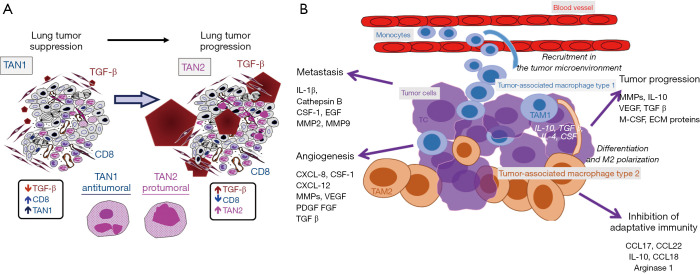
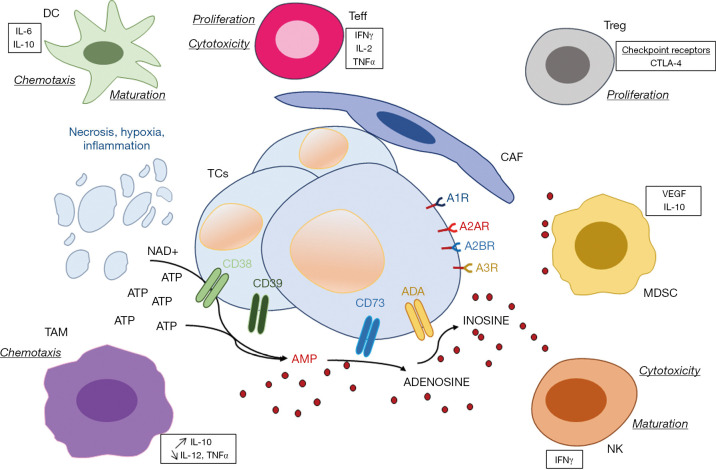
The basis of current and future lung cancer immunotherapy depends mainly on our knowledge of the molecular mechanisms of interactions between cancer and immune cells (ICs), as well as on interactions occurring between the different populations of intra-tumor ICs. These interactions are very complex, as virtually all immune cell types, including macrophages, neutrophils, mast cells, natural killer (NK) cells, dendritic cells and T and B lymphocytes can infiltrate lung cancer tissues at the same time. Moreover these interactions lead to progressive emergence of an imbalance in ICs. Initially ICs have an anti-tumor effect but then induce immune tolerance and eventually tumor progression and dissemination. All the cells of innate and adaptive intra-tumor immunity engage in this progressive phenotypic switch. A majority of non-small cell lung carcinoma (NSCLC) patients do not benefit from the expected positive responses associated with current immunotherapy. Thus, there is urgent need to better understand the different roles of the associated cancer ICs. This review summarizes some of the new insights into this domain, with particular focus on: the myeloid cell population associated with tumors, the tertiary lymphoid structures (TLSs), the role of the P2 purinergic receptors (P2R) and ATP, and the new concept of the "liquid microenvironment" implying blood circulating ICs.
当前及未来肺癌免疫治疗的基础主要取决于我们对癌症与免疫细胞(ICs)之间相互作用分子机制的了解,以及肿瘤内不同ICs群体之间发生的相互作用。这些相互作用非常复杂,因为几乎所有免疫细胞类型,包括巨噬细胞、中性粒细胞、肥大细胞、自然杀伤(NK)细胞、树突状细胞以及T和B淋巴细胞,都能同时浸润肺癌组织。此外,这些相互作用会导致ICs逐渐出现失衡。最初ICs具有抗肿瘤作用,但随后会诱导免疫耐受并最终导致肿瘤进展和扩散。肿瘤内先天性和适应性免疫的所有细胞都参与了这种渐进性的表型转换。大多数非小细胞肺癌(NSCLC)患者并未从当前免疫治疗预期的阳性反应中获益。因此,迫切需要更好地了解相关癌症ICs的不同作用。本综述总结了该领域的一些新见解,特别关注:与肿瘤相关的髓样细胞群体、三级淋巴结构(TLSs)、P2嘌呤能受体(P2R)和ATP的作用,以及意味着血液循环中ICs的“液体微环境”这一新概念。