Department of Breast Surgery, the First Affiliated Hospital, Xi'an Jiaotong University, 277 Yanta Western Rd., Xi'an, 710061, Shaan'xi Province, China.
BMC Cancer. 2020 Nov 19;20(1):1120. doi: 10.1186/s12885-020-07621-7.
Previous research results on the predictive factors of neoadjuvant chemotherapy (NCT) efficacy in breast cancer are inconsistent, suggesting that the ability of a single factor to predict efficacy is insufficient. Combining multiple potential efficacy-related factors to build a model may improve the accuracy of prediction. This study intends to explore the clinical and biological factors in breast cancer patients receiving NCT and to establish a nomogram that can predict the pathologic complete response (pCR) rate of NCT.
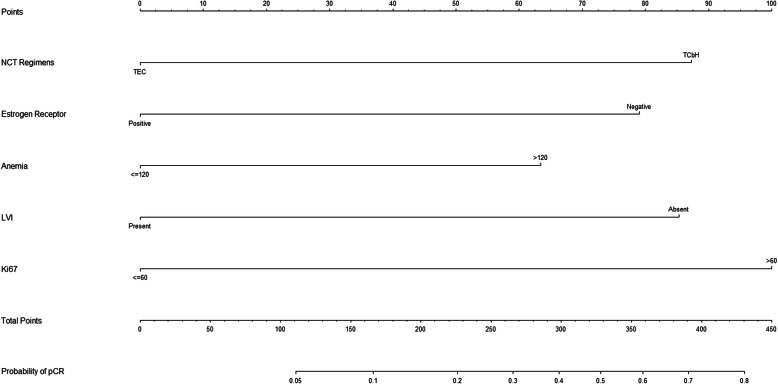
We selected 165 breast cancer patients receiving NCT from July 2017 to May 2019. Using pretreatment biopsy materials, immunohistochemical studies to assess estrogen receptor (ER), progesterone receptor (PR), human epidermal growth factor receptor 2 (HER-2), and Ki-67 expression. The correlation between biological markers and pCR was analyzed. These predictors were used to develop a binary logistic regression model with cross-validation and to show the established predictive model with a nomogram.
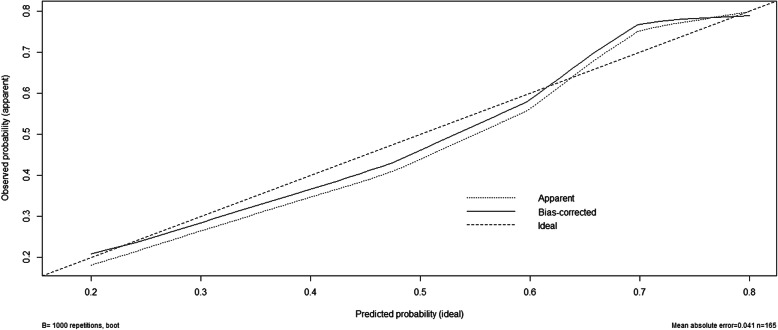
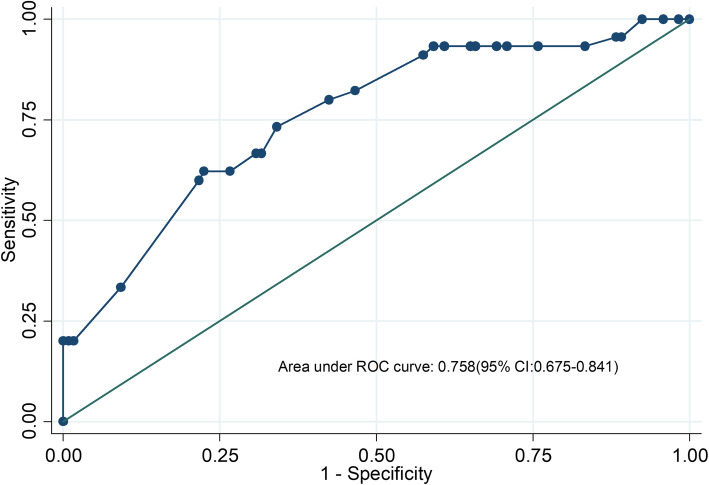
The nomogram for pCR based on lymphovascular invasion, anemia (hemoglobin≤120 g/L), ER, Ki67 expression levels and NCT regimen had good discrimination performance (area under the curve [AUC], 0.758; 95% confidence interval [CI], 0.675-0.841) and calibration coordination. According to the Hosmer-Lemeshow test, the calibration chart showed satisfactory agreement between the predicted and observed probabilities. The final prediction accuracy of cross-validation was 76%.
We developed a nomogram based on multiple clinical and biological covariations that can provide an early prediction of NCT response and can help to quickly assess the individual benefits of NCT.
先前关于乳腺癌新辅助化疗(NCT)疗效预测因素的研究结果不一致,这表明单一因素预测疗效的能力不足。结合多个潜在的疗效相关因素构建模型可能会提高预测的准确性。本研究旨在探讨接受 NCT 的乳腺癌患者的临床和生物学因素,并建立一个能够预测 NCT 病理完全缓解(pCR)率的列线图。
我们选择了 2017 年 7 月至 2019 年 5 月期间接受 NCT 的 165 例乳腺癌患者。使用预处理活检材料,通过免疫组织化学研究评估雌激素受体(ER)、孕激素受体(PR)、人表皮生长因子受体 2(HER-2)和 Ki-67 的表达。分析了生物标志物与 pCR 的相关性。使用交叉验证建立二元逻辑回归模型,并使用列线图展示所建立的预测模型。
基于血管淋巴管侵犯、贫血(血红蛋白≤120g/L)、ER、Ki67 表达水平和 NCT 方案的 pCR 列线图具有良好的区分性能(曲线下面积 [AUC],0.758;95%置信区间 [CI],0.675-0.841)和校准一致性。根据 Hosmer-Lemeshow 检验,校准图显示预测概率与观察概率之间存在良好的一致性。交叉验证的最终预测准确率为 76%。
我们基于多个临床和生物学变异性建立了一个列线图,可以提供 NCT 反应的早期预测,并有助于快速评估 NCT 的个体获益。