Chelsea and Westminster NHS Foundation Trust, 369 Fulham Road, London, SW10 9NH, UK.
National Institute for Health Research Health Protection Research Unit in Healthcare Associated Infections and Antimicrobial Resistance, Imperial College London, Hammersmith Campus, Du Cane Road, London, W12 0NN, UK.
BMC Med Inform Decis Mak. 2020 Nov 19;20(1):299. doi: 10.1186/s12911-020-01316-6.
Accurately predicting patient outcomes in Severe acute respiratory syndrome coronavirus 2 (SARS-CoV-2) could aid patient management and allocation of healthcare resources. There are a variety of methods which can be used to develop prognostic models, ranging from logistic regression and survival analysis to more complex machine learning algorithms and deep learning. Despite several models having been created for SARS-CoV-2, most of these have been found to be highly susceptible to bias. We aimed to develop and compare two separate predictive models for death during admission with SARS-CoV-2.
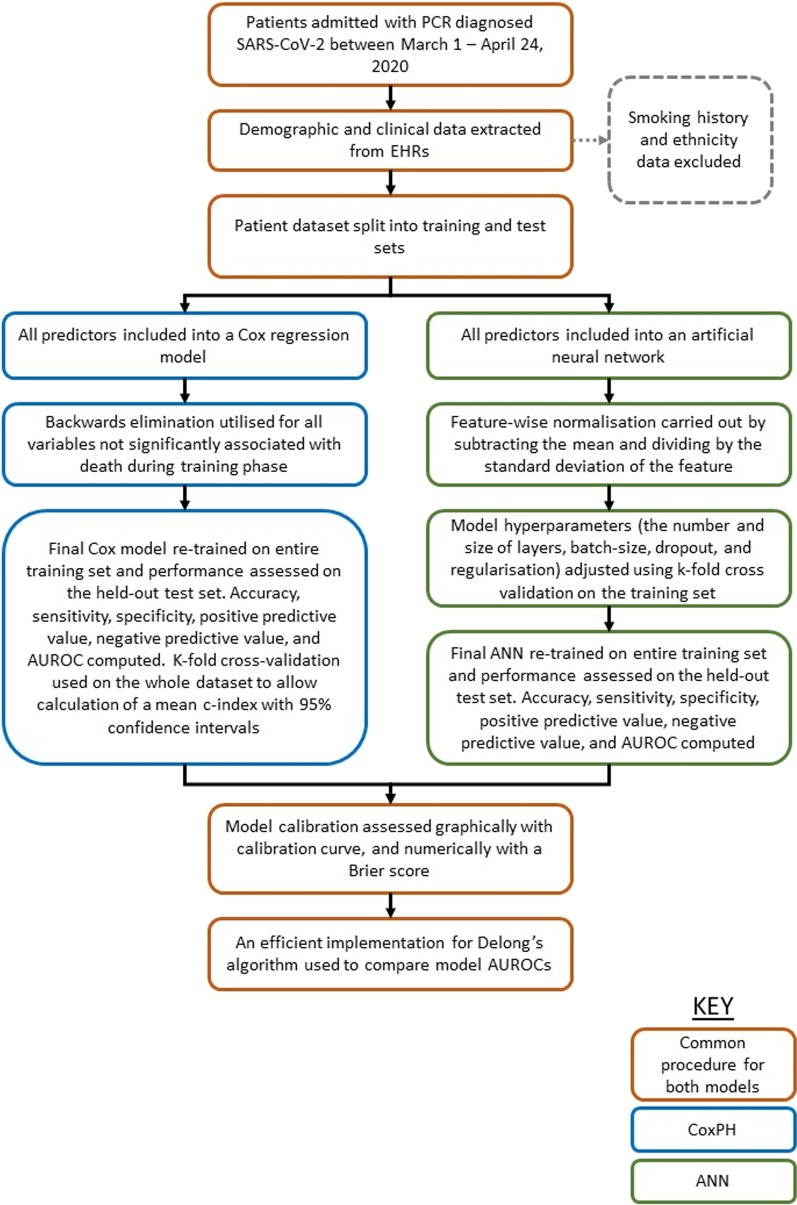
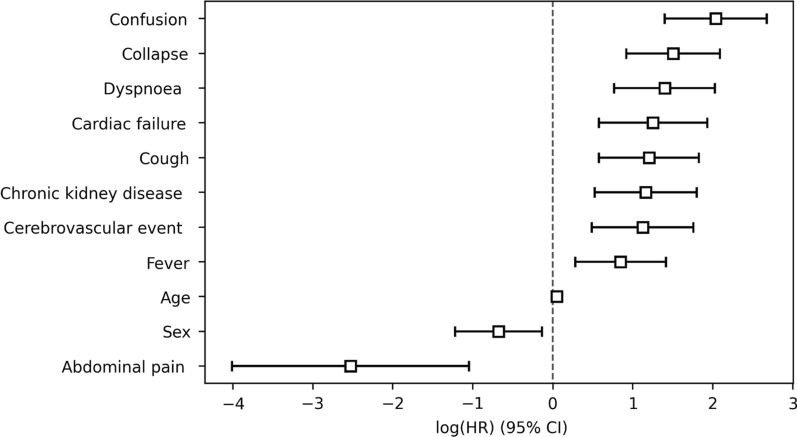
Between March 1 and April 24, 2020, 398 patients were identified with laboratory confirmed SARS-CoV-2 in a London teaching hospital. Data from electronic health records were extracted and used to create two predictive models using: (1) a Cox regression model and (2) an artificial neural network (ANN). Model performance profiles were assessed by validation, discrimination, and calibration.
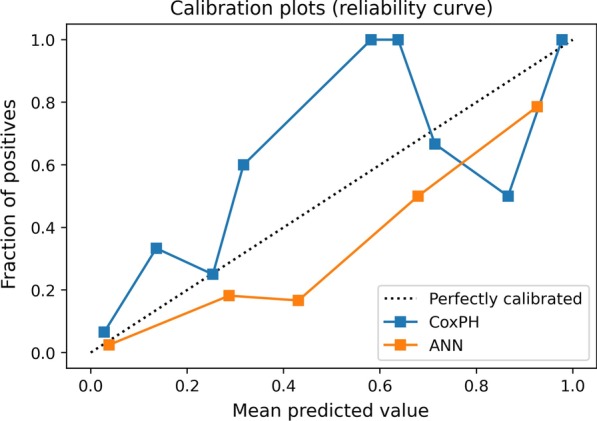
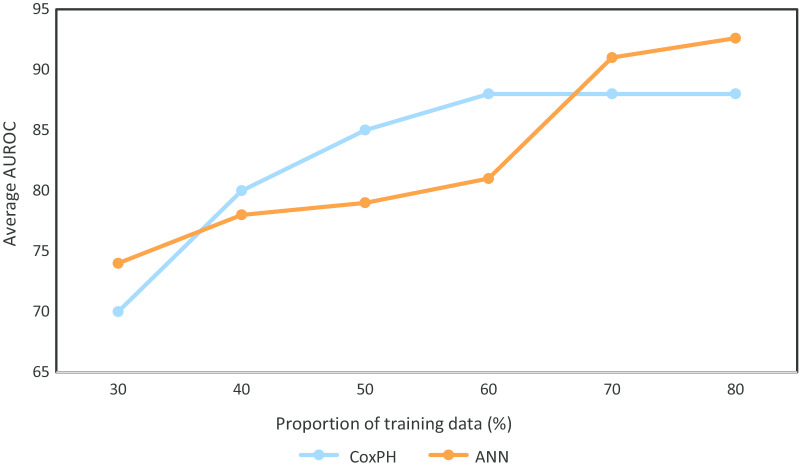
Both the Cox regression and ANN models achieved high accuracy (83.8%, 95% confidence interval (CI) 73.8-91.1 and 90.0%, 95% CI 81.2-95.6, respectively). The area under the receiver operator curve (AUROC) for the ANN (92.6%, 95% CI 91.1-94.1) was significantly greater than that of the Cox regression model (86.9%, 95% CI 85.7-88.2), p = 0.0136. Both models achieved acceptable calibration with Brier scores of 0.13 and 0.11 for the Cox model and ANN, respectively.
We demonstrate an ANN which is non-inferior to a Cox regression model but with potential for further development such that it can learn as new data becomes available. Deep learning techniques are particularly suited to complex datasets with non-linear solutions, which make them appropriate for use in conditions with a paucity of prior knowledge. Accurate prognostic models for SARS-CoV-2 can provide benefits at the patient, departmental and organisational level.
准确预测严重急性呼吸综合征冠状病毒 2(SARS-CoV-2)患者的结局可以帮助管理患者并分配医疗资源。有多种方法可用于开发预后模型,从逻辑回归和生存分析到更复杂的机器学习算法和深度学习。尽管已经为 SARS-CoV-2 开发了多种模型,但大多数模型都发现存在高度偏见。我们旨在开发和比较两种用于预测 SARS-CoV-2 住院期间死亡的独立预测模型。
2020 年 3 月 1 日至 4 月 24 日,在伦敦一家教学医院确定了 398 例实验室确诊的 SARS-CoV-2 患者。从电子健康记录中提取数据,并使用以下方法创建两个预测模型:(1)Cox 回归模型和(2)人工神经网络(ANN)。通过验证、区分和校准评估模型性能概况。
Cox 回归和 ANN 模型均具有较高的准确性(83.8%,95%置信区间(CI)73.8-91.1 和 90.0%,95%CI 81.2-95.6)。ANN 的接收器操作曲线下面积(AUROC)(92.6%,95%CI 91.1-94.1)显著大于 Cox 回归模型(86.9%,95%CI 85.7-88.2),p=0.0136。两个模型的 Brier 评分分别为 Cox 模型和 ANN 的 0.13 和 0.11,均具有可接受的校准度。
我们证明了一种 ANN 不劣于 Cox 回归模型,但具有进一步发展的潜力,以便可以随着新数据的出现而学习。深度学习技术特别适合具有非线性解决方案的复杂数据集,这使它们适用于缺乏先验知识的情况。SARS-CoV-2 的准确预后模型可以为患者、科室和组织层面带来益处。