• 文献检索
  • 文档翻译
  • 深度研究
  • 学术资讯
  • Suppr Zotero 插件Zotero 插件
  • 邀请有礼
  • 套餐&价格
  • 历史记录
应用&插件
Suppr Zotero 插件Zotero 插件浏览器插件Mac 客户端Windows 客户端微信小程序
定价
高级版会员购买积分包购买API积分包
服务
文献检索文档翻译深度研究API 文档MCP 服务
关于我们
关于 Suppr公司介绍联系我们用户协议隐私条款
关注我们

Suppr 超能文献

核心技术专利:CN118964589B侵权必究
粤ICP备2023148730 号-1Suppr @ 2026

文献检索

告别复杂PubMed语法,用中文像聊天一样搜索,搜遍4000万医学文献。AI智能推荐,让科研检索更轻松。

立即免费搜索

文件翻译

保留排版,准确专业,支持PDF/Word/PPT等文件格式,支持 12+语言互译。

免费翻译文档

深度研究

AI帮你快速写综述,25分钟生成高质量综述,智能提取关键信息,辅助科研写作。

立即免费体验

单变量与多变量方法分析脑-行为映射的实证比较。

An empirical comparison of univariate versus multivariate methods for the analysis of brain-behavior mapping.

机构信息

University of California, Berkeley, California, USA.

VA Northern California Health Care System, Martinez, California, USA.

出版信息

Hum Brain Mapp. 2021 Mar;42(4):1070-1101. doi: 10.1002/hbm.25278. Epub 2020 Nov 20.

DOI:10.1002/hbm.25278
PMID:33216425
原文链接:https://pmc.ncbi.nlm.nih.gov/articles/PMC7856656/
Abstract

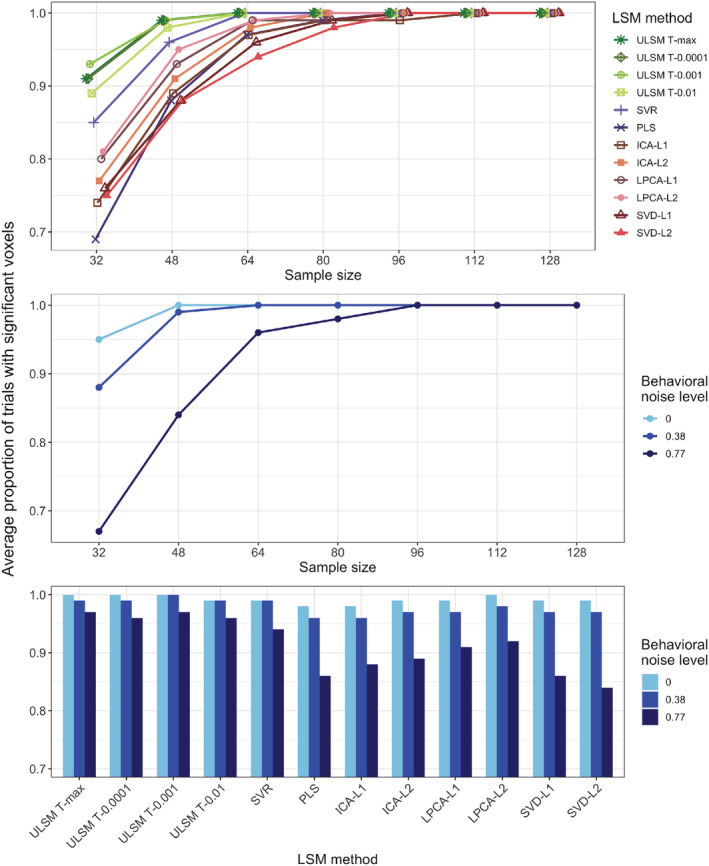
Lesion symptom mapping (LSM) tools are used on brain injury data to identify the neural structures critical for a given behavior or symptom. Univariate lesion symptom mapping (ULSM) methods provide statistical comparisons of behavioral test scores in patients with and without a lesion on a voxel by voxel basis. More recently, multivariate lesion symptom mapping (MLSM) methods have been developed that consider the effects of all lesioned voxels in one model simultaneously. In the current study, we provide a much-needed systematic comparison of several ULSM and MLSM methods, using both synthetic and real data to identify the potential strengths and weaknesses of both approaches. We tested the spatial precision of each LSM method for both single and dual (network type) anatomical target simulations across anatomical target location, sample size, noise level, and lesion smoothing. Additionally, we performed false positive simulations to identify the characteristics associated with each method's spurious findings. Simulations showed no clear superiority of either ULSM or MLSM methods overall, but rather highlighted specific advantages of different methods. No single method produced a thresholded LSM map that exclusively delineated brain regions associated with the target behavior. Thus, different LSM methods are indicated, depending on the particular study design, specific hypotheses, and sample size. Overall, we recommend the use of both ULSM and MLSM methods in tandem to enhance confidence in the results: Brain foci identified as significant across both types of methods are unlikely to be spurious and can be confidently reported as robust results.

摘要

病灶症状映射(LSM)工具用于脑损伤数据,以识别对于特定行为或症状至关重要的神经结构。单变量病灶症状映射(ULSM)方法提供了基于体素的患者有病变和无病变的行为测试分数的统计比较。最近,已经开发了多变量病灶症状映射(MLSM)方法,该方法同时考虑了一个模型中所有病变体素的影响。在当前的研究中,我们使用合成和真实数据对几种 ULSM 和 MLSM 方法进行了急需的系统比较,以确定这两种方法的潜在优势和弱点。我们测试了每种 LSM 方法在单个和双重(网络类型)解剖目标模拟中的空间精度,跨越解剖目标位置、样本大小、噪声水平和病变平滑。此外,我们进行了假阳性模拟,以确定与每种方法的虚假发现相关的特征。模拟结果表明,总体而言,ULSM 或 MLSM 方法都没有明显的优势,而是强调了不同方法的特定优势。没有一种单一的方法可以生成一个阈值 LSM 图,专门描绘与目标行为相关的大脑区域。因此,根据特定的研究设计、具体假设和样本大小,需要使用不同的 LSM 方法。总的来说,我们建议同时使用 ULSM 和 MLSM 方法,以增强对结果的信心:两种类型的方法都确定为显著的大脑焦点不太可能是虚假的,可以自信地报告为可靠的结果。
https://cdn.ncbi.nlm.nih.gov/pmc/blobs/765f/7856656/612a94903e22/HBM-42-1070-g014.jpg
https://cdn.ncbi.nlm.nih.gov/pmc/blobs/765f/7856656/f7f15f3a0356/HBM-42-1070-g001.jpg
https://cdn.ncbi.nlm.nih.gov/pmc/blobs/765f/7856656/3230162787e0/HBM-42-1070-g002.jpg
https://cdn.ncbi.nlm.nih.gov/pmc/blobs/765f/7856656/07a1d8559128/HBM-42-1070-g003.jpg
https://cdn.ncbi.nlm.nih.gov/pmc/blobs/765f/7856656/278b97ce918c/HBM-42-1070-g004.jpg
https://cdn.ncbi.nlm.nih.gov/pmc/blobs/765f/7856656/bda5e57dc4a0/HBM-42-1070-g005.jpg
https://cdn.ncbi.nlm.nih.gov/pmc/blobs/765f/7856656/5bb95e37023a/HBM-42-1070-g006.jpg
https://cdn.ncbi.nlm.nih.gov/pmc/blobs/765f/7856656/33ff8303eb73/HBM-42-1070-g007.jpg
https://cdn.ncbi.nlm.nih.gov/pmc/blobs/765f/7856656/bfa1ffd1b47f/HBM-42-1070-g008.jpg
https://cdn.ncbi.nlm.nih.gov/pmc/blobs/765f/7856656/8f8437810614/HBM-42-1070-g009.jpg
https://cdn.ncbi.nlm.nih.gov/pmc/blobs/765f/7856656/2bfecb4a861c/HBM-42-1070-g010.jpg
https://cdn.ncbi.nlm.nih.gov/pmc/blobs/765f/7856656/46cfb3a14b11/HBM-42-1070-g011.jpg
https://cdn.ncbi.nlm.nih.gov/pmc/blobs/765f/7856656/43b3249c477a/HBM-42-1070-g012.jpg
https://cdn.ncbi.nlm.nih.gov/pmc/blobs/765f/7856656/8173d98a9d88/HBM-42-1070-g013.jpg
https://cdn.ncbi.nlm.nih.gov/pmc/blobs/765f/7856656/612a94903e22/HBM-42-1070-g014.jpg
https://cdn.ncbi.nlm.nih.gov/pmc/blobs/765f/7856656/f7f15f3a0356/HBM-42-1070-g001.jpg
https://cdn.ncbi.nlm.nih.gov/pmc/blobs/765f/7856656/3230162787e0/HBM-42-1070-g002.jpg
https://cdn.ncbi.nlm.nih.gov/pmc/blobs/765f/7856656/07a1d8559128/HBM-42-1070-g003.jpg
https://cdn.ncbi.nlm.nih.gov/pmc/blobs/765f/7856656/278b97ce918c/HBM-42-1070-g004.jpg
https://cdn.ncbi.nlm.nih.gov/pmc/blobs/765f/7856656/bda5e57dc4a0/HBM-42-1070-g005.jpg
https://cdn.ncbi.nlm.nih.gov/pmc/blobs/765f/7856656/5bb95e37023a/HBM-42-1070-g006.jpg
https://cdn.ncbi.nlm.nih.gov/pmc/blobs/765f/7856656/33ff8303eb73/HBM-42-1070-g007.jpg
https://cdn.ncbi.nlm.nih.gov/pmc/blobs/765f/7856656/bfa1ffd1b47f/HBM-42-1070-g008.jpg
https://cdn.ncbi.nlm.nih.gov/pmc/blobs/765f/7856656/8f8437810614/HBM-42-1070-g009.jpg
https://cdn.ncbi.nlm.nih.gov/pmc/blobs/765f/7856656/2bfecb4a861c/HBM-42-1070-g010.jpg
https://cdn.ncbi.nlm.nih.gov/pmc/blobs/765f/7856656/46cfb3a14b11/HBM-42-1070-g011.jpg
https://cdn.ncbi.nlm.nih.gov/pmc/blobs/765f/7856656/43b3249c477a/HBM-42-1070-g012.jpg
https://cdn.ncbi.nlm.nih.gov/pmc/blobs/765f/7856656/8173d98a9d88/HBM-42-1070-g013.jpg
https://cdn.ncbi.nlm.nih.gov/pmc/blobs/765f/7856656/612a94903e22/HBM-42-1070-g014.jpg

相似文献

1
An empirical comparison of univariate versus multivariate methods for the analysis of brain-behavior mapping.单变量与多变量方法分析脑-行为映射的实证比较。
Hum Brain Mapp. 2021 Mar;42(4):1070-1101. doi: 10.1002/hbm.25278. Epub 2020 Nov 20.
2
Improved accuracy of lesion to symptom mapping with multivariate sparse canonical correlations.利用多元稀疏正则相关提高病变与症状映射的准确性。
Neuropsychologia. 2018 Jul 1;115:154-166. doi: 10.1016/j.neuropsychologia.2017.08.027. Epub 2017 Sep 5.
3
Multivariate lesion-symptom mapping using support vector regression.使用支持向量回归的多变量病变-症状映射
Hum Brain Mapp. 2014 Dec;35(12):5861-76. doi: 10.1002/hbm.22590. Epub 2014 Jul 16.
4
An empirical evaluation of multivariate lesion behaviour mapping using support vector regression.使用支持向量回归进行多元病变行为映射的实证评估。
Hum Brain Mapp. 2019 Apr 1;40(5):1381-1390. doi: 10.1002/hbm.24476. Epub 2018 Dec 13.
5
Hippocampal diaschisis contributes to anosognosia for hemiplegia: Evidence from lesion network-symptom-mapping.海马旁回失联络导致偏瘫失认症:来自病变网络-症状映射的证据。
Neuroimage. 2020 Mar;208:116485. doi: 10.1016/j.neuroimage.2019.116485. Epub 2019 Dec 20.
6
Consistent spatial lesion-symptom patterns: A comprehensive analysis using triangulation in lesion-symptom mapping in a cohort of stroke patients.一致的空间病变-症状模式:利用病变-症状映射中的三角剖分对一组中风患者进行的综合分析。
Magn Reson Imaging. 2024 Jun;109:286-293. doi: 10.1016/j.mri.2024.03.031. Epub 2024 Mar 24.
7
Support vector regression based multivariate lesion-symptom mapping.基于支持向量回归的多变量病变-症状映射
Annu Int Conf IEEE Eng Med Biol Soc. 2014;2014:5599-602. doi: 10.1109/EMBC.2014.6944896.
8
Relative contributions of lesion location and lesion size to predictions of varied language deficits in post-stroke aphasia.病灶位置和病灶大小对卒中后失语症各种语言缺陷预测的相对贡献。
Neuroimage Clin. 2018;20:1129-1138. doi: 10.1016/j.nicl.2018.10.017. Epub 2018 Oct 19.
9
Multivariate Connectome-Based Symptom Mapping in Post-Stroke Patients: Networks Supporting Language and Speech.基于多变量连接组的中风后患者症状映射:支持语言和言语的网络
J Neurosci. 2016 Jun 22;36(25):6668-79. doi: 10.1523/JNEUROSCI.4396-15.2016.
10
Voxel-based lesion analysis of brain regions underlying reading and writing.基于体素的阅读和书写相关脑区病变分析。
Neuropsychologia. 2018 Jul 1;115:51-59. doi: 10.1016/j.neuropsychologia.2018.03.021. Epub 2018 Mar 20.

引用本文的文献

1
Neural Correlates of Rhythm in Post-Stroke Aphasia.中风后失语症中节律的神经关联
Neurobiol Lang (Camb). 2025 Aug 14;6. doi: 10.1162/nol.a.9. eCollection 2025.
2
Role for Left Dorsomedial Prefrontal Cortex in Self-Generated, but not Externally Cued, Language Production.左背内侧前额叶皮质在自我生成而非外部提示的语言产生中的作用。
Neurobiol Lang (Camb). 2025 Jun 12;6. doi: 10.1162/nol_a_00166. eCollection 2025.
3
Benchmarking machine learning models in lesion-symptom mapping for predicting language outcomes in stroke survivors.

本文引用的文献

1
Comparison of Variable Selection Methods for Time-to-Event Data in High-Dimensional Settings.高维环境下生存数据分析中变量选择方法的比较。
Comput Math Methods Med. 2020 Jul 1;2020:6795392. doi: 10.1155/2020/6795392. eCollection 2020.
2
Rethinking causality and data complexity in brain lesion-behaviour inference and its implications for lesion-behaviour modelling.重新思考脑损伤-行为推断中的因果关系和数据复杂性及其对损伤-行为建模的影响。
Cortex. 2020 May;126:49-62. doi: 10.1016/j.cortex.2020.01.004. Epub 2020 Jan 24.
3
The neural and neurocomputational bases of recovery from post-stroke aphasia.
用于预测中风幸存者语言结局的病变-症状映射中机器学习模型的基准测试
Front Neuroimaging. 2025 May 30;4:1573816. doi: 10.3389/fnimg.2025.1573816. eCollection 2025.
4
Using unsupervised dimensionality reduction to identify lesion patterns predictive of post-stroke aphasia severity.使用无监督降维来识别预测中风后失语严重程度的病变模式。
Cortex. 2025 Jul;188:25-41. doi: 10.1016/j.cortex.2025.04.015. Epub 2025 May 9.
5
Linking Memory Impairment to Structural Connectivity in Extrahippocampal Temporal Lobe Epilepsy Surgery.将记忆障碍与海马旁颞叶癫痫手术中的结构连接性相关联
Neurol Int. 2025 Mar 31;17(4):52. doi: 10.3390/neurolint17040052.
6
Post-stroke outcome prediction based on lesion-derived features.基于病灶衍生特征的中风后预后预测
Neuroimage Clin. 2025;45:103747. doi: 10.1016/j.nicl.2025.103747. Epub 2025 Jan 31.
7
Iowa Brain-Behavior Modeling Toolkit: An Open-Source MATLAB Tool for Inferential and Predictive Modeling of Imaging-Behavior and Lesion-Deficit Relationships.爱荷华脑行为建模工具包:一个用于成像行为和病变缺陷关系的推理与预测建模的开源MATLAB工具。
Hum Brain Mapp. 2024 Dec 15;45(18):e70115. doi: 10.1002/hbm.70115.
8
Verbal working memory and syntactic comprehension segregate into the dorsal and ventral streams, respectively.言语工作记忆和句法理解分别定位于背侧流和腹侧流。
Brain Commun. 2024 Dec 11;6(6):fcae449. doi: 10.1093/braincomms/fcae449. eCollection 2024.
9
Mapping sentence comprehension and syntactic complexity: evidence from 131 stroke survivors.映射句子理解与句法复杂性:来自131名中风幸存者的证据。
Brain Commun. 2024 Nov 15;6(6):fcae379. doi: 10.1093/braincomms/fcae379. eCollection 2024.
10
Voxel-Based Lesion Analysis of Ideomotor Apraxia.基于体素的观念运动性失用症病变分析
Brain Sci. 2024 Aug 24;14(9):853. doi: 10.3390/brainsci14090853.
脑卒中后失语症康复的神经和神经计算基础。
Nat Rev Neurol. 2020 Jan;16(1):43-55. doi: 10.1038/s41582-019-0282-1. Epub 2019 Nov 26.
4
Neuroplasticity in Aphasia: A Proposed Framework of Language Recovery.失语症中的神经可塑性:语言恢复的框架。
J Speech Lang Hear Res. 2019 Nov 22;62(11):3973-3985. doi: 10.1044/2019_JSLHR-L-RSNP-19-0054.
5
A network underlying human higher-order motor control: Insights from machine learning-based lesion-behaviour mapping in apraxia of pantomime.人类高级运动控制的网络基础:基于机器学习的模仿性失用症病灶-行为映射的见解。
Cortex. 2019 Dec;121:308-321. doi: 10.1016/j.cortex.2019.08.023. Epub 2019 Oct 4.
6
Lesion Studies in Contemporary Neuroscience.当代神经科学中的病变研究。
Trends Cogn Sci. 2019 Aug;23(8):653-671. doi: 10.1016/j.tics.2019.05.009. Epub 2019 Jul 3.
7
Grey and white matter substrates of action naming.动作命名的灰质和白质基础。
Neuropsychologia. 2019 Aug;131:249-265. doi: 10.1016/j.neuropsychologia.2019.05.015. Epub 2019 May 23.
8
An empirical evaluation of multivariate lesion behaviour mapping using support vector regression.使用支持向量回归进行多元病变行为映射的实证评估。
Hum Brain Mapp. 2019 Apr 1;40(5):1381-1390. doi: 10.1002/hbm.24476. Epub 2018 Dec 13.
9
Relative contributions of lesion location and lesion size to predictions of varied language deficits in post-stroke aphasia.病灶位置和病灶大小对卒中后失语症各种语言缺陷预测的相对贡献。
Neuroimage Clin. 2018;20:1129-1138. doi: 10.1016/j.nicl.2018.10.017. Epub 2018 Oct 19.
10
A multivariate lesion symptom mapping toolbox and examination of lesion-volume biases and correction methods in lesion-symptom mapping.多变量病灶症状映射工具箱及病灶-症状映射中病灶体积偏差与校正方法的研究。
Hum Brain Mapp. 2018 Nov;39(11):4169-4182. doi: 10.1002/hbm.24289. Epub 2018 Jul 4.