Myopia Research Lab, Prof. Brien Holden Eye Research Centre, LV Prasad Eye Institute, Hyderabad, Telangana, India.
Brien Holden Institute of Optometry and Vision Sciences, LV Prasad Eye Institute, Hyderabad, Telangana, India.
PLoS One. 2020 Nov 20;15(11):e0241759. doi: 10.1371/journal.pone.0241759. eCollection 2020.
To investigate annual myopia progression in individuals from South Indian states across different age groups, and its association with age of onset and severity of myopia.
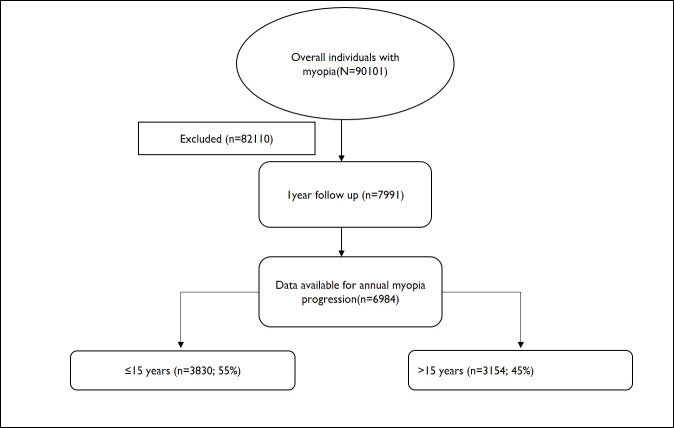
This retrospective study included the data of 6984 myopes (range: 1-30 years), who visited at least twice to LV Prasad Eye Institute and on whom a standard retinoscopy technique was performed to determine refractive error. Based on spherical equivalent (SE) refractive error, individuals were classified into mild, moderate, high and severe myopic groups. Myopia progression was calculated as difference between SE at 1-year follow-up visit and at baseline. To determine the age-specific myopia progression, individuals were further categorized as myopes who are at least 15 years or younger and those who are above 15.
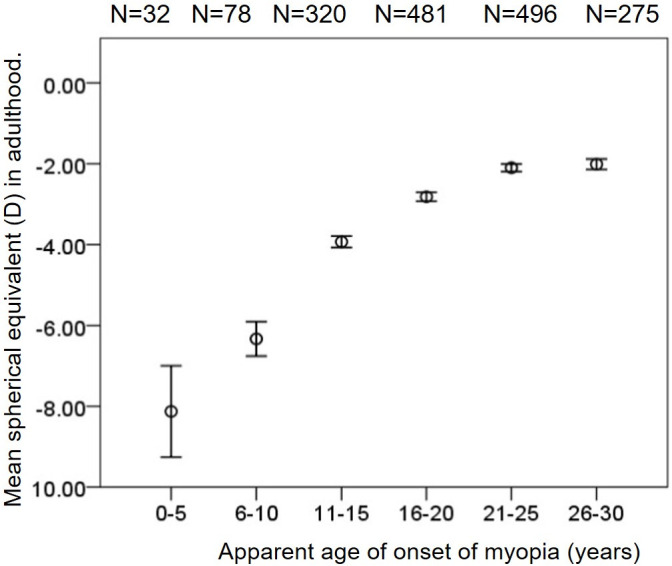
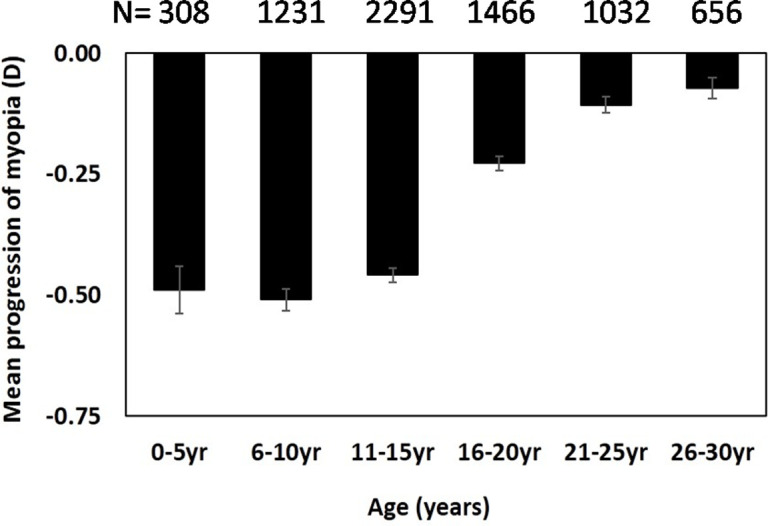
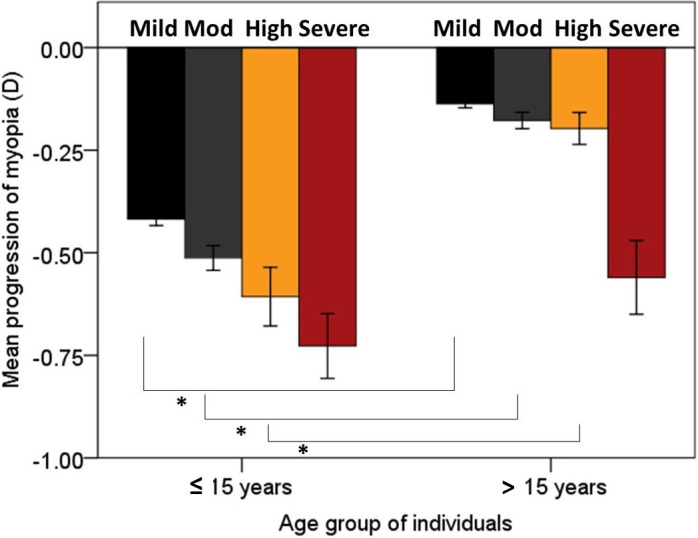
The mean annual progression of myopia was influenced by both the age group (p < 0.001) and severity type of myopia (p < 0.001). The overall mean myopia progression ranged from -0.07 ± 0.02 D (standard error) to -0.51 ± 0.02 D across different age groups with maximum change in refractive error noted in children aged 6-10 years and the least in adults aged 26-30 years. Myopia progression was greater in severe myopes, followed by high, moderate, mild myopes and in individuals aged ≤ 15 years compared to those aged >15 years (-0.45 ± 0.01 vs. 0.14 ± 0.01, p < 0.001). Severe myopes alone had similar annual myopia progression rate irrespective of age (i.e ≤15 and >15 years, p = 0.71). Early onset of myopia was associated with high myopia in adulthood.
The magnitude of myopia progression in children from South Indian states is comparable to that of Caucasians and Chinese. The greater progression in 'severe myopes' across different age groups emphasize the need for regular follow-ups, monitoring axial lengths, and anti-myopia strategies to control myopia progression irrespective of the age and degree of myopia.
研究来自印度南部各州不同年龄组个体的年近视进展情况及其与近视发病年龄和严重程度的关系。
本回顾性研究纳入了 6984 名近视患者(年龄范围:1-30 岁)的数据,他们至少两次到 LV Prasad 眼科研究所就诊,并进行标准视网膜检影术以确定屈光不正。根据等效球镜(SE)屈光不正,将个体分为轻度、中度、高度和重度近视组。近视进展定义为 1 年随访时 SE 与基线时 SE 的差值。为了确定特定年龄的近视进展情况,将个体进一步分为至少 15 岁以下和 15 岁以上的近视患者。
近视进展的年均速度受年龄组(p<0.001)和近视严重程度类型(p<0.001)的影响。不同年龄组的总体平均近视进展范围为-0.07±0.02D(标准误差)至-0.51±0.02D,在 6-10 岁儿童中观察到最大的屈光误差变化,在 26-30 岁成人中观察到最小的变化。在重度近视患者中,近视进展最大,其次是高度近视、中度近视、轻度近视患者,在≤15 岁的个体中比>15 岁的个体中(-0.45±0.01 对 0.14±0.01,p<0.001)更大。仅重度近视患者的年均近视进展率与年龄无关(即≤15 岁和>15 岁,p=0.71)。近视的早期发病与成年后的高度近视有关。
来自印度南部各州的儿童的近视进展程度与白种人和中国人相当。不同年龄组的“重度近视”患者的进展程度更大,这强调了需要定期随访、监测眼轴长度以及采取近视防控策略,以控制近视进展,无论近视的程度和年龄如何。