Department of Computer Science, University of Colorado Boulder.
BioFrontiers Institute, University of Colorado Boulder.
Sci Adv. 2021 Jan 1;7(1). doi: 10.1126/sciadv.abd5393. Print 2021 Jan.
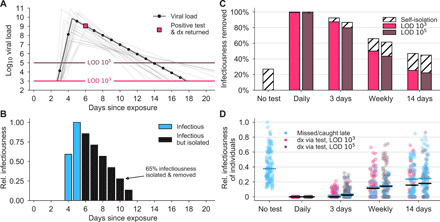
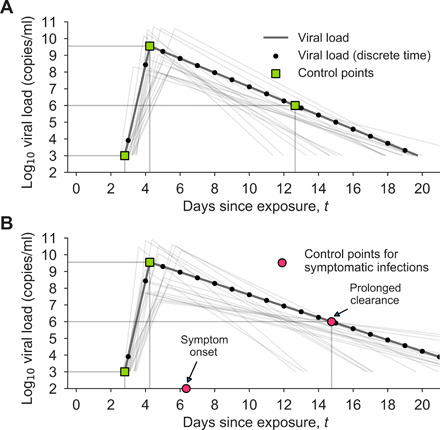
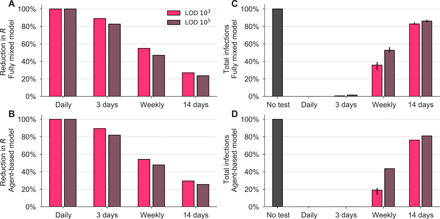
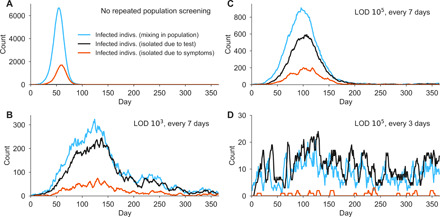
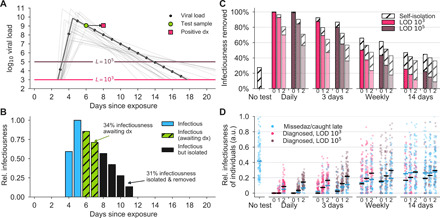
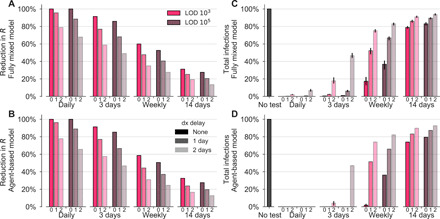
The COVID-19 pandemic has created a public health crisis. Because SARS-CoV-2 can spread from individuals with presymptomatic, symptomatic, and asymptomatic infections, the reopening of societies and the control of virus spread will be facilitated by robust population screening, for which virus testing will often be central. After infection, individuals undergo a period of incubation during which viral titers are too low to detect, followed by exponential viral growth, leading to peak viral load and infectiousness and ending with declining titers and clearance. Given the pattern of viral load kinetics, we model the effectiveness of repeated population screening considering test sensitivities, frequency, and sample-to-answer reporting time. These results demonstrate that effective screening depends largely on frequency of testing and speed of reporting and is only marginally improved by high test sensitivity. We therefore conclude that screening should prioritize accessibility, frequency, and sample-to-answer time; analytical limits of detection should be secondary.
COVID-19 大流行引发了一场公共卫生危机。由于 SARS-CoV-2 可以在有症状前、有症状和无症状感染者中传播,因此通过强大的人群筛查来重新开放社会并控制病毒传播将变得更加容易,而病毒检测通常将是筛查的核心。感染后,个体经历潜伏期,在此期间病毒滴度太低而无法检测到,随后病毒呈指数级增长,导致病毒载量和传染性达到峰值,最后病毒滴度下降并清除。鉴于病毒载量动力学模式,我们针对检测灵敏度、频率和样本至报告时间,对重复人群筛查的效果进行建模。这些结果表明,有效的筛查在很大程度上取决于检测频率和报告速度,而高检测灵敏度的改善作用微乎其微。因此,我们得出结论,筛查应优先考虑可及性、频率和样本至报告时间;分析检测限应是次要的。