Department of Biostatistics, Jonathan and Karen Fielding School of Public Health, University of California, Los Angeles, CA, United States of America.
Department of Biostatistics, Jonathan and Karen Fielding School of Public Health, University of California, Los Angeles, CA, United States of America; Department of Human Genetics, David Geffen School of Medicine, University of California, Los Angeles, CA, United States of America; Department of Computational Medicine, University of California, Los Angeles, CA, United States of America.
Epidemics. 2020 Dec;33:100418. doi: 10.1016/j.epidem.2020.100418. Epub 2020 Nov 9.
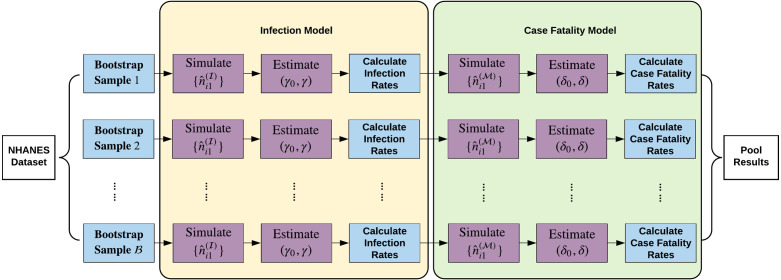
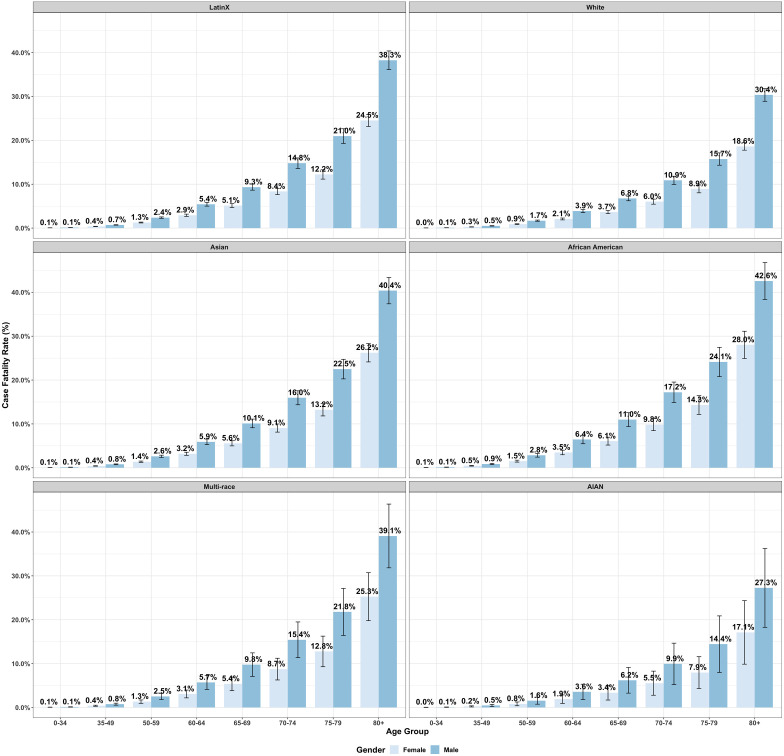
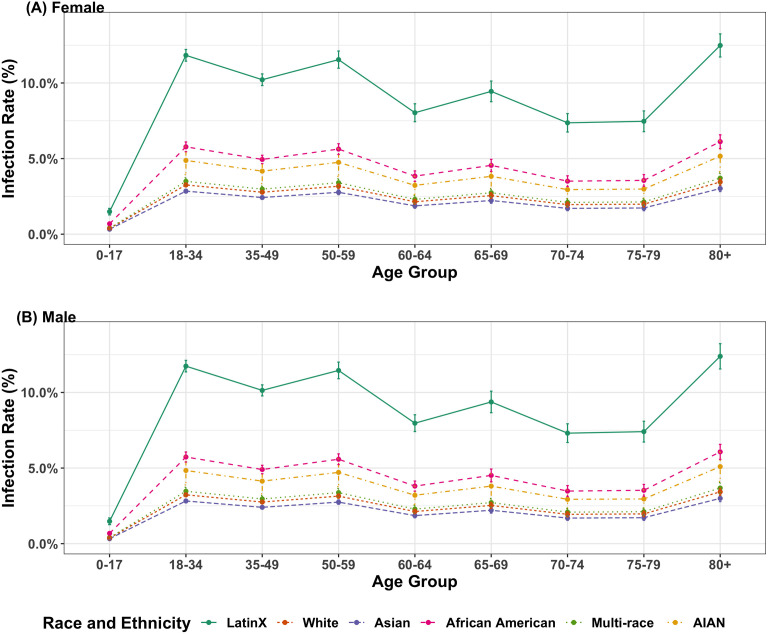
In emerging epidemics, early estimates of key epidemiological characteristics of the disease are critical for guiding public policy. In particular, identifying high-risk population subgroups aids policymakers and health officials in combating the epidemic. This has been challenging during the coronavirus disease 2019 (COVID-19) pandemic because governmental agencies typically release aggregate COVID-19 data as summary statistics of patient demographics. These data may identify disparities in COVID-19 outcomes between broad population subgroups, but do not provide comparisons between more granular population subgroups defined by combinations of multiple demographics. We introduce a method that helps to overcome the limitations of aggregated summary statistics and yields estimates of COVID-19 infection and case fatality rates - key quantities for guiding public policy related to the control and prevention of COVID-19 - for population subgroups across combinations of demographic characteristics. Our approach uses pseudo-likelihood based logistic regression to combine aggregate COVID-19 case and fatality data with population-level demographic survey data to estimate infection and case fatality rates for population subgroups across combinations of demographic characteristics. We illustrate our method on California COVID-19 data to estimate test-based infection and case fatality rates for population subgroups defined by gender, age, and race/ethnicity. Our analysis indicates that in California, males have higher test-based infection rates and test-based case fatality rates across age and race/ethnicity groups, with the gender gap widening with increasing age. Although elderly infected with COVID-19 are at an elevated risk of mortality, the test-based infection rates do not increase monotonically with age. The workforce population, especially, has a higher test-based infection rate than children, adolescents, and other elderly people in their 60-80. LatinX and African Americans have higher test-based infection rates than other race/ethnicity groups. The subgroups with the highest 5 test-based case fatality rates are all-male groups with race as African American, Asian, Multi-race, LatinX, and White, followed by African American females, indicating that African Americans are an especially vulnerable California subpopulation.
在新出现的传染病中,早期估计疾病的关键流行病学特征对于指导公共政策至关重要。特别是,确定高危人群亚组有助于政策制定者和卫生官员对抗疫情。在 2019 年冠状病毒病(COVID-19)大流行期间,这一直具有挑战性,因为政府机构通常会发布汇总的 COVID-19 数据,作为患者人口统计学的汇总统计数据。这些数据可能会识别出 COVID-19 结局在广泛的人群亚组之间的差异,但不能在更细粒度的人群亚组之间进行比较,这些人群亚组由多个人口统计学特征的组合定义。我们介绍了一种方法,可以帮助克服汇总摘要统计数据的局限性,并对 COVID-19 感染率和病死率进行估计-这些是指导与 COVID-19 控制和预防相关的公共政策的关键数量-用于人口统计学特征组合的人群亚组。我们的方法使用基于伪似然的逻辑回归将汇总的 COVID-19 病例和病死率数据与人群水平的人口统计调查数据相结合,以估计人口统计学特征组合的人群亚组的感染率和病死率。我们在加利福尼亚 COVID-19 数据上说明了我们的方法,以估计按性别、年龄和种族/族裔定义的人群亚组的基于检测的感染率和病死率。我们的分析表明,在加利福尼亚州,男性在所有年龄和种族/族裔群体中的基于检测的感染率和基于检测的病死率都较高,随着年龄的增长,性别差距扩大。尽管感染 COVID-19 的老年人死亡风险较高,但基于检测的感染率并不随年龄单调增加。劳动力人口,尤其是比儿童、青少年和其他 60-80 岁的老年人具有更高的基于检测的感染率。拉丁裔和非裔美国人的基于检测的感染率高于其他种族/族裔群体。基于检测的病死率最高的 5 个亚组均为全男性群体,种族为非裔美国人、亚洲人、多种族、拉丁裔和白人,其次是非裔美国女性,这表明非裔美国人是加利福尼亚州特别脆弱的人群。