Rafieian-Kopaei Mahmoud, Hamedi Azadeh, Soleiman Dehkordi Ebrahim, Pasdaran Arsalan, Pasdaran Aradalan
Medicinal Plants Research Center, Basic Health Sciences Institute, Shahrekord University of Medical Sciences, Shahrekord, Iran.
Department of Pharmacognosy, School of Pharmacy, Shiraz University of Medical Sciences, Shiraz, Iran.
Iran J Pharm Res. 2020 Spring;19(2):360-370. doi: 10.22037/ijpr.2019.15209.12935.
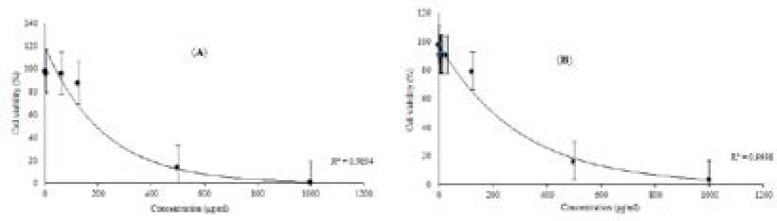
In this study, methoxylated flavonoids and volatile constitutions of Roth (Poaceae) were investigated for the first time. The flavonoids were identified by spectroscopic methods (H-NMR, C-NMR, COSY, NOSEY, TCOSY, and HMBC). The volatile constitutions of aerial parts and seeds were analyzed by gas chromatography-mass spectrometry (GC-MS). Two methoxylated flavonoids, luteolin 5-methyl ether (1), and cirsilineol (2) were isolated from the aerial parts of this plant. According to the GC-MS data the main constitutions of these volatile oils belong to the simple phenolic category which include coniferyl alcohol (18.80%) and eugenol (12.19%) in aerial parts and seeds, respectively. By using the computer- aided molecular modeling approaches, the binding affinity of these compounds was predicted in the catalytic domains of aryl hydrocarbon receptor (AhR). These two isolated flavonoids were investigated for their inhibitory activity on 4T1 breast carcinoma cells. It was predicted that these compounds could be well-matched in aryl hydrocarbon receptor (3H82) active site, but based on the assay, the IC values on cytotoxicity were 428.24 ±3.21 and 412.7±3.02 μg/mL for luteolin 5-methyl ether and cirsilineol, respectively. Thus, it can be concluded that these flavonoids exhibit low cytotoxicity against 4T1 breast carcinoma cell line.
在本研究中,首次对黑麦草(禾本科)的甲氧基黄酮类化合物和挥发性成分进行了研究。通过光谱方法(氢核磁共振、碳核磁共振、化学位移相关谱、核欧沃豪斯效应谱、全相关谱和异核多键相关谱)对黄酮类化合物进行了鉴定。通过气相色谱-质谱联用仪(GC-MS)分析了地上部分和种子的挥发性成分。从该植物的地上部分分离出两种甲氧基黄酮类化合物,木犀草素5-甲醚(1)和刺槐素(2)。根据GC-MS数据,这些挥发油的主要成分属于简单酚类,其中地上部分和种子中的主要成分分别为松柏醇(18.80%)和丁香酚(12.19%)。通过计算机辅助分子建模方法,预测了这些化合物在芳烃受体(AhR)催化结构域中的结合亲和力。研究了这两种分离出的黄酮类化合物对4T1乳腺癌细胞的抑制活性。据预测,这些化合物在芳烃受体(3H82)活性位点可能匹配良好,但根据实验,木犀草素5-甲醚和刺槐素对细胞毒性的半数抑制浓度(IC)值分别为428.24±3.21和412.7±3.02μg/mL。因此,可以得出结论,这些黄酮类化合物对4T1乳腺癌细胞系表现出低细胞毒性。