Giorgi Pietro Domenico, Gallazzi Enrico, Capitani Paolo, D'Aliberti Giuseppe Antiono, Bove Federico, Chiara Osvaldo, Peretti Giuseppe, Schirò Giuseppe Rosario
Orthopedics and Traumatology Unit, Emergency and Urgency Department, A.S.S.T. Grande Ospedale Metropolitano Niguarda, Milan, Italy.
Neurosurgery Unit, Emergency and Urgency Department, A.S.S.T. Grande Ospedale Metropolitano Niguarda, Milan, Italy.
Bone Jt Open. 2020 May 6;1(5):93-97. doi: 10.1302/2633-1462.15.BJO-2020-0016. eCollection 2020 May.
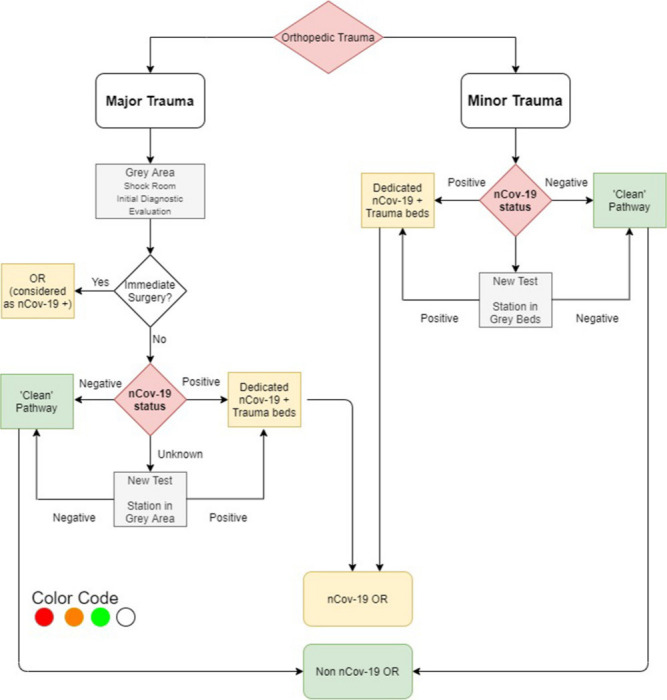
The COVID-19 virus is a tremendous burden for the Italian health system. The regionally-based Italian National Health System has been reorganized. Hospitals' biggest challenge was to create new intensive care unit (ICU) beds, as the existing system was insufficient to meet new demand, especially in the most affected areas. Our institution in the Milan metropolitan area of Lombardy, the epicentre of the infection, was selected as one of the three regional hub for major trauma, serving a population of more than three million people. The aims were the increase the ICU beds and the rationalization of human and structural resources available for treating COVID-19 patients. In our hub hospital, the reorganization aimed to reduce the risk of infection and to obtained resources, in terms of beds and healthcare personnel to be use in the COVID-19 emergency. Non-urgent outpatient orthopaedic activity and elective surgery was also suspended. A training programme for healthcare personnel started immediately. Orthopaedic and radiological pathways dedicated to COVID-19 patients, or with possible infection, have been established. In our orthopaedic department, we passed from 70 to 26 beds. Our goal is to treat trauma surgery's patient in the "golden 72 hours" in order to reduce the overall hospital length of stay. We applied an objective priority system to manage the flow of surgical procedures in the emergency room based on clinical outcomes and guidelines. Organizing the present to face the emergency is a challenge, but in the global plan of changes in hospital management one must also think about the near future. We reported the Milan metropolitan area orthopaedic surgery management during the COVID-19 pandemic. Our decisions are not based on scientific evidence; therefore, the decision on how reorganize hospitals will likely remain in the hands of individual countries.
新冠病毒给意大利医疗系统带来了巨大负担。以地区为基础的意大利国家医疗系统已进行了重组。医院面临的最大挑战是增设新的重症监护病房床位,因为现有系统不足以满足新的需求,尤其是在受影响最严重的地区。我们位于伦巴第大区米兰都会区(疫情中心)的机构被选为三个主要创伤区域枢纽之一,服务人口超过300万。目标是增加重症监护病房床位,并合理配置用于治疗新冠患者的人力和结构资源。在我们的枢纽医院,重组旨在降低感染风险,并获取用于新冠疫情紧急情况的床位和医护人员等资源。非紧急的门诊骨科活动和择期手术也被暂停。针对医护人员的培训计划立即启动。已建立了专门针对新冠患者或可能感染患者的骨科和放射科诊疗流程。在我们的骨科部门,床位从70张减少到了26张。我们的目标是在“黄金72小时”内治疗创伤外科患者,以缩短整体住院时间。我们应用了一个客观的优先系统,根据临床结果和指南来管理急诊室手术流程。组织当前工作以应对紧急情况是一项挑战,但在医院管理变革的总体计划中,还必须考虑到不久的将来。我们报告了新冠疫情期间米兰都会区的骨科手术管理情况。我们的决定并非基于科学证据;因此,关于如何重组医院的决策可能仍将由各个国家自行决定。