Graduate Degree Program in Ecology, Colorado State University, Fort Collins, Colorado, United States of America.
Department of Statistics, Colorado State University, Fort Collins, Colorado, United States of America.
PLoS Negl Trop Dis. 2020 Nov 23;14(11):e0008868. doi: 10.1371/journal.pntd.0008868. eCollection 2020 Nov.
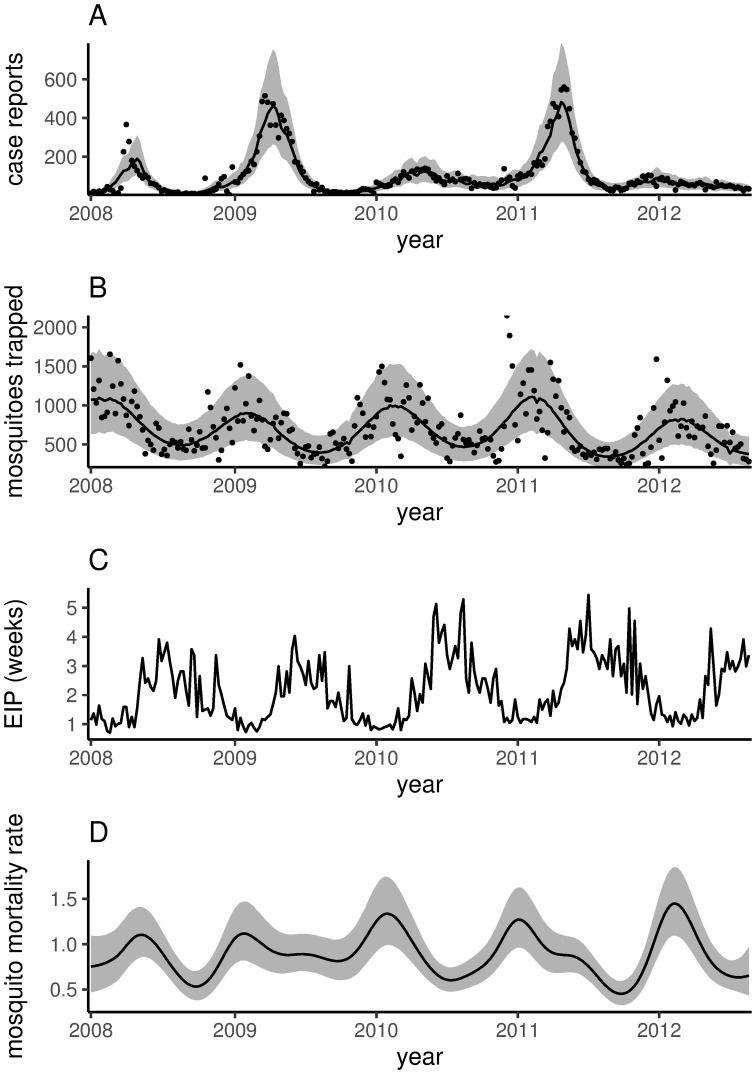
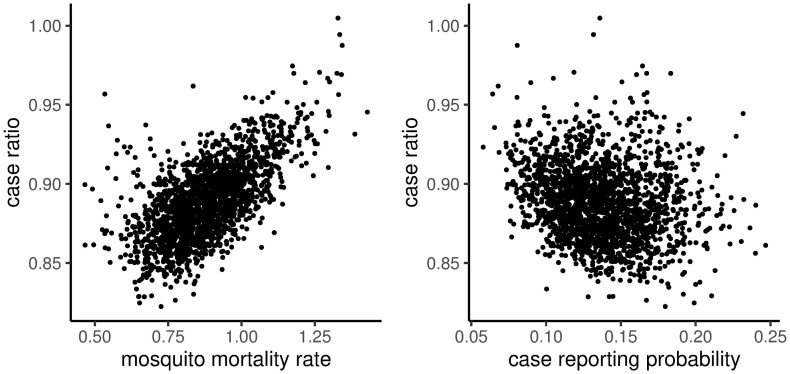
Our ability to effectively prevent the transmission of the dengue virus through targeted control of its vector, Aedes aegypti, depends critically on our understanding of the link between mosquito abundance and human disease risk. Mosquito and clinical surveillance data are widely collected, but linking them requires a modeling framework that accounts for the complex non-linear mechanisms involved in transmission. Most critical are the bottleneck in transmission imposed by mosquito lifespan relative to the virus' extrinsic incubation period, and the dynamics of human immunity. We developed a differential equation model of dengue transmission and embedded it in a Bayesian hierarchical framework that allowed us to estimate latent time series of mosquito demographic rates from mosquito trap counts and dengue case reports from the city of Vitória, Brazil. We used the fitted model to explore how the timing of a pulse of adult mosquito control influences its effect on the human disease burden in the following year. We found that control was generally more effective when implemented in periods of relatively low mosquito mortality (when mosquito abundance was also generally low). In particular, control implemented in early September (week 34 of the year) produced the largest reduction in predicted human case reports over the following year. This highlights the potential long-term utility of broad, off-peak-season mosquito control in addition to existing, locally targeted within-season efforts. Further, uncertainty in the effectiveness of control interventions was driven largely by posterior variation in the average mosquito mortality rate (closely tied to total mosquito abundance) with lower mosquito mortality generating systems more vulnerable to control. Broadly, these correlations suggest that mosquito control is most effective in situations in which transmission is already limited by mosquito abundance.
我们能否通过有针对性地控制埃及伊蚊这一登革热病毒的传播媒介来有效预防该病毒的传播,关键取决于我们对蚊子数量与人类疾病风险之间联系的理解。蚊子和临床监测数据广泛收集,但将它们联系起来需要一个建模框架,以考虑到传播过程中涉及的复杂非线性机制。最关键的是,蚊子寿命相对于病毒外潜伏期的传播瓶颈,以及人类免疫力的动态变化。我们开发了登革热传播的微分方程模型,并将其嵌入贝叶斯分层框架中,从而能够根据巴西维多利亚市的蚊子诱捕计数和登革热病例报告来估计蚊子种群动态的潜在时间序列。我们使用拟合模型来探讨在成虫蚊子控制的脉冲出现时,其对次年人类疾病负担的影响。我们发现,当蚊子死亡率相对较低(此时蚊子数量通常也较低)时,控制措施通常更有效。特别是,在 9 月初(当年第 34 周)实施控制,可使次年预测的人类病例报告数量减少最多。这突出了除了现有的季节性局部目标控制措施之外,在非高峰期广泛开展蚊子控制的潜在长期效用。此外,控制干预措施的有效性的不确定性主要是由平均蚊子死亡率的后验变化驱动的(与总蚊子数量密切相关),较低的蚊子死亡率导致系统更容易受到控制的影响。总体而言,这些相关性表明,在蚊子数量已经受到限制的情况下,蚊子控制的效果最佳。