Banerjee Debanjan, Vaishnav Mrugesh, Rao Ts Sathyanarayana, Raju Msvk, Dalal P K, Javed Afzal, Saha Gautam, Mishra Kshirod K, Kumar Vinay, Jagiwala Mukhesh P
Department of Psychiatry, National Institute of Mental Health and Neurosciences (NIMHANS), Bengaluru, Karnataka, India.
Samvedna Group of Hospitals and Research Centre, Ahmedabad, Gujarat, India.
Indian J Psychiatry. 2020 Sep;62(Suppl 3):S343-S353. doi: 10.4103/psychiatry.IndianJPsychiatry_1002_20. Epub 2020 Sep 28.
Coronavirus disease 2019 (COVID-19) has emerged as a global health threat. The South-Asian (SA) countries have witnessed both the initial brunt of the outbreak as well as the ongoing rise of cases. Their unique challenges in relation to mental health during the pandemic are worth exploring.
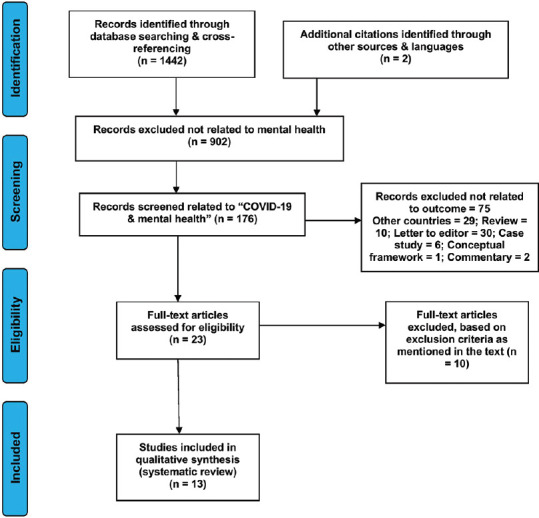
A systematic review was conducted for all the original studies on the impact of COVID-19 and lockdown on psychological health/well-being in the SA countries of the World Psychiatric Association Zone 16. PubMed, Google Scholar, PSYCHINFO, EMBASE, and SCOPUS were searched till June 2020. Studies conducted in the age group of 18-60 years with a minimum sample size of 10, and statistically significant results were included.
Thirteen studies were included in the review. They showed increase prevalence in nonpsychotic depression, preanxiety, somatic concerns, alcohol-related disorders, and insomnia in the general population. Psychological symptoms correlated more with physical complaints of fatigue and pain in older adults and were directly related to social media use, misinformation, xenophobia, and social distancing. Frontline workers reported guilt, stigma, anxiety, and poor sleep quality, which were related to the lack of availability of adequate personal protective equipment, increased workload, and discrimination. One study validated the Coronavirus anxiety scale in the Indian population while another explored gaming as a double-edged sword during the lockdown in adolescents. Another study from Bangladesh explored psychosexual health during lockdown. Most studies were cross-sectional online surveys, used screening tools and had limited accessibility.
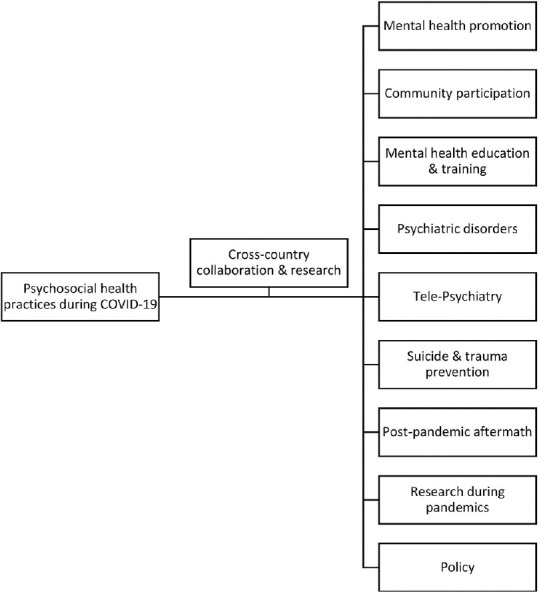
The ongoing COVID-19 crisis and its impact serve as an important period for adequate mental healthcare, promotion, research, and holistic biopsychosocial management of psychiatric disorders, especially in vulnerable groups. Mental healthcare and research strategies during the pandemic and preparedness for postpandemic aftermath are advocated subsequently.
2019冠状病毒病(COVID-19)已成为全球健康威胁。南亚国家既经历了疫情爆发初期的冲击,也目睹了病例的持续增加。疫情期间这些国家在心理健康方面面临的独特挑战值得探讨。
对世界精神病学协会第16区南亚国家中关于COVID-19及封锁对心理健康/幸福感影响的所有原始研究进行系统综述。检索了PubMed、谷歌学术、PSYCHINFO、EMBASE和SCOPUS数据库,检索截至2020年6月。纳入18至60岁年龄组、最小样本量为10且具有统计学显著结果的研究。
该综述纳入了13项研究。这些研究表明,普通人群中非精神病性抑郁、焦虑前期、躯体不适、酒精相关障碍和失眠的患病率有所增加。心理症状在老年人中与疲劳和疼痛等身体不适的相关性更强,并且与社交媒体使用、错误信息、仇外心理和社交距离直接相关。一线工作人员报告有内疚感、耻辱感、焦虑和睡眠质量差,这些与缺乏足够的个人防护设备、工作量增加和歧视有关。一项研究在印度人群中验证了冠状病毒焦虑量表,另一项研究探讨了封锁期间游戏对青少年的双刃剑作用。孟加拉国的另一项研究探讨了封锁期间的性心理健康。大多数研究是横断面在线调查,使用了筛查工具且可及性有限。
持续的COVID-19危机及其影响是进行充分的精神卫生保健、促进、研究以及对精神障碍进行整体生物心理社会管理的重要时期,尤其是在弱势群体中。随后提倡在疫情期间的精神卫生保健和研究策略以及为疫情后后果做好准备。