Dittmer Angela, Dittmer Jürgen
Clinic for Gynecology, University of Halle-Wittenberg, Ernst-Grube-Str. 40, 06120 Halle/Saale, Germany.
Cancers (Basel). 2020 Nov 19;12(11):3435. doi: 10.3390/cancers12113435.
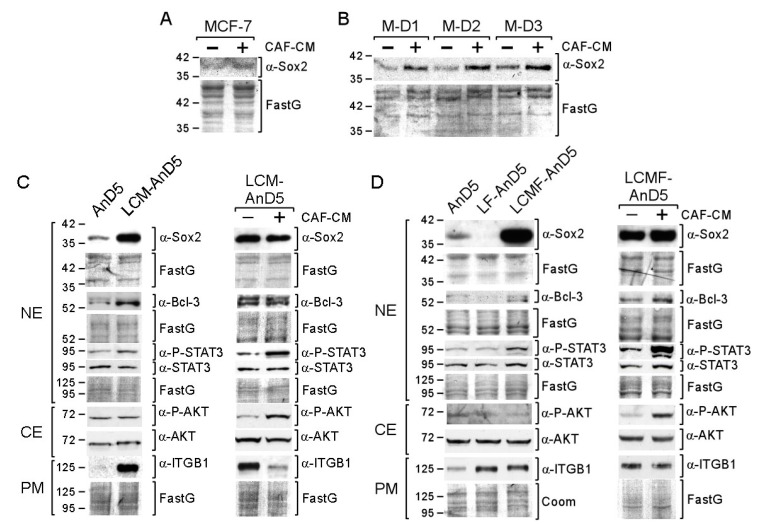
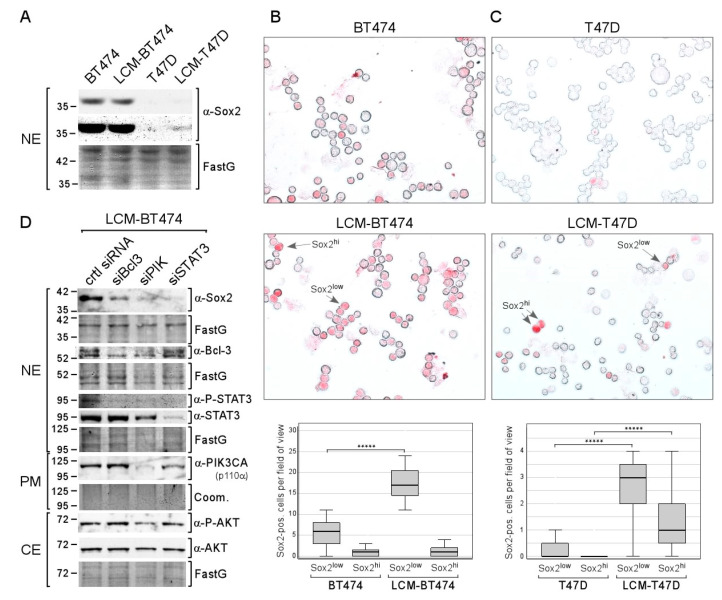
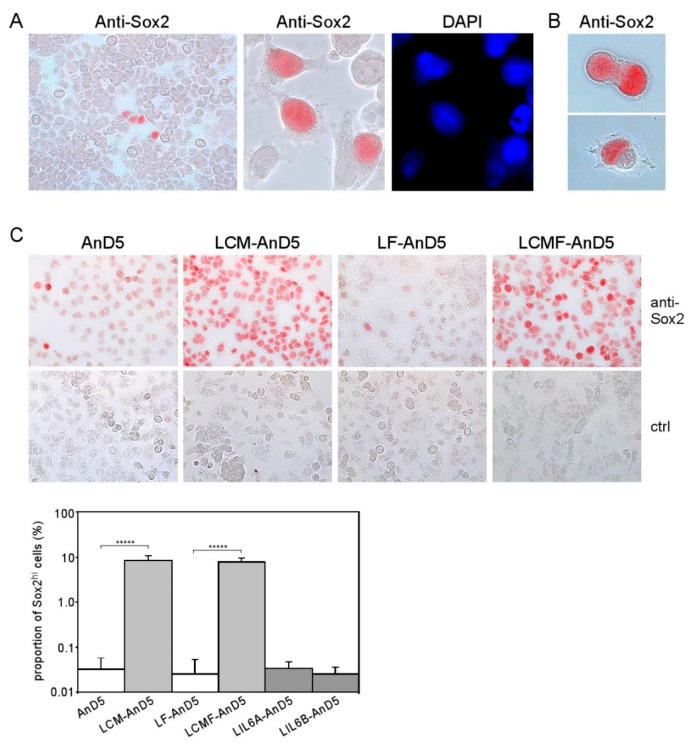
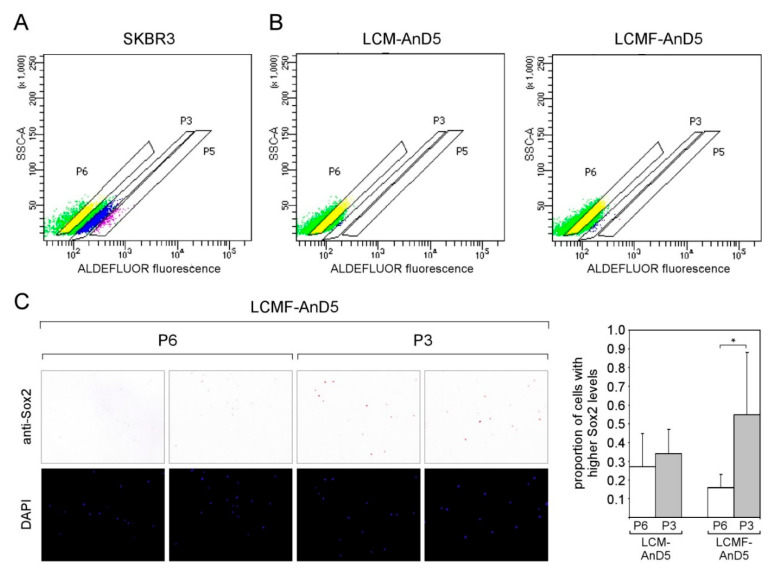
CAFs (Carcinoma-associated fibroblasts) play an important role in cancer progression. For instance, they promote resistance to anti-estrogens, such as fulvestrant. Here, we show that, in ERα-positive breast cancer cell lines, the cocktail of factors secreted by CAFs (CAF-CM) induce the expression of the embryonal stem cell transcription factor Sox2 (sex determining region Y (SRY)-box 2). Long-term exposure to CAF-CM was able to give rise to very high Sox2 levels both in the absence and presence of fulvestrant. IL-6 (interleukin-6), a major component of CAF-CM, failed to raise Sox2 expression. In MCF-7 sublines established in the presence of CAF-CM, almost all cells showed Sox2 expression, whereas long-term treatment of T47D cells with CAF-CM resulted in a ~60-fold increase in the proportions of two distinct populations of Sox2 high and low expresser cells. Exposure of BT474 cells to CAF-CM raised the fraction of Sox2 high expresser cells by ~3-fold. Cell sorting based on CD44 and CD24 expression or ALDH (aldehyde dehydrogenase) activity revealed that most Sox2 high expresser cells were not CD44/CD24- or ALDH-positive cells suggesting that they were not CSCs (cancer stem cells), though CD44 played a role in Sox2 expression. Functionally, Sox2 was found to protect CAF-CM-treated cells against apoptosis and to allow higher growth activity in the presence of fulvestrant. Mechanistically, the key drivers of Sox2 expression was found to be STAT3 (Signal transducer and activator of transcription 3), Bcl-3 (B-cell lymphoma 3) and the PI3K (Phosphoinositide 3-kinase)/AKT pathway, whose activities/expression can all be upregulated by CAF-CM. These data suggest that CAF-CM induces Sox2 expression in non-CSCs by activating proteins involved in growth control and drug resistance, leading to higher protection against apoptosis.
癌相关成纤维细胞(CAFs)在癌症进展中起重要作用。例如,它们促进对抗雌激素药物(如氟维司群)的耐药性。在此,我们表明,在雌激素受体α(ERα)阳性乳腺癌细胞系中,CAFs分泌的因子混合物(CAF-CM)诱导胚胎干细胞转录因子Sox2(性别决定区Y(SRY)-盒2)的表达。长期暴露于CAF-CM能够在有无氟维司群的情况下都产生非常高的Sox2水平。白细胞介素-6(IL-6)是CAF-CM的主要成分,未能提高Sox2表达。在CAF-CM存在下建立的MCF-7亚系中,几乎所有细胞都显示Sox2表达,而用CAF-CM长期处理T47D细胞导致Sox2高表达和低表达细胞的两个不同群体比例增加约60倍。将BT474细胞暴露于CAF-CM使Sox2高表达细胞的比例提高了约3倍。基于CD44和CD24表达或醛脱氢酶(ALDH)活性的细胞分选显示,大多数Sox2高表达细胞不是CD44/CD24或ALDH阳性细胞,这表明它们不是癌症干细胞(CSCs),尽管CD44在Sox2表达中起作用。在功能上,发现Sox2可保护CAF-CM处理的细胞免于凋亡,并在氟维司群存在下具有更高的生长活性。从机制上讲,发现Sox2表达的关键驱动因素是信号转导和转录激活因子3(STAT3)、B细胞淋巴瘤3(Bcl-3)和磷脂酰肌醇3激酶(PI3K)/蛋白激酶B(AKT)途径,其活性/表达均可被CAF-CM上调。这些数据表明,CAF-CM通过激活参与生长控制和耐药性的蛋白质在非CSCs中诱导Sox2表达,从而导致对凋亡的更高保护。