Rothblatt J A, Webb J R, Ammerer G, Meyer D I
Cell Biology Programme, European Molecular Biology Laboratory, Heidelberg, FRG.
EMBO J. 1987 Nov;6(11):3455-63. doi: 10.1002/j.1460-2075.1987.tb02669.x.
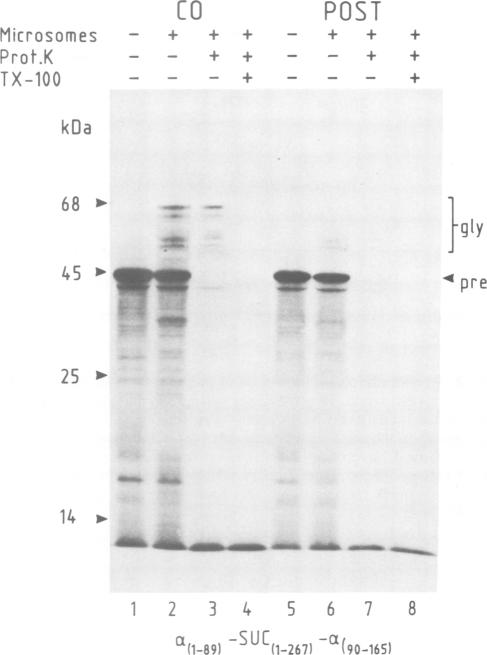
In vitro, efficient translocation and glycosylation of the precursor of yeast alpha-factor can take place post-translationally. This property of prepro-alpha-factor appears to be unique as it could not be extended to other yeast protein precursors such as preinvertase or preprocarboxypeptidase Y. In order to determine if specific domains of prepro-alpha-factor were involved in post-translational translocation, we carried out a series of experiments in which major domains were either deleted or fused onto reporter proteins. Fusion of various domains of prepro-alpha-factor onto the reporter protein alpha-globin did not allow post-translational translocation to occur in the yeast in vitro system. Prepro-alpha-factor retained its ability to be post-translationally translocated when parts or all of the pro region were deleted. Removal of the C-terminal repeats containing mature alpha-factor had the most profound influence as post-translational translocation decreased in proportion to the number of repeats deleted. Taken together, these results suggest that efficient post-translational translocation requires a signal sequence and the four C-terminal repeats. There does not however, appear to be specific information contained within the C-terminus, as their presence in fusion did not enable the post-translational translocation of reporter proteins. Lastly, the ability to post-translationally translocate radiochemically pure prepro-alpha-factor that had been isolated by immuno-affinity chromatography required the addition of a yeast lysate fraction. Moreover, post-translational translocation is a function of the microsomal membrane of yeast microsomes and not of a factor peculiar to the yeast lysate, as reticulocyte lysate supported this as well.
在体外,酵母α因子前体的有效转运和糖基化可在翻译后发生。前原α因子的这一特性似乎是独特的,因为它不能扩展到其他酵母蛋白前体,如前转化酶或前原羧肽酶Y。为了确定前原α因子的特定结构域是否参与翻译后转运,我们进行了一系列实验,其中主要结构域要么被删除,要么与报告蛋白融合。将前原α因子的各个结构域与报告蛋白α珠蛋白融合,在酵母体外系统中不允许发生翻译后转运。当部分或全部原区被删除时,前原α因子保留了其翻译后转运的能力。去除含有成熟α因子的C末端重复序列影响最为深远,因为翻译后转运与删除的重复序列数量成比例下降。综上所述,这些结果表明,有效的翻译后转运需要信号序列和四个C末端重复序列。然而,C末端似乎不包含特定信息,因为它们在融合中的存在并不能使报告蛋白进行翻译后转运。最后,通过免疫亲和色谱法分离得到的放射性化学纯前原α因子进行翻译后转运的能力需要添加酵母裂解物组分。此外,翻译后转运是酵母微粒体微粒体膜的功能,而不是酵母裂解物特有的因子的功能,因为网织红细胞裂解物也支持这一点。