Global Health Institute, School of Public Health, Xi'an Jiaotong University Health Science Center, 76 West Yanta Road, Xi'an 710061, China.
Human Nutrition Department, College of Health Sciences, QU Health, Qatar University, Doha 2713, Qatar.
Int J Environ Res Public Health. 2020 Nov 19;17(22):8594. doi: 10.3390/ijerph17228594.
Little is known about the prevalence and risk factors of diabetes among Gaza Palestinians, 64% of whom are refugees with exceeded sugar intake. We aimed to estimate the prevalence of type 2 diabetes (T2D) and its association with added sugar intake among residents, with regular visits to primary healthcare centers (PHCs) across Gaza.
From October to December of 2019, a cross-sectional survey was conducted among 1000 citizens and refugees in nine PHCs selected from the five governorates of the Gaza Strip. Information on dietary intake, medical history, and other risk factors was collected by trained health workers, using structured questionnaires. Anthropometry and biochemical data were extracted from the PHC medical record system.
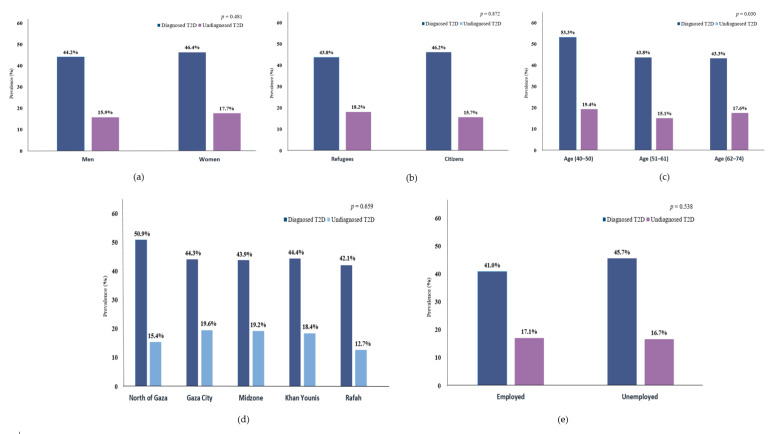
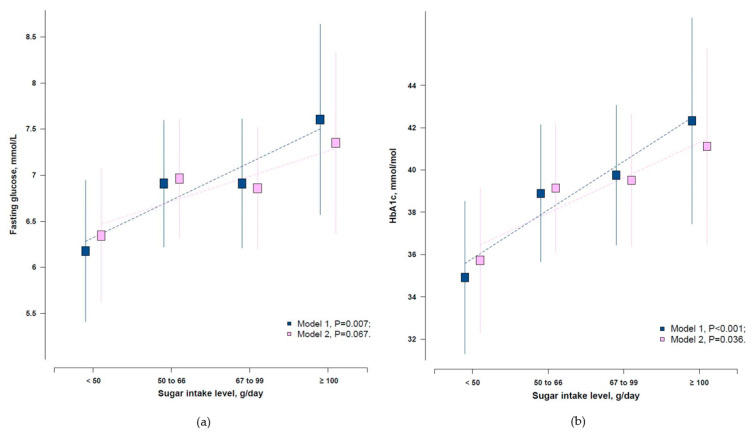
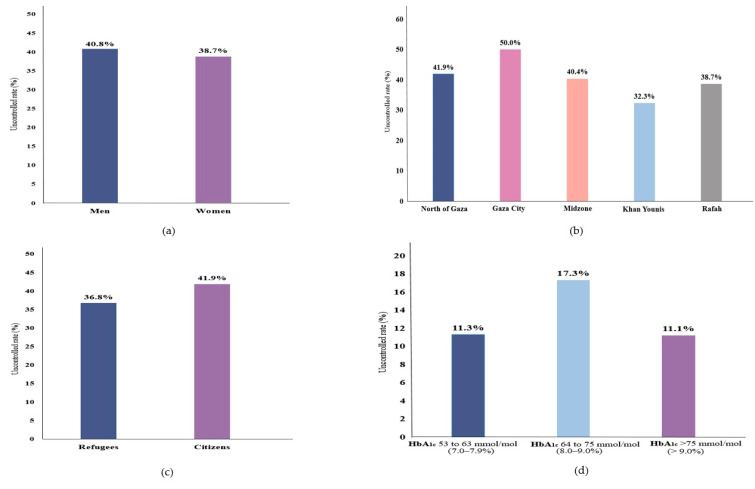
Overall, the prevalence of diagnosed T2D and undiagnosed T2D were 45.2% and 16.8%, respectively, in adults aged 42 to 74 years, with the differences among citizens and refugees (diagnosed: 46.2% vs. 43.8%; undiagnosed: 15.7% vs. 18.2%). The uncontrolled glycaemic rate was 41.9% and 36.8% for diagnosed patients in citizens and refugees, respectively. Among those without a clinical diagnosis of T2D, after multivariable adjustment, daily added sugar intake was positively associated with fasting glucose and the risk of undiagnosed T2D (odds ratio, 95% CI, highest vs. lowest intake, was 2.71 (1.12-6.54) ( < 0.001). In stratified analysis, the associations between added sugar intake and the risk of undiagnosed T2D tend to be stronger among refugees or those with higher body mass index.
Among Palestinian adults, both citizens and refugees are affected by T2D. Added sugar intake is associated with the risk of undiagnosed T2D.
加沙地带 64%的巴勒斯坦人为难民,其糖摄入量超标,然而有关该地区巴勒斯坦人糖尿病患病率及其危险因素的信息却很少。我们旨在评估在加沙地带的居民中,经常到初级保健中心(PHC)就诊的人群中 2 型糖尿病(T2D)的患病率及其与添加糖摄入量的关系。
2019 年 10 月至 12 月,在加沙地带五个省的 9 个 PHC 中,选择了 1000 名公民和难民进行了横断面调查。受过培训的卫生工作者使用结构化问卷收集了有关饮食摄入、病史和其他危险因素的信息。人体测量学和生化数据从 PHC 医疗记录系统中提取。
在年龄在 42 至 74 岁的成年人中,总体上患有已确诊 T2D 和未确诊 T2D 的患者分别为 45.2%和 16.8%,公民和难民之间存在差异(已确诊:46.2%比 43.8%;未确诊:15.7%比 18.2%)。已确诊患者的血糖控制率分别为公民 41.9%和难民 36.8%。在没有 T2D 临床诊断的人群中,在校正多变量后,每日添加糖的摄入量与空腹血糖和未确诊 T2D 的风险呈正相关(比值比,95%CI,最高与最低摄入量,为 2.71(1.12-6.54)(<0.001)。在分层分析中,在难民或体重指数较高的人群中,添加糖的摄入量与未确诊 T2D 的风险之间的关联似乎更强。
在巴勒斯坦成年人中,公民和难民均受到 T2D 的影响。添加糖的摄入量与未确诊 T2D 的风险有关。