School of Mechanical, Materials, Mechatronic and Biomedical Engineering, Faculty of Engineering and Information Sciences, University of Wollongong, Wollongong, NSW 2522, Australia.
Applied Mechatronics and Biomedical Engineering Research (AMBER) Group, University of Wollongong, Wollongong, NSW 2522, Australia.
Sensors (Basel). 2020 Nov 19;20(22):6637. doi: 10.3390/s20226637.
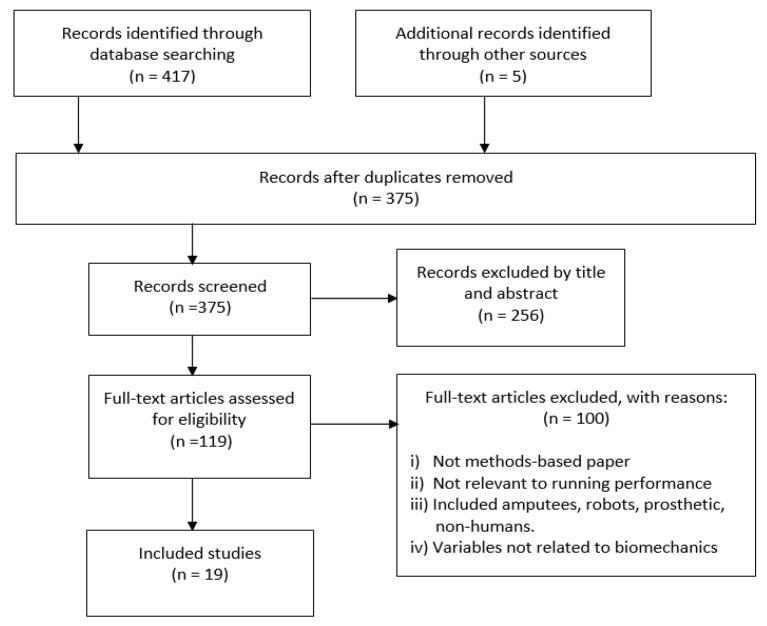
This present review includes a systematic search for peer-reviewed articles published between March 2009 and March 2020 that evaluated the effects of wearable devices with biofeedback on the biomechanics of running. The included articles did not focus on physiological and metabolic metrics. Articles with patients, animals, orthoses, exoskeletons and virtual reality were not included. Following the PRISMA guidelines, 417 articles were first identified, and nineteen were selected following the removal of duplicates and articles which did not meet the inclusion criteria. Most reviewed articles reported a significant reduction in positive peak acceleration, which was found to be related to tibial stress fractures in running. Some previous studies provided biofeedback aiming to increase stride frequencies. They produced some positive effects on running, as they reduced vertical load in knee and ankle joints and vertical displacement of the body and increased knee flexion. Some other parameters, including contact ground time and speed, were fed back by wearable devices for running. Such devices reduced running time and increased swing phase time. This article reviews challenges in this area and suggests future studies can evaluate the long-term effects in running biomechanics produced by wearable devices with biofeedback.
本综述包括对 2009 年 3 月至 2020 年 3 月期间发表的同行评议文章进行的系统搜索,这些文章评估了具有生物反馈功能的可穿戴设备对跑步生物力学的影响。纳入的文章不关注生理和代谢指标。不包括针对患者、动物、矫形器、外骨骼和虚拟现实的文章。根据 PRISMA 指南,首先确定了 417 篇文章,在去除重复和不符合纳入标准的文章后,选择了 19 篇文章。大多数综述文章报道了正向峰值加速度的显著降低,这与跑步时胫骨应力性骨折有关。一些先前的研究提供了生物反馈,旨在增加步频。它们对跑步产生了一些积极的影响,因为它们减少了膝关节和踝关节的垂直负荷以及身体的垂直位移,并增加了膝关节的弯曲度。其他一些参数,包括触地时间和速度,也通过可穿戴设备反馈给跑步者。这些设备减少了跑步时间并增加了摆动阶段的时间。本文回顾了这一领域的挑战,并建议未来的研究可以评估具有生物反馈功能的可穿戴设备对跑步生物力学的长期影响。