Kiernan Dovin, Katzman Zachary David, Hawkins David A, Christiansen Blaine Andrew
Biomedical Engineering Graduate Group, University of California Davis, Davis, CA 95616, USA.
Department of Neurobiology, Physiology & Behavior, University of California Davis, Davis, CA 95616, USA.
Sensors (Basel). 2024 Jan 19;24(2):656. doi: 10.3390/s24020656.
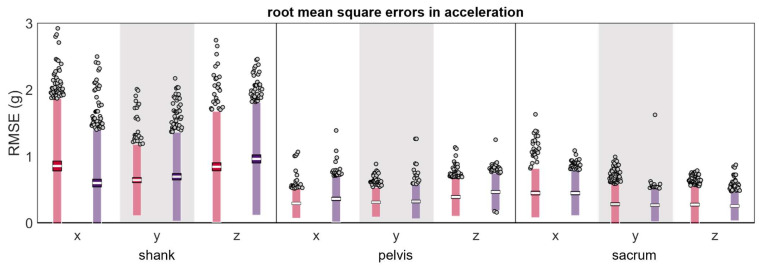
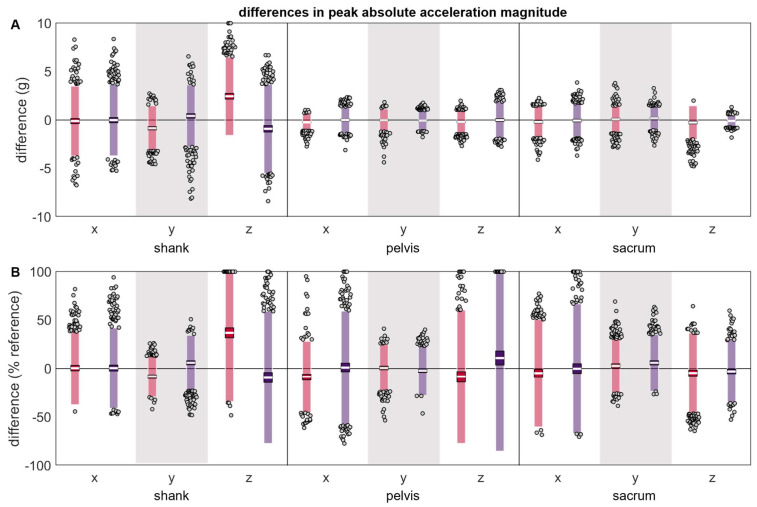
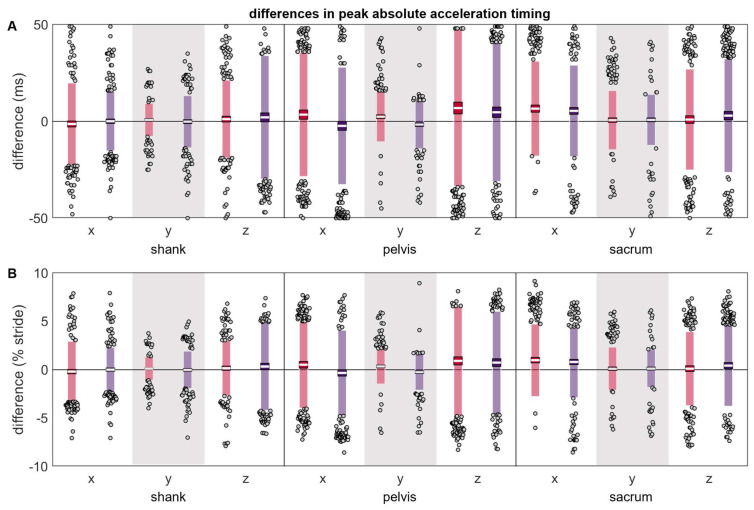
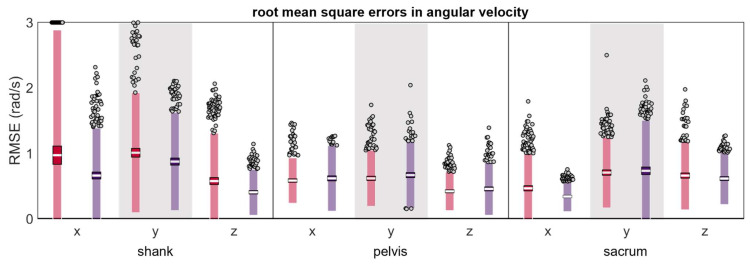
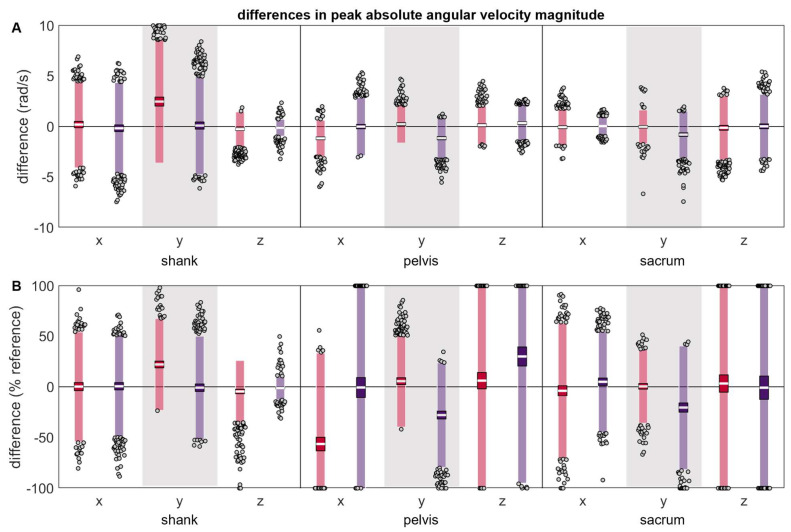
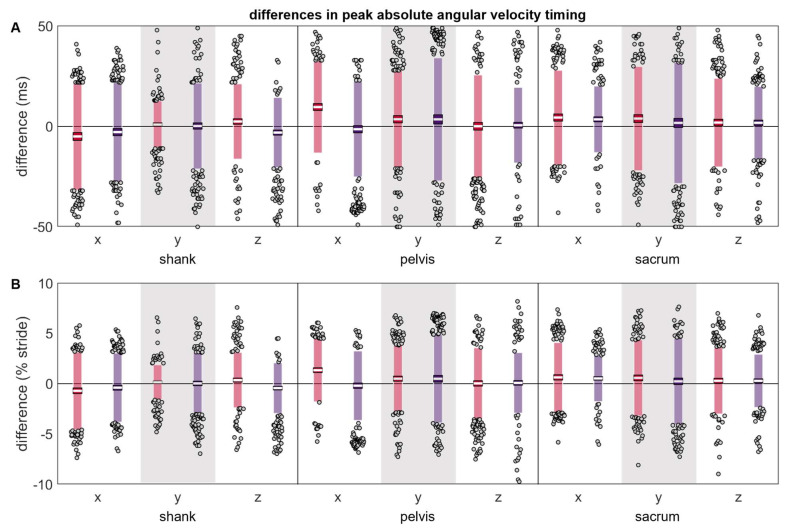
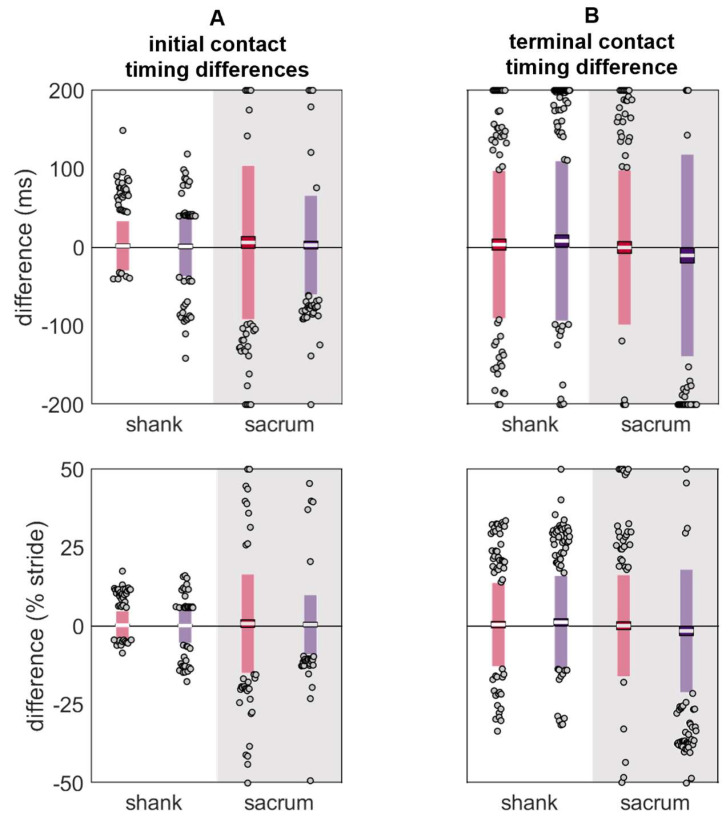
Inertial measurement units (IMUs) provide exciting opportunities to collect large volumes of running biomechanics data in the real world. IMU signals may, however, be affected by variation in the initial IMU placement or movement of the IMU during use. To quantify the effect that changing an IMU's location has on running data, a reference IMU was 'correctly' placed on the shank, pelvis, or sacrum of 74 participants. A second IMU was 'misplaced' 0.05 m away, simulating a 'worst-case' misplacement or movement. Participants ran over-ground while data were simultaneously recorded from the reference and misplaced IMUs. Differences were captured as root mean square errors (RMSEs) and differences in the absolute peak magnitudes and timings. RMSEs were ≤1 g and 1 rad/s for all axes and misplacement conditions while mean differences in the peak magnitude and timing reached up to 2.45 g, 2.48 rad/s, and 9.68 ms (depending on the axis and direction of misplacement). To quantify the downstream effects of these differences, initial and terminal contact times and vertical ground reaction forces were derived from both the reference and misplaced IMU. Mean differences reached up to -10.08 ms for contact times and 95.06 N for forces. Finally, the behavior in the frequency domain revealed high coherence between the reference and misplaced IMUs (particularly at frequencies ≤10 Hz). All differences tended to be exaggerated when data were analyzed using a wearable coordinate system instead of a segment coordinate system. Overall, these results highlight the potential errors that IMU placement and movement can introduce to running biomechanics data.
惯性测量单元(IMU)为在现实世界中收集大量跑步生物力学数据提供了令人兴奋的机会。然而,IMU信号可能会受到初始IMU放置位置的变化或使用过程中IMU移动的影响。为了量化改变IMU位置对跑步数据的影响,将一个参考IMU“正确地”放置在74名参与者的小腿、骨盆或骶骨上。另一个IMU“放置错误”,距离0.05米,模拟“最坏情况”的放置错误或移动。参与者在地面上跑步时,同时从参考IMU和放置错误的IMU记录数据。差异以均方根误差(RMSE)以及绝对峰值大小和时间的差异来表示。对于所有轴和放置错误情况,RMSE在所有轴上均≤1 g且约为1 rad/s,而峰值大小和时间的平均差异分别高达2.45 g、2.48 rad/s和9.68 ms(取决于轴和放置错误的方向)。为了量化这些差异的下游影响,从参考IMU和放置错误的IMU中得出初始和终末接触时间以及垂直地面反作用力。接触时间的平均差异高达 -10.08 ms,力的平均差异高达95.06 N。最后,频域中的行为表明参考IMU和放置错误的IMU之间具有高度一致性(特别是在频率≤~10 Hz时)。当使用可穿戴坐标系而不是节段坐标系分析数据时,所有差异往往会被放大。总体而言,这些结果突出了IMU放置和移动可能给跑步生物力学数据带来的潜在误差。