Military Teaching Hospital Desgenettes, Intensive Care Unit and Anaesthesiology Department, 69003 Lyon, France; Edouard Herriot Hospital, Intensive Care Unit and Anaesthesiology Department, Hospices Civils de Lyon, 69437 Lyon, France.
Military Teaching Hospital Saint-Anne, Intensive Care Unit and Anaesthesiology Department, 83000 Toulon, France.
Anaesth Crit Care Pain Med. 2021 Feb;40(1):100786. doi: 10.1016/j.accpm.2020.11.004. Epub 2020 Nov 21.
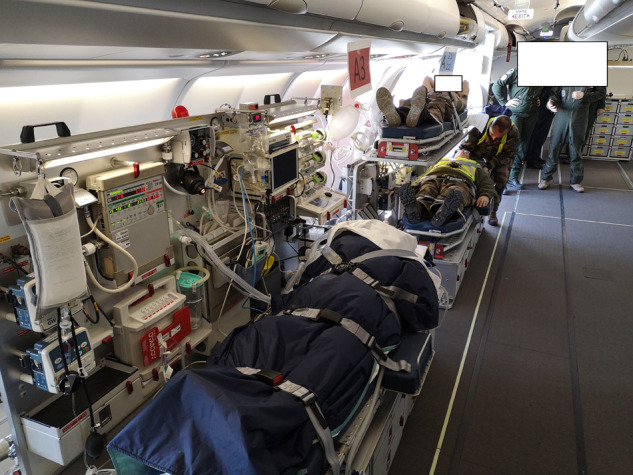
In early 2020, the coronavirus disease 2019 (COVID-19) pandemic outbreak has posed the risk of critical care resources overload in every affected country. Collective interhospital transport of critically ill COVID-19 patients as a way to mitigate the localised pressure from overloaded intensive care units at a national or international level has not been reported yet. The aim of this study was to provide descriptive data about the first six collective aeromedical evacuation (MEDEVAC) of COVID-19 patients performed within Europe.
This retrospective study included all adult patients transported by the first six collective MEDEVAC missions for COVID-19 patients performed within Europe on the 18, 21, 24, 27, 31 of March and the 3 of April 2020.
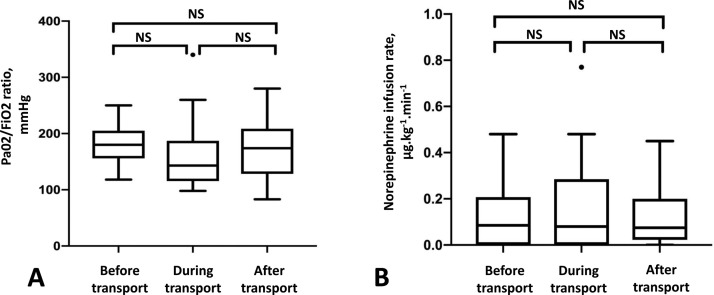
Thirty-six patients with acute respiratory distress syndrome (ARDS) were transported aboard six MEDEVAC missions. The median duration of mechanical ventilation in ICU before transportation was 4 days (3-5.25). The median PaO/FiO ratio obtained before, during the flight and at day 1 after the transport was 180 mmHg (156-202,5), 143 mmHg (118,75-184,75) and 174 mmHg (129,5-205,5), respectively, with no significant difference. The median norepinephrine infusion rate observed before, during the flight and at day 1 after the transport was 0,08 µg/kg. min (0,00-0,20), 0,08 (0,00-0,25), and 0,07 (0,03-0,18), respectively, with no significant difference. No life-threatening event was reported.
Collective aero-MEDEVAC of COVID-19 critically ill patients could provide a reliable solution to help control the burden of the disease at a national or international level.
2020 年初,新型冠状病毒病 2019(COVID-19)大流行爆发,给每个受影响国家的重症监护资源带来了过载的风险。在国家或国际层面上,将危重症 COVID-19 患者集体转院到另一家医院,以减轻重症监护室的局部压力,这种做法尚未有报道。本研究的目的是提供关于在欧洲进行的首次六次 COVID-19 患者集体航空医疗后送(MEDEVAC)的描述性数据。
这是一项回顾性研究,纳入了 2020 年 3 月 18、21、24、27、31 日和 4 月 3 日期间在欧洲进行的首次六次 COVID-19 患者集体 MEDEVAC 任务中转运的所有成年患者。
36 名急性呼吸窘迫综合征(ARDS)患者通过六次 MEDEVAC 任务进行转运。在转运前的 ICU 机械通气中位时间为 4 天(3-5.25 天)。在转运前、飞行期间和转运后第 1 天,患者的 PaO/FiO 比值分别为 180mmHg(156-202.5)、143mmHg(118.75-184.75)和 174mmHg(129.5-205.5),差异无统计学意义。在转运前、飞行期间和转运后第 1 天,患者的去甲肾上腺素输注率分别为 0.08µg/kg.min(0.00-0.20)、0.08(0.00-0.25)和 0.07(0.03-0.18),差异无统计学意义。没有发生危及生命的事件。
COVID-19 危重症患者的集体航空 MEDEVAC 可以为在国家或国际层面控制疾病负担提供可靠的解决方案。