Kutscha Regina, Pflügl Stefan
Institute for Chemical, Environmental and Bioscience Engineering, Research Area Biochemical Engineering, Technische Universität Wien, Gumpendorfer Straße 1a, 1060 Vienna, Austria.
Int J Mol Sci. 2020 Nov 20;21(22):8777. doi: 10.3390/ijms21228777.
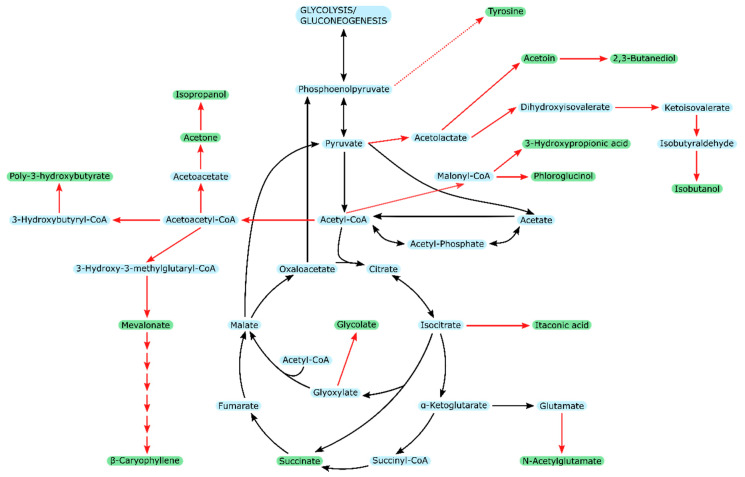
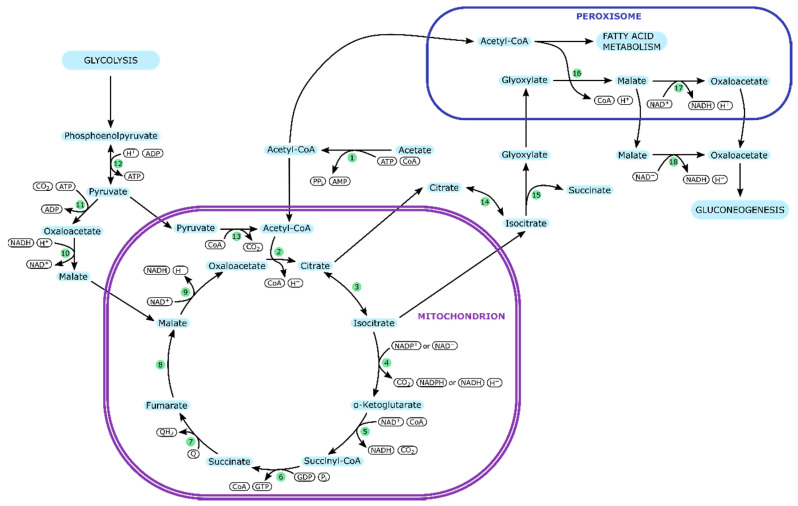
Ecological concerns have recently led to the increasing trend to upgrade carbon contained in waste streams into valuable chemicals. One of these components is acetate. Its microbial upgrading is possible in various species, with being the best-studied. Several chemicals derived from acetate have already been successfully produced in on a laboratory scale, including acetone, itaconic acid, mevalonate, and tyrosine. As acetate is a carbon source with a low energy content compared to glucose or glycerol, energy- and redox-balancing plays an important role in acetate-based growth and production. In addition to the energetic challenges, acetate has an inhibitory effect on microorganisms, reducing growth rates, and limiting product concentrations. Moreover, extensive metabolic engineering is necessary to obtain a broad range of acetate-based products. In this review, we illustrate some of the necessary energetic considerations to establish robust production processes by presenting calculations of maximum theoretical product and carbon yields. Moreover, different strategies to deal with energetic and metabolic challenges are presented. Finally, we summarize ways to alleviate acetate toxicity and give an overview of process engineering measures that enable sustainable acetate-based production of value-added chemicals.
近期,出于生态方面的考虑,将废物流中的碳升级转化为有价值化学品的趋势日益增强。其中一种成分是乙酸盐。在多种微生物中都可以实现其微生物升级转化,其中研究最为深入。已经在实验室规模成功利用乙酸盐生产了几种化学品,包括丙酮、衣康酸、甲羟戊酸和酪氨酸。由于与葡萄糖或甘油相比,乙酸盐是一种能量含量较低的碳源,能量和氧化还原平衡在基于乙酸盐的生长和生产中起着重要作用。除了能量方面的挑战,乙酸盐对微生物具有抑制作用,会降低生长速率并限制产物浓度。此外,需要进行广泛的代谢工程才能获得多种基于乙酸盐的产物。在本综述中,我们通过给出最大理论产物和碳产率的计算结果,阐述了建立稳健生产工艺所需的一些能量方面的考量。此外,还介绍了应对能量和代谢挑战的不同策略。最后,我们总结了减轻乙酸盐毒性的方法,并概述了实现基于乙酸盐的可持续增值化学品生产的过程工程措施。