Rhea Elizabeth M, Logsdon Aric F, Banks William A, Erickson Michelle E
Geriatrics Research Education and Clinical Center, Veterans Affairs Puget Sound Health Care System, Seattle, WA 98108, USA.
Division of Gerontology and Geriatric Medicine, Department of Medicine, University of Washington School of Medicine, Seattle, WA 98195, USA.
Pharmaceutics. 2020 Nov 20;12(11):1120. doi: 10.3390/pharmaceutics12111120.
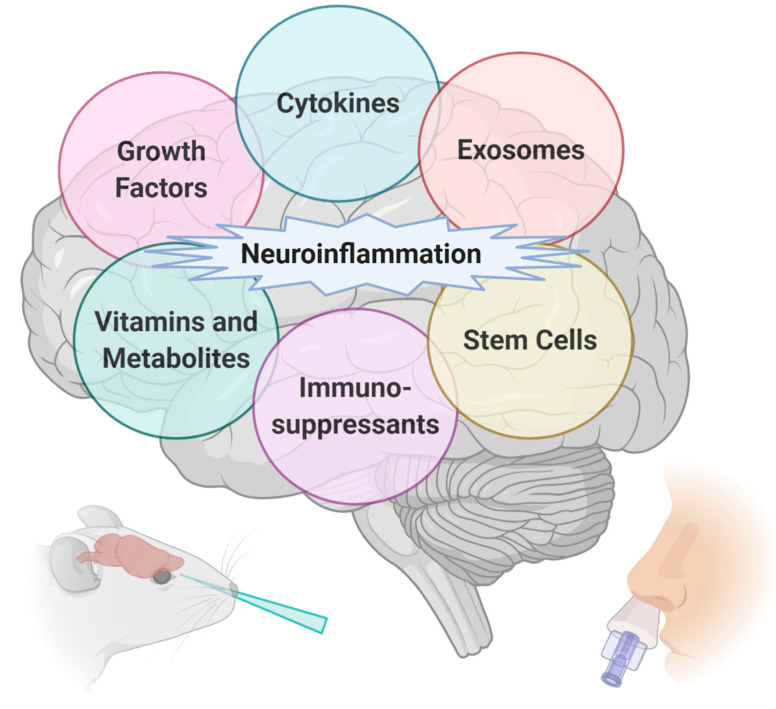
This review highlights the pre-clinical and clinical work performed to use intranasal delivery of various compounds from growth factors to stem cells to reduce neuroimmune interactions. We introduce the concept of intranasal (IN) delivery and the variations of this delivery method based on the model used (i.e., rodents, non-human primates, and humans). We summarize the literature available on IN delivery of growth factors, vitamins and metabolites, cytokines, immunosuppressants, exosomes, and lastly stem cells. We focus on the improvement of neuroimmune interactions, such as the activation of resident central nervous system (CNS) immune cells, expression or release of cytokines, and detrimental effects of signaling processes. We highlight common diseases that are linked to dysregulations in neuroimmune interactions, such as Alzheimer's disease, Parkinson's disease, stroke, multiple sclerosis, and traumatic brain injury.
本综述重点介绍了为利用鼻内递送从生长因子到干细胞等各种化合物以减少神经免疫相互作用而开展的临床前和临床工作。我们介绍了鼻内(IN)递送的概念以及基于所使用模型(即啮齿动物、非人灵长类动物和人类)的这种递送方法的变体。我们总结了关于鼻内递送生长因子、维生素和代谢物、细胞因子、免疫抑制剂、外泌体以及最后干细胞的现有文献。我们关注神经免疫相互作用的改善,例如驻留中枢神经系统(CNS)免疫细胞的激活、细胞因子的表达或释放以及信号传导过程的有害影响。我们强调与神经免疫相互作用失调相关的常见疾病,如阿尔茨海默病、帕金森病、中风、多发性硬化症和创伤性脑损伤。