Abbaoui Abdellatif, Fatoba Oluwaseun, Yamashita Toshihide
Department of Molecular Neuroscience, Graduate School of Medicine, Osaka University, Osaka, Japan.
World Premier International (WPI)-Immunology Frontier Research Center, Osaka University, Osaka, Japan.
Front Cell Neurosci. 2023 Aug 7;17:1181071. doi: 10.3389/fncel.2023.1181071. eCollection 2023.
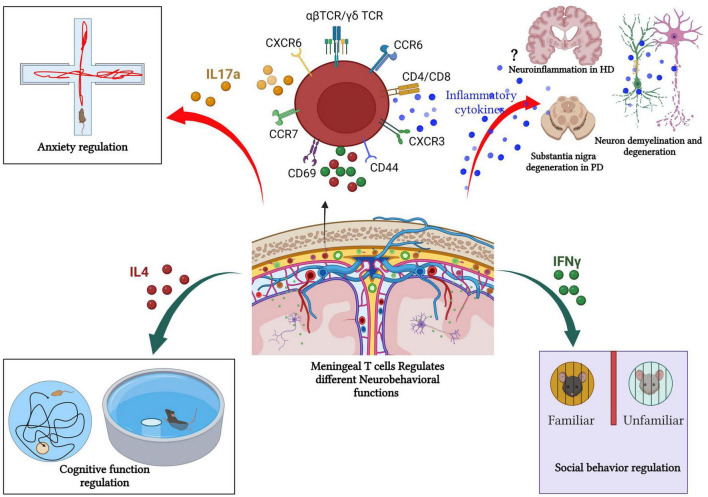
Recently, a rising interest is given to neuroimmune communication in physiological and neuropathological conditions. Meningeal immunity is a complex immune environment housing different types of immune cells. Here, we focus on meningeal T cells, possibly the most explored aspect of neuro-immune cell interactions. Emerging data have shown that meningeal T cells play a crucial role in the pathogenesis of several neurodegenerative disorders, including multiple sclerosis, Alzheimer's, Parkinson's, and Huntington's diseases. This review highlights how meningeal T cells may contribute to immune surveillance of the central nervous system (CNS) and regulate neurobehavioral functions through the secretion of cytokines. Overall, this review assesses the recent knowledge of meningeal T cells and their effects on CNS functioning in both health and disease conditions and the underlying mechanisms.
最近,人们对生理和神经病理条件下的神经免疫通讯越来越感兴趣。脑膜免疫是一个包含不同类型免疫细胞的复杂免疫环境。在这里,我们聚焦于脑膜T细胞,这可能是神经免疫细胞相互作用中研究最多的方面。新出现的数据表明,脑膜T细胞在包括多发性硬化症、阿尔茨海默病、帕金森病和亨廷顿病在内的几种神经退行性疾病的发病机制中起关键作用。这篇综述强调了脑膜T细胞如何通过细胞因子的分泌促进对中枢神经系统(CNS)的免疫监视并调节神经行为功能。总体而言,这篇综述评估了关于脑膜T细胞及其在健康和疾病状态下对CNS功能的影响以及潜在机制的最新知识。