Department of Oral and Maxillofacial Surgery, Guizhou Provincial People's Hospital, Guizhou, China.
Department of Urology, Guizhou Provincial People's Hospital, Guizhou, China.
Aging (Albany NY). 2020 Nov 21;13(8):10821-10832. doi: 10.18632/aging.202224.
Novel Coronavirus disease 2019 (COVID-19) was first detected in pneumonia patients in Wuhan, China in December 2019. Based on the current understanding, COVID-19 has become a global issue. Presumably, numerous studies have found that SARS-CoV-2 also transpires in kidney tissue with permanent viral loads. However, it is elusive as to whether SARS-CoV-2 can directly damage the kidney or induce acute renal failure. Hence, to comprehensively understand the impact of COVID-19 on kidney damage, we conducted a retrospective series of case studies to assess kidney functions. Additionally, ACE2 distribution in kidney tissue was analyzed through RNAseq data in open-access databases.
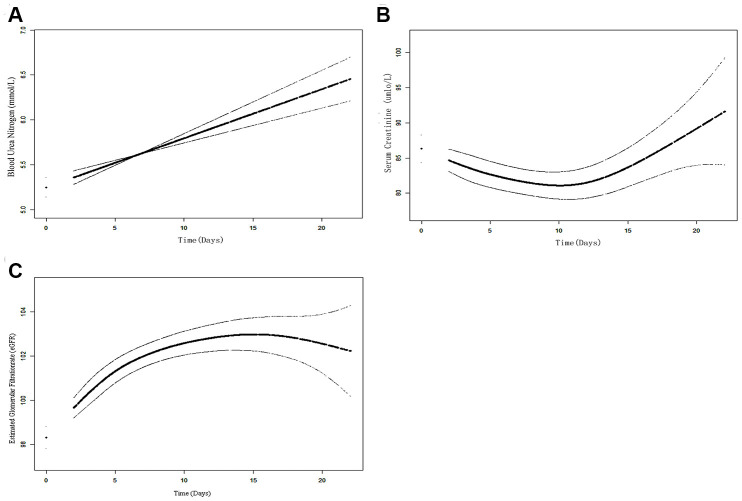
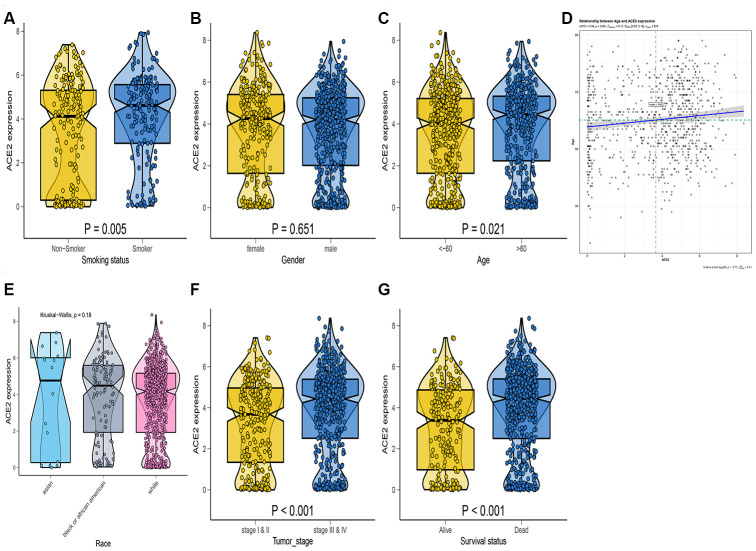
According to the findings from transcriptome analysis, we revealed higher ACE2 expression levels in females than males. Similar results were more noticeable in the elderly than in young adults. Furthermore, single-cell RNA sequencing data analysis showed high ACE2 expression in kidney tubule and collecting duct principal cells as well as glomerular parietal epithelial cells. On their admission, the patient's serum creatinine and blood urea nitrogen (BUN) were elevated to between 36.13% and 16.80%, respectively. The estimated glomerular filtration rate (EGFR) of < 60 ml/min per 1.73 m2 was reported in 10.92 % of the patients. Notably, at admission, increased BUN time varied linearly following the generalized additive mixed model. Thus, the hourly-increase of BUN in patients was 0.495 (95%CI: 0.263, 0.726).
Based on clinical findings, it was ascertained that COVID-19 can damage renal function, but it seldom causes acute renal failure. Coronavirus may directly bind to ACE2-positive cells and damage kidney tissue in the analysis of scRNA-seq data in kidney tissue. Therefore, this evidence suggests that kidney tissue act as the SARS-CoV-2 infection site and the findings could provide insight into the pathophysiology of kidney damage.
We systematically analyzed ACE2 expression profiles in organs based on open-access datasets for healthy individuals. Meanwhile, single-cell sequencing data for kidney samples were collected and analyzed. Assessments on kidney functions were conducted on 119 selected COVID-19 positive patients admitted from 10 February - 18 March 2020, in hospital in Wuhan City, Hubei Province. Consequently, their clinical records and laboratory findings, such as the estimated glomerular filtration rate (eGFR), Blood Urea Nitrogen (BUN), Creatinine, and Comorbidities, were collected.
新型冠状病毒病 2019(COVID-19)于 2019 年 12 月在中国武汉的肺炎患者中首次被发现。基于目前的认识,COVID-19 已经成为全球性问题。据推测,许多研究发现,SARS-CoV-2 也在肾脏组织中存在,且具有持续的病毒载量。然而,SARS-CoV-2 是否可以直接损害肾脏或导致急性肾衰竭仍不清楚。因此,为了全面了解 COVID-19 对肾脏损害的影响,我们进行了回顾性病例系列研究以评估肾脏功能。此外,还通过开放获取数据库中的 RNAseq 数据分析了肾脏组织中 ACE2 的分布。
根据转录组分析的结果,我们发现女性的 ACE2 表达水平高于男性。在老年人中,这种情况比年轻人更为明显。此外,单细胞 RNA 测序数据分析显示,ACE2 在肾小管和集合管主细胞以及肾小球壁上皮细胞中高表达。在入院时,患者的血清肌酐和血尿素氮(BUN)分别升高至 36.13%和 16.80%之间。报告的肾小球滤过率(eGFR)<60ml/min/1.73m2 占 10.92%。值得注意的是,入院时,BUN 时间的增加呈线性变化,符合广义相加混合模型。因此,患者的 BUN 每小时增加 0.495(95%CI:0.263,0.726)。
根据临床发现,确定 COVID-19 会损害肾功能,但很少引起急性肾衰竭。在分析肾脏组织的 scRNA-seq 数据时,冠状病毒可能直接与 ACE2 阳性细胞结合并损害肾脏组织。因此,这一证据表明,肾脏组织是 SARS-CoV-2 感染的部位,研究结果可以深入了解肾脏损伤的病理生理学。
我们基于健康个体的开放数据集系统地分析了器官中 ACE2 的表达谱。同时,收集并分析了肾脏样本的单细胞测序数据。对 2020 年 2 月 10 日至 3 月 18 日期间从湖北省武汉市医院收治的 119 例 COVID-19 阳性患者的肾脏功能进行了评估。随后收集了他们的临床记录和实验室发现,例如估计肾小球滤过率(eGFR)、血尿素氮(BUN)、肌酐和合并症。