Talie Eneyew, Wondiye Habtamu, Kassie Nigus, Gutema Hordofa
Department of Health Promotion and Behavioral Science, School of Public Health, College of Medicine and Health Science, Bahir Dar University, Bahir Dar, Ethiopia.
Department of midwifery, college of medicine and health science, Dire Dawa University, Dire Dawa, Ethiopia.
J Blood Med. 2020 Nov 17;11:429-437. doi: 10.2147/JBM.S277411. eCollection 2020.
The World Health Organization recommends that 1% to 3% of a country's population should donate blood to meet its demand and should focus on young people to achieve 100% voluntary blood donation. The aim of this study was to assess voluntary blood donation among Bahir Dar University students by using an integrated behavioral model.
An institution-based cross-sectional study was conducted on Bahir Dar University students from March 1-21, 2020. A multi-stage sampling technique was applied to select 625 study participants. Data were entered in Epi data version 3.1 and then exported to SPSS version 23.0 for analysis. Path analysis was done using Stata 15 to check the causal effect of the integrated behavioral model constructs on voluntary blood donation. Internal consistency and validity of constructs were checked using Cronbach's alpha and exploratory factor analysis, respectively. Multivariable linear and logistics regression were used to predict independent predictors on intention and voluntary blood donation, respectively. The significant independent predictor was declared at 95% confidence interval and P-value < 0.05.
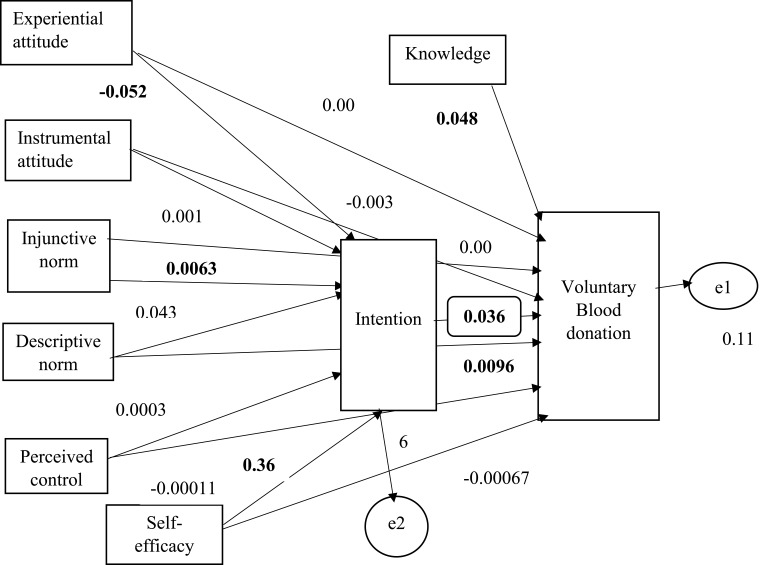
One hundred and four (16.8%) university students donated blood voluntarily. Being female (AOR = 1.92 (1.15-3.22)), being third year (AOR = 2.88 (1.55-5.35)), knowledge (AOR = 1.53 (1.32-1.77)), descriptive norm (AOR = 1.10 (1.01-1.12)) and intention (AOR = 1.42 (1.28-1.57)) were positively associated with blood donation. Injunctive norm (B = 0.06) and self-efficacy (B = 0.36) have significant association with intention. Intention, descriptive norm and knowledge have significant effect on blood donation with path coefficient 0.0, 0.09 and 0.48, respectively.
The magnitude of voluntary blood donation was low as compared to other similar studies. Descriptive norm, intention, knowledge, sex, year of study were significant predictors associated with voluntary blood donation. Therefore, behavioral change health communication strategies should develop to address these factors among the students. Researchers should conduct prospective analytical study design to examine the causal relationship of constructs of the model to develop better interventional strategy.
世界卫生组织建议,一个国家1%至3%的人口应献血以满足需求,且应着重关注年轻人以实现100%的自愿无偿献血。本研究的目的是通过使用综合行为模型评估巴希尔达尔大学学生的自愿无偿献血情况。
于2020年3月1日至21日对巴希尔达尔大学学生开展了一项基于机构的横断面研究。采用多阶段抽样技术选取625名研究参与者。数据录入Epi数据3.1版本,然后导出至SPSS 23.0版本进行分析。使用Stata 15进行路径分析,以检验综合行为模型各构成要素对自愿无偿献血的因果效应。分别使用克朗巴哈系数和探索性因子分析来检验各构成要素的内部一致性和效度。多变量线性回归和逻辑回归分别用于预测影响献血意愿和自愿无偿献血的独立预测因素。在95%置信区间和P值<0.05时确定显著的独立预测因素。
104名(16.8%)大学生自愿献血。女性(调整后比值比[AOR]=1.92[1.15 - 3.22])、三年级学生(AOR = 2.88[1.55 - 5.35])、知识水平(AOR = 1.53[1.32 - 1.77])、描述性规范(AOR = 1.10[1.01 - 1.12])和献血意愿(AOR = 1.42[1.28 - 1.57])与献血呈正相关。指令性规范(B = 0.06)和自我效能感(B = 0.36)与献血意愿有显著关联。献血意愿、描述性规范和知识水平对献血有显著影响,路径系数分别为0.0、0.09和0.48。
与其他类似研究相比,自愿无偿献血的比例较低。描述性规范、献血意愿、知识水平、性别、年级是与自愿无偿献血相关的显著预测因素。因此,应制定行为改变健康传播策略来解决学生中的这些因素。研究人员应进行前瞻性分析研究设计,以检验模型各构成要素之间的因果关系,从而制定更好的干预策略。