Cardiovascular Research and Development Unit, University of Porto and Department of Cardiothoracic Surgery, University Hospital Center of São João, Porto, Portugal.
Department of Cardiothoracic Surgery, Maastricht University Medical Center, Maastricht, Netherlands.
Interact Cardiovasc Thorac Surg. 2021 Jan 22;32(2):167-173. doi: 10.1093/icvts/ivaa248.
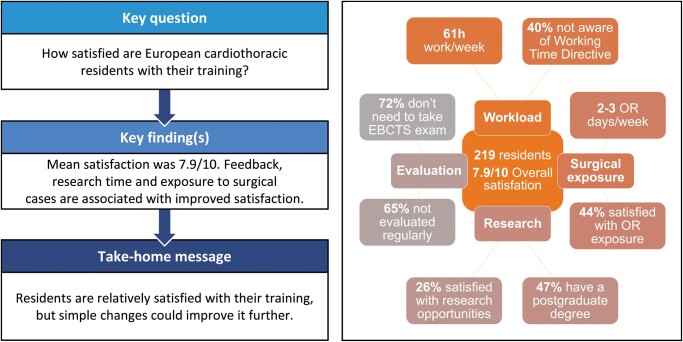
The increasing complexity of surgical patients and working time constraints represent challenges for training. In this study, the European Association for Cardio-Thoracic Surgery Residents' Committee aimed to evaluate satisfaction with current training programmes across Europe.
We conducted an online survey between October 2018 and April 2019, completed by a total of 219 participants from 24 countries.
The average respondent was in the fourth or fifth year of training, mostly on a cardiac surgery pathway. Most trainees follow a 5-6-year programme, with a compulsory final certification exam, but no regular skills evaluation. Only a minority are expected to take the examination by the European Board of Cardiothoracic Surgery. Participants work on average 61.0 ± 13.1 h per week, including 27.1 ± 20.2 on-call. In total, only 19.7% confirmed the implementation of the European Working Time Directive, with 42.0% being unaware that European regulations existed. Having designated time for research was reported by 13.0%, despite 47.0% having a postgraduate degree. On average, respondents rated their satisfaction 7.9 out of 10, although 56.2% of participants were not satisfied with their training opportunities. We found an association between trainee satisfaction and regular skills evaluation, first operator experience and protected research time.
On average, residents are satisfied with their training, despite significant disparities in the quality and structure of cardiothoracic surgery training across Europe. Areas for potential improvement include increasing structured feedback, research time integration and better working hours compliance. The development of European guidelines on training standards may support this.
手术患者日益复杂和工作时间限制对培训构成挑战。本研究中,欧洲心胸外科住院医师委员会旨在评估欧洲各地当前培训计划的满意度。
我们于 2018 年 10 月至 2019 年 4 月期间进行了一项在线调查,共有来自 24 个国家的 219 名参与者完成了调查。
平均受访者处于培训的第四或第五年,主要从事心脏手术。大多数受训者遵循 5-6 年的计划,并进行强制性的最终认证考试,但没有定期的技能评估。只有少数人有望通过欧洲心胸外科委员会的考试。参与者平均每周工作 61.0±13.1 小时,其中 27.1±20.2 小时为值班。总共只有 19.7%的人确认实施了欧洲工作时间指令,42.0%的人不知道存在欧洲法规。尽管 47.0%的人拥有研究生学历,但只有 13.0%的人报告有专门用于研究的时间。平均而言,受访者对培训的满意度评分为 10 分中的 7.9 分,尽管 56.2%的参与者对培训机会不满意。我们发现,培训满意度与定期技能评估、首次操作经验和受保护的研究时间之间存在关联。
平均而言,住院医师对培训感到满意,尽管欧洲各地心胸外科培训的质量和结构存在显著差异。潜在的改进领域包括增加结构化反馈、研究时间整合和更好地遵守工作时间。制定关于培训标准的欧洲指南可能会支持这一点。