Cardiovascular R&D Centre (UnIC), Department of Surgery and Physiology, Faculty of Medicine, University of Porto, 4200-319 Porto, Portugal.
Int J Mol Sci. 2020 Nov 23;21(22):8866. doi: 10.3390/ijms21228866.
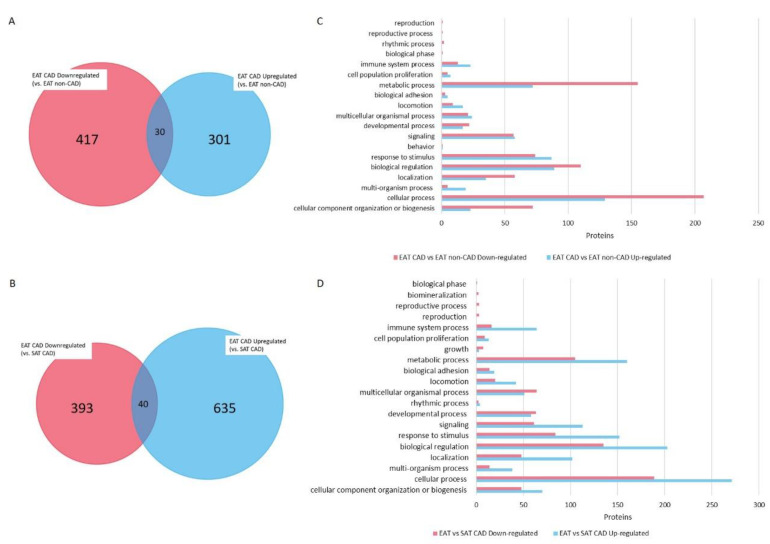
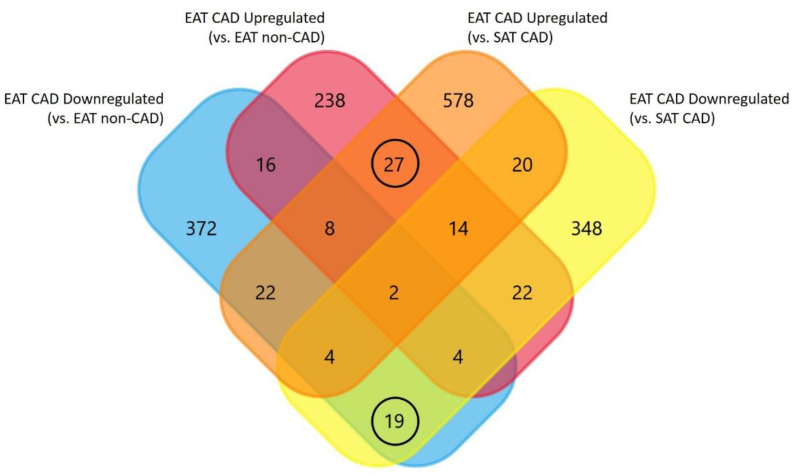
The role of epicardial adipose tissue (EAT) in the pathophysiology of coronary artery disease (CAD) remains unclear. The present systematic review aimed at compiling dysregulated proteins/genes from different studies to dissect the potential role of EAT in CAD pathophysiology. Exhaustive literature research was performed using the keywords "epicardial adipose tissue and coronary artery disease", to highlight a group of proteins that were consistently regulated among all studies. Reactome, a pathway analysis database, was used to clarify the function of the selected proteins and their intertwined association. SignalP/SecretomeP was used to clarify the endocrine function of the selected proteins. Overall, 1886 proteins/genes were identified from 44 eligible studies. The proteins were separated according to the control used in each study (EAT non-CAD or subcutaneous adipose tissue (SAT) CAD) and by their regulation (up- or downregulated). Using a Venn diagram, we selected the proteins that were upregulated and downregulated (identified as 27 and 19, respectively) in EAT CAD for both comparisons. The analysis of these proteins revealed the main pathways altered in the EAT and how they could communicate with the heart, potentially contributing to CAD development. In summary, in this study, the identified dysregulated proteins highlight the importance of inflammatory processes to modulate the local environment and the progression of CAD, by cellular and metabolic adaptations of epicardial fat that facilitate the formation and progression of atherogenesis of coronaries.
心外膜脂肪组织(EAT)在冠状动脉疾病(CAD)的病理生理学中的作用仍不清楚。本系统评价旨在综合来自不同研究的失调蛋白/基因,以剖析 EAT 在 CAD 病理生理学中的潜在作用。使用关键词“心外膜脂肪组织和冠状动脉疾病”进行全面的文献研究,以突出一组在所有研究中均受一致调节的蛋白。使用途径分析数据库 Reactome 来阐明选定蛋白的功能及其相互交织的关联。使用 SignalP/SecretomeP 来阐明选定蛋白的内分泌功能。总体而言,从 44 项合格研究中鉴定出 1886 种蛋白/基因。这些蛋白根据每个研究中使用的对照(非 CAD 的 EAT 或 CAD 的皮下脂肪组织(SAT))和其调节情况(上调或下调)进行分离。使用韦恩图,我们选择了在 EAT CAD 中上调和下调的蛋白(分别鉴定为 27 个和 19 个)用于这两种比较。对这些蛋白的分析揭示了 EAT 中改变的主要途径,以及它们如何与心脏相互交流,这可能有助于 CAD 的发展。总之,在这项研究中,鉴定出的失调蛋白强调了炎症过程的重要性,通过心外膜脂肪的细胞和代谢适应性来调节局部环境和 CAD 的进展,从而促进冠状动脉粥样硬化的形成和进展。