División de Inmunología, Centro de Investigación Biomédica de Occidente (CIBO)-Instituto Mexicano del Seguro Social (IMSS), Sierra Mojada No. 800, Col. Independencia, 44340, Guadalajara, Jalisco, Mexico.
Programa de Doctorado en Ciencias Biomédicas, Centro Universitario de Ciencias de la Salud (CUCS), Universidad de Guadalajara, Guadalajara, Jalisco, Mexico.
BMC Infect Dis. 2020 Nov 25;20(1):889. doi: 10.1186/s12879-020-05627-x.
Human papillomavirus infection is an important factor associated with cervical cancer (CC) development. The prevalence and genotype distribution vary greatly worldwide. Examining local epidemiological data constitutes an important step towards the development of vaccines to prevent CC. In this work, we studied the prevalence of HPV genotypes in women from Western Mexico with the COBAS 4800 and/or Linear Array Genotyping Test (LA).
The samples analysed in this study represent a population from Western Mexico, which includes six different states. Our approach was first to test for HPV in cervical samples from women who attended their health clinic for routine gynaecological studies (open-population, n = 3000) by utilizing COBAS 4800. Afterwards, 300 of the HPV-positive samples were randomly selected to be genotyped with LA; finally, we genotyped samples from women with cervical intraepithelial neoplasia grade 1 (CIN 1, n = 71) and CC (n = 96) with LA. Sociodemographic data of the diverse groups were also compared.
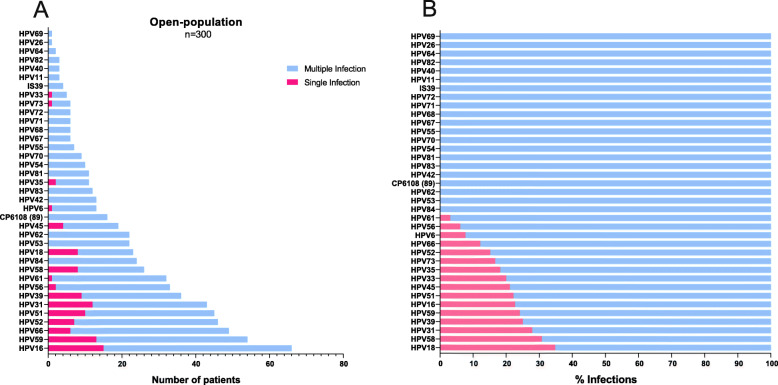
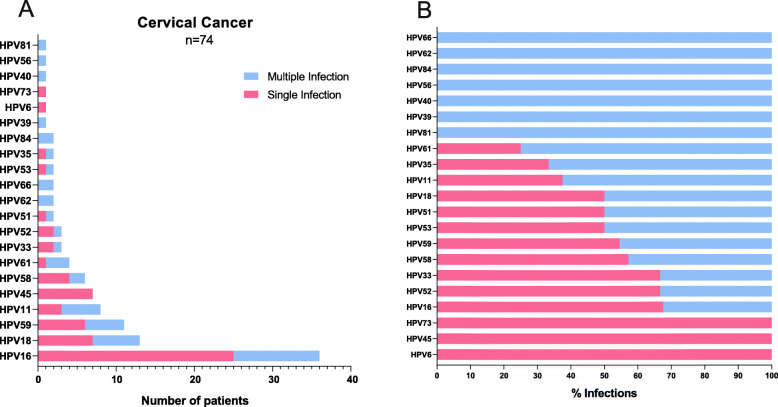
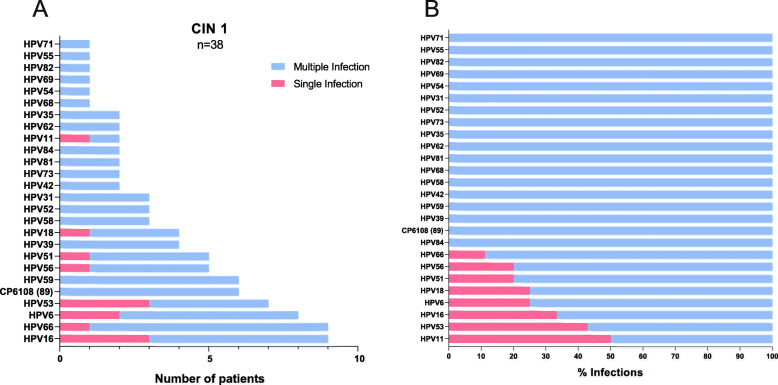
The overall HPV prevalence among the open-population of women as determined by COBAS 4800 was 12.1% (n = 364/3000). Among the HPV-positive samples, single infections (SI) with HPV16 were detected in 12.4% (n = 45/364), SI with HPV18 were detected in 1.4%, and infection with at least one of the genotypes included in the high-risk HPV pool was detected in 74.5% of the cases. LA analysis of the samples showed that in addition to HPV genotypes 16 and 18, there was a high prevalence of HPV genotypes 59, 66, 52, 51, 39 and 56 in women from Western Mexico. With respect to the sociodemographic data, we found statistically significant differences in the number of pregnancies, the use of hormonal contraceptives and tobacco intake.
Our data indicate that there is a high prevalence of HPV genotypes which are not covered by the vaccines currently available in Mexico; therefore, it is necessary to include HPVs 59, 66, 51, 39 and 56 in the design of future vaccines to reduce the risk of CC development. It is also essential to emphasize that the use of hormonal contraceptives and tobacco smoking are risk factors for CC development in addition to the presence of HPV.
人乳头瘤病毒(HPV)感染是宫颈癌(CC)发展的一个重要因素。其流行率和基因型分布在全球范围内差异很大。研究当地的流行病学数据是开发预防 CC 的疫苗的重要一步。在这项工作中,我们使用 COBAS 4800 和/或线性阵列基因分型检测(LA)检测了来自墨西哥西部的女性 HPV 基因型的流行率。
本研究分析的样本代表了墨西哥西部的一个人群,包括六个不同的州。我们的方法首先是利用 COBAS 4800 检测在常规妇科研究中到诊所就诊的女性的宫颈样本中的 HPV(开放人群,n=3000)。之后,随机选择 300 例 HPV 阳性样本用 LA 进行基因分型;最后,我们用 LA 对宫颈上皮内瘤变 1 级(CIN 1,n=71)和 CC(n=96)的女性样本进行基因分型。还比较了不同组的社会人口统计学数据。
COBAS 4800 检测的开放人群中 HPV 的总体流行率为 12.1%(n=364/3000)。在 HPV 阳性样本中,HPV16 的单一感染(SI)占 12.4%(n=45/364),HPV18 的 SI 占 1.4%,高危 HPV 池中的至少一种基因型感染占 74.5%。对样本的 LA 分析表明,除了 HPV 基因型 16 和 18 之外,墨西哥西部的女性还存在 HPV 基因型 59、66、52、51、39 和 56 的高流行率。关于社会人口统计学数据,我们发现妊娠次数、使用激素避孕药和吸烟摄入方面存在统计学显著差异。
我们的数据表明,存在大量未被墨西哥目前可用疫苗覆盖的 HPV 基因型,因此有必要在未来疫苗设计中加入 HPV 59、66、51、39 和 56,以降低 CC 发展的风险。此外,除了 HPV 之外,使用激素避孕药和吸烟也是 CC 发展的危险因素,这一点也很重要。