Geroscience Center for Brain Health and Metabolism (GERO), Santiago, Chile.
Neuropsychology and Clinical Neuroscience Laboratory (LANNEC), Physiopathology Department - Institute of Biomedical Sciences (ICBM), Neuroscience and East Neuroscience Departments, Faculty of Medicine, University of Chile, Santiago, Chile.
BMC Geriatr. 2020 Nov 25;20(1):505. doi: 10.1186/s12877-020-01866-4.
With the global population aging and life expectancy increasing, dementia has turned a priority in the health care system. In Chile, dementia is one of the most important causes of disability in the elderly and the most rapidly growing cause of death in the last 20 years. Cognitive complaint is considered a predictor for cognitive and functional decline, incident mild cognitive impairment, and incident dementia. The GERO cohort is the Chilean core clinical project of the Geroscience Center for Brain Health and Metabolism (GERO). The objective of the GERO cohort is to analyze the rate of functional decline and progression to clinical dementia and their associated risk factors in a community-dwelling elderly with subjective cognitive complaint, through a population-based study. We also aim to undertake clinical research on brain ageing and dementia disorders, to create data and biobanks with the appropriate infrastructure to conduct other studies and facilitate to the national and international scientific community access to the data and samples for research.
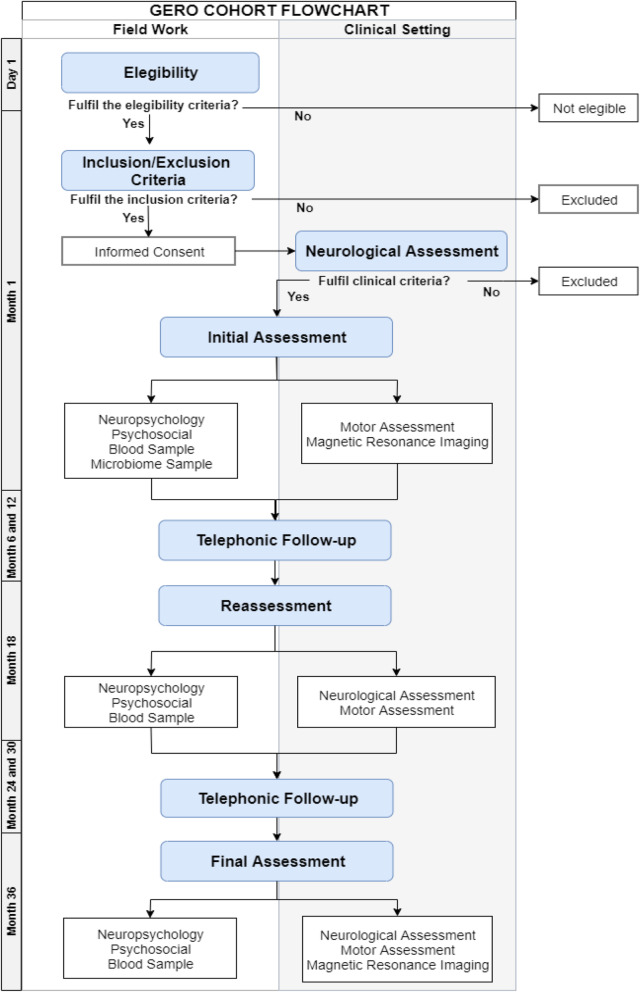
The GERO cohort aims the recruitment of 300 elderly subjects (> 70 years) from Santiago (Chile), following them up for at least 3 years. Eligible people are adults not diagnosed with dementia with subjective cognitive complaint, which are reported either by the participant, a proxy or both. Participants are identified through a household census. The protocol for evaluation is based on a multidimensional approach including socio-demographic, biomedical, psychosocial, neuropsychological, neuropsychiatric and motor assessments. Neuroimaging, blood and stool samples are also obtained. This multidimensional evaluation is carried out in a baseline and 2 follow-ups assessments, at 18 and 36 months. In addition, in months 6, 12, 24, and 30, a telephone interview is performed in order to keep contact with the participants and to assess general well-being.
Our work will allow us to determine multidimensional risks factors associated with functional decline and conversion to dementia in elderly with subjective cognitive complain. The aim of our GERO group is to establish the capacity to foster cutting edge and multidisciplinary research on aging in Chile including basic and clinical research.
NCT04265482 in ClinicalTrials.gov. Registration Date: February 11, 2020. Retrospectively Registered.
随着全球人口老龄化和预期寿命的延长,痴呆症已成为医疗保健系统的重点。在智利,痴呆症是老年人最重要的残疾原因之一,也是过去 20 年中增长最快的死因。认知主诉被认为是认知和功能下降、轻度认知障碍和痴呆症的预测指标。GERO 队列是智利大脑健康与代谢老龄化研究中心(GERO)的核心临床项目。GERO 队列的目的是通过一项基于人群的研究,分析有主观认知主诉的社区居住老年人的功能下降率和向临床痴呆的进展及其相关危险因素。我们还旨在开展大脑老化和痴呆症障碍的临床研究,创建具有适当基础设施的数据和生物库,以开展其他研究,并为国家和国际科学界提供数据和样本,以促进研究。
GERO 队列旨在从圣地亚哥(智利)招募 300 名年龄在 70 岁以上的老年人,对他们进行至少 3 年的随访。合格的人是没有被诊断为痴呆症的成年人,他们有主观认知主诉,这些主诉是由参与者、代理人或两者报告的。参与者是通过家庭普查确定的。评估方案基于包括社会人口统计学、生物医学、心理社会、神经心理学、神经精神病学和运动评估在内的多维方法。还获得了神经影像学、血液和粪便样本。这种多维评估是在基线和 2 次随访评估中进行的,分别在 18 个月和 36 个月。此外,在第 6、12、24 和 30 个月,通过电话访谈与参与者保持联系并评估总体健康状况。
我们的工作将使我们能够确定与有主观认知主诉的老年人功能下降和向痴呆症转化相关的多维危险因素。我们的 GERO 小组的目标是建立在智利开展老龄化的前沿和多学科研究的能力,包括基础和临床研究。
ClinicalTrials.gov 中的 NCT04265482。注册日期:2020 年 2 月 11 日。回顾性注册。