Chan Chieh-Kai, Chi Chun-Yi, Lai Tai-Shuan, Huang Tao-Min, Chou Nai-Kuan, Huang Yi-Ping, Prowle John R, Wu Vin-Cent, Chen Yung-Ming
Department of Internal Medicine, National Taiwan University Hospital, Hsin-Chu Branch, Hsin Chu County, Taiwan.
Department of Internal Medicine, National Taiwan University Hospital, 7 Chung-Shan South Road, Zhong-Zheng District, Taipei, 100, Taiwan.
Sci Rep. 2020 Nov 25;10(1):20572. doi: 10.1038/s41598-020-77556-3.
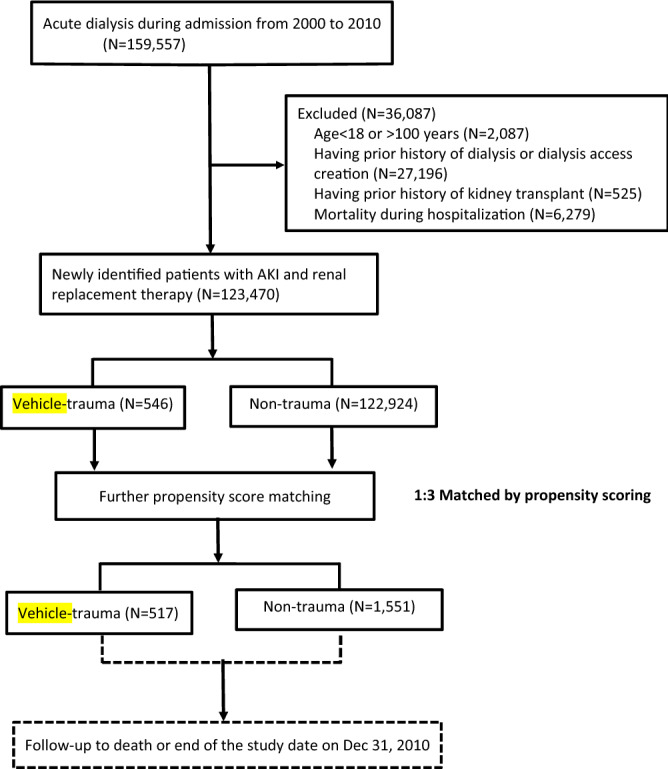
Acute kidney injury (AKI) is a frequent complication of traumatic injury; however, long-term outcomes such as mortality and end-stage kidney disease (ESKD) have been rarely reported in this important patient population. We compared the long-term outcome of vehicle-traumatic and non-traumatic AKI requiring renal replacement therapy (AKI-RRT). This nationwide cohort study used data from the Taiwan National Health Insurance Research Database. Vehicle-trauma patients who were suffered from vehicle accidents developing AKI-RRT during hospitalization were identified, and matching non-traumatic AKI-RRT patients were identified between 2000 and 2010. The incidences of ESKD, 30-day, and long-term mortality were evaluated, and clinical and demographic associations with these outcomes were identified using Cox proportional hazards regression models. 546 vehicle-traumatic AKI-RRT patients, median age 47.6 years (interquartile range: 29.0-64.3) and 76.4% male, were identified. Compared to non-traumatic AKI-RRT, vehicle-traumatic AKI-RRT patients had longer length of stay in hospital [median (IQR):15 (5-34) days vs. 6 (3-11) days; p < 0.001). After propensity matching with non-traumatic AKI-RRT cases with similar demographic and clinical characteristics. Vehicle-traumatic AKI-RRT patients had lower rates of long-term mortality (adjusted hazard ratio (HR), 0.473; 95% CI, 0.392-0.571; p < 0.001), but similar rates of ESKD (HR, 1.166; 95% CI, 0.829-1.638; p = 0.377) and short-term risk of death (HR, 1.134; 95% CI, 0.894-1.438; p = 0.301) as non-traumatic AKI-RRT patients. In competing risk models that focused on ESKD, vehicle-traumatic AKI-RRT patients were associated with lower ESKD rates (HR, 0.552; 95% CI, 0.325-0.937; p = 0.028) than non-traumatic AKI-RRT patients. Despite severe injuries, vehicle-traumatic AKI-RRT patients had better long-term survival than non-traumatic AKI-RRT patients, but a similar risk of ESKD. Our results provide a better understanding of long-term outcomes after vehicle-traumatic AKI-RRT.
急性肾损伤(AKI)是创伤性损伤的常见并发症;然而,在这一重要患者群体中,诸如死亡率和终末期肾病(ESKD)等长期预后情况鲜有报道。我们比较了需要肾脏替代治疗(AKI-RRT)的车祸创伤性AKI和非创伤性AKI的长期预后。这项全国性队列研究使用了台湾国民健康保险研究数据库的数据。确定了在住院期间因车祸发生AKI-RRT的车祸创伤患者,并在2000年至2010年间确定了匹配的非创伤性AKI-RRT患者。评估了ESKD的发生率、30天和长期死亡率,并使用Cox比例风险回归模型确定了与这些预后相关的临床和人口统计学因素。共确定了546例车祸创伤性AKI-RRT患者,中位年龄47.6岁(四分位间距:29.0-64.3),男性占76.4%。与非创伤性AKI-RRT相比,车祸创伤性AKI-RRT患者的住院时间更长[中位(IQR):15(5-34)天 vs. 6(3-11)天;p<0.001]。在与具有相似人口统计学和临床特征的非创伤性AKI-RRT病例进行倾向匹配后。车祸创伤性AKI-RRT患者的长期死亡率较低(调整后风险比[HR],0.473;95%置信区间,0.392-0.571;p<0.001),但ESKD发生率(HR,1.166;95%置信区间,0.829-1.638;p = 0.377)和短期死亡风险(HR,1.134;——95%置信区间,0.894-1.438;p = 0.301)与非创伤性AKI-RRT患者相似。在关注ESKD的竞争风险模型中,车祸创伤性AKI-RRT患者的ESKD发生率(HR,0.552;95%置信区间,0.325-0.937;p = 0.028)低于非创伤性AKI-RRT患者。尽管伤势严重,但车祸创伤性AKI-RRT患者的长期生存率高于非创伤性AKI-RRT患者,但ESKD风险相似。我们的研究结果有助于更好地了解车祸创伤性AKI-RRT后的长期预后。