Devine Shaunna L, Walker Susannah C, Makdani Adarsh, Stockton Elizabeth R, McFarquhar Martyn J, McGlone Francis P, Trotter Paula D
Research Centre for Brain and Behaviour, Liverpool John Moores University, Liverpool, United Kingdom.
Division of Neuroscience and Experimental Psychology, The University of Manchester, Manchester, United Kingdom.
Front Psychol. 2020 Nov 10;11:557171. doi: 10.3389/fpsyg.2020.557171. eCollection 2020.
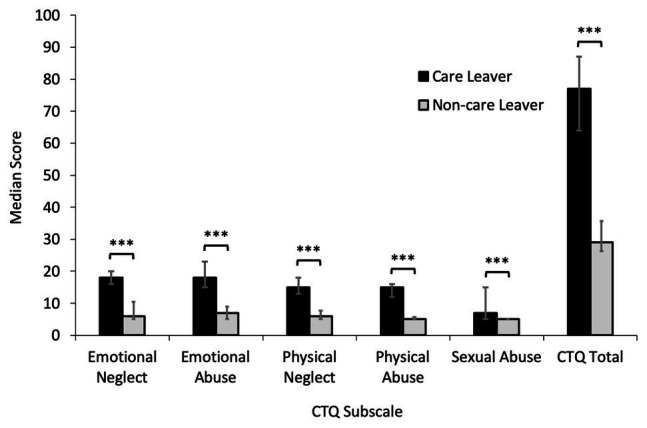
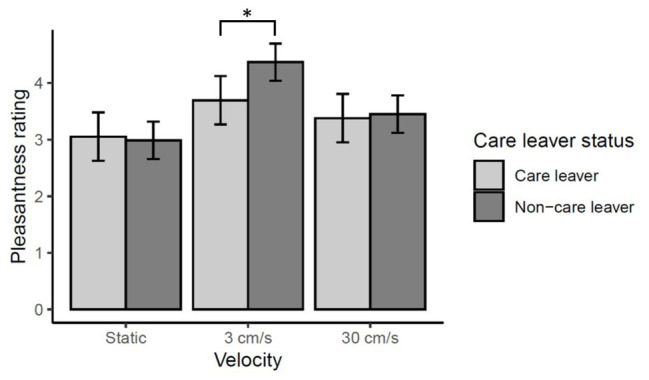
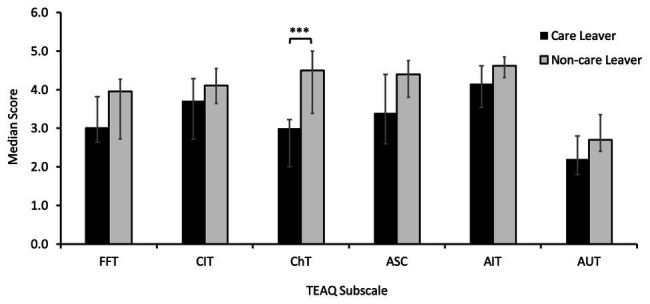
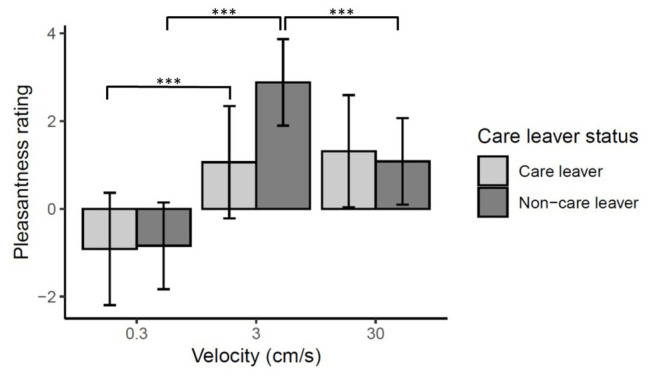
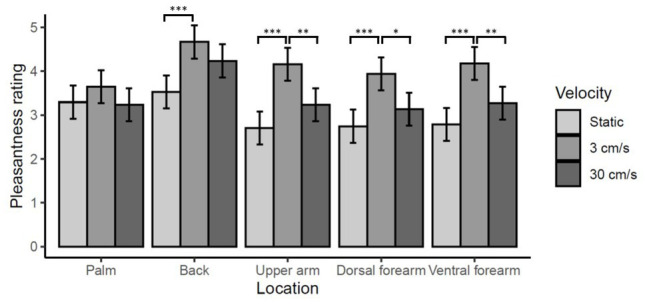
In the United Kingdom, the most common reasons for a child to come under the care of social services are neglect and abuse. Such early childhood adversity is a risk factor for social-isolation and poor mental health in adulthood. Touch is a key channel for nurturing interactions, and previous studies have shown links between early somatosensory input, experience dependent neural plasticity, and later life emotional functioning. The aim of the present study was to test the relationship between childhood neglect/abuse and later life experiences, attitudes, and hedonic ratings of affective touch. Here, affective touch is defined as low force, dynamic touch which C-Tactile afferents (CTs) respond optimally to. We hypothesized that a childhood lacking in early nurturing tactile stimulation would be associated with reduced sensitivity to socially relevant affective touch in adulthood. To test this, 19 care leavers (average 9.32 ± 3.70 years in foster care) and 32 non-care leavers were recruited through opportunity sampling (mean age = 21.25 ± 1.74 years). Participants completed a range of psychophysical somatosensory tests. First, they rated the pleasantness of CT-optimal (3 cm/s) and non-CT-optimal (0.3 and 30 cm/s) stroking touch applied to their forearm, both robotically and by an experimenter. They also made vicarious ratings of the anticipated pleasantness of social tactile interactions depicted in a series of videos. Finally, they filled in the Childhood Trauma Questionnaire (CTQ) and the Touch Experiences and Attitudes Questionnaire (TEAQ). As expected, care leavers reported significantly higher levels of childhood trauma than the control group. They also reported significantly lower levels of positive childhood touch compared to non-care leavers, but their attitudes and experiences of current intimate and affiliative touch did not differ. Across all psychophysical tests, care leavers showed specific reduction in sensitivity to the affective value of CT targeted 3 cm/s touch. The results of this study support the hypothesis that a lack of nurturing touch in early developmental periods leads to blunted sensitivity to the specific social value of affective touch. Future research should investigate the neural and physiological mechanisms underlying the observed effect.
在英国,儿童受到社会服务机构照料的最常见原因是忽视和虐待。这种童年早期的逆境是成年后社会孤立和心理健康不佳的一个风险因素。触摸是培养互动的关键渠道,先前的研究已经表明早期体感输入、经验依赖性神经可塑性与后期生活情绪功能之间存在联系。本研究的目的是测试童年期忽视/虐待与后期生活经历、态度以及对情感触摸的享乐评级之间的关系。在这里,情感触摸被定义为低力度、动态的触摸,C触觉传入纤维(CTs)对其反应最为理想。我们假设童年缺乏早期滋养性触觉刺激会与成年后对社会相关情感触摸的敏感度降低有关。为了验证这一点,通过机会抽样招募了19名离开照料机构的人(在寄养机构平均时长为9.32 ± 3.70年)和32名未离开照料机构的人(平均年龄 = 21.25 ± 1.74岁)。参与者完成了一系列心理物理学体感测试。首先,他们对以机器人方式和由实验者施加在前臂上的CT理想速度(3厘米/秒)和非CT理想速度(0.3和30厘米/秒)的抚摸触摸的愉悦程度进行评分。他们还对一系列视频中描绘的社交触觉互动的预期愉悦程度进行了替代性评分。最后,他们填写了儿童创伤问卷(CTQ)和触摸经历与态度问卷(TEAQ)。正如预期的那样,离开照料机构的人报告的童年创伤水平显著高于对照组。与未离开照料机构的人相比,他们报告的积极童年触摸水平也显著更低,但他们当前亲密和亲和触摸的态度和经历并无差异。在所有心理物理学测试中,离开照料机构的人对目标为3厘米/秒的CT触摸的情感价值的敏感度表现出特定降低。本研究结果支持了这样的假设,即发育早期缺乏滋养性触摸会导致对情感触摸的特定社会价值的敏感度降低。未来的研究应该调查所观察到的效应背后的神经和生理机制。