Karki Pratap, Birukov Konstantin G, Birukova Anna A
Department of Medicine, University of Maryland School of Medicine, Baltimore, MD, USA.
Department of Anesthesiology, University of Maryland School of Medicine, Baltimore, MD, USA.
Pulm Circ. 2020 Nov 10;10(4):2045894020965357. doi: 10.1177/2045894020965357. eCollection 2020 Oct-Dec.
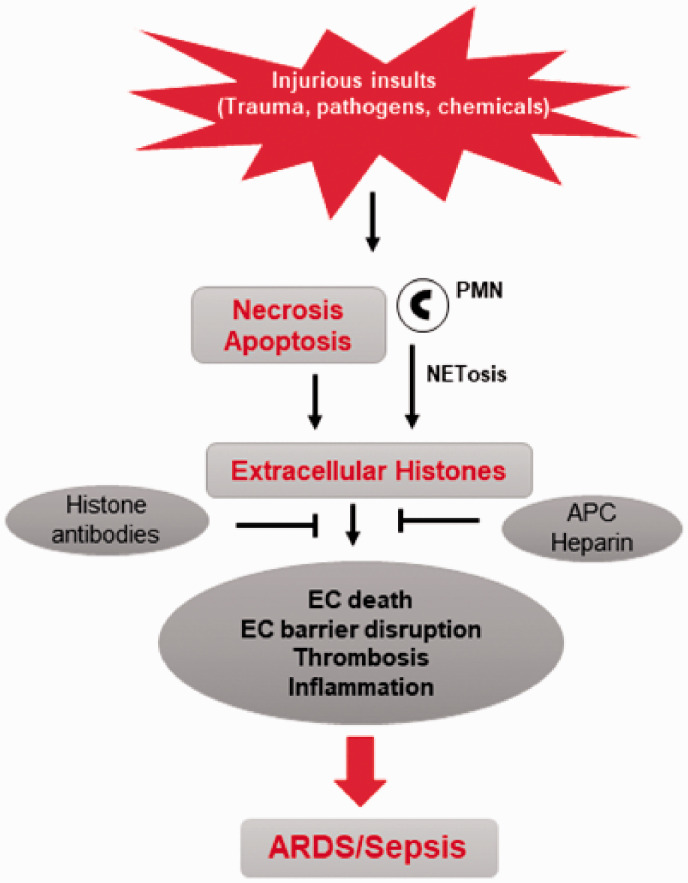
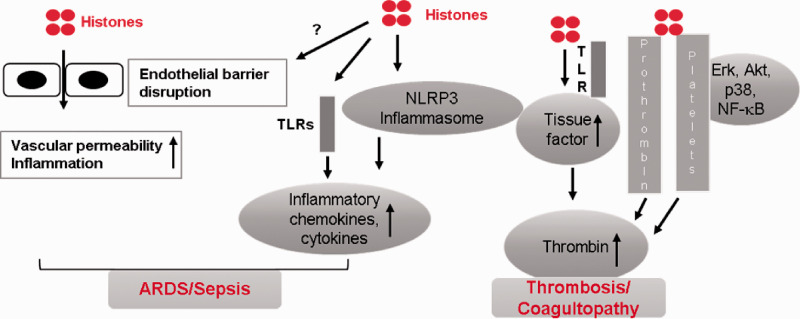
Extracellular histones released from injured or dying cells following trauma and other severe insults can act as potent damage-associated molecular patterns. In fact, elevated levels of histones are present in human circulation in hyperinflammatory states such as acute respiratory distress syndrome and sepsis. The molecular mechanisms owing to histone-induced pathologies are at the very beginning of elucidating. However, neutralization of histones with antibodies, histone-binding or histone-degrading proteins, and heparan sulfates have shown promising therapeutic effects in pre-clinical acute respiratory distress syndrome and sepsis models. Various cell types undergoing necrosis and apoptosis or activated neutrophils forming neutrophil extracellular traps have been implicated in excessive release of histones which further augments tissue injury and may culminate in multiple organ failure. At the molecular level, an uncontrolled inflammatory cascade has been considered as the major event; however, histone-activated coagulation and thrombosis represent additional pathologic events reflecting coagulopathy. Furthermore, epigenetic regulation and chemical modifications of circulating histones appear to be critically important in their biological functions as evidenced by increased cytotoxicity associated with citrullinated histone. Herein, we will briefly review the current knowledge on the role of histones in acute respiratory distress syndrome and sepsis, and discuss the future potential of anti-histone therapy for treatment of these life-threatening disorders.
创伤及其他严重损伤后,从受损或濒死细胞释放的细胞外组蛋白可作为强效的损伤相关分子模式。事实上,在急性呼吸窘迫综合征和脓毒症等高炎症状态下,人体循环中组蛋白水平会升高。由组蛋白诱导的病理过程的分子机制才刚刚开始阐明。然而,在临床前急性呼吸窘迫综合征和脓毒症模型中,用抗体、组蛋白结合蛋白或组蛋白降解蛋白以及硫酸乙酰肝素中和组蛋白已显示出有前景的治疗效果。经历坏死和凋亡的各种细胞类型或形成中性粒细胞胞外陷阱的活化中性粒细胞与组蛋白的过度释放有关,这会进一步加剧组织损伤,并可能最终导致多器官功能衰竭。在分子水平上,不受控制的炎症级联反应被认为是主要事件;然而,组蛋白激活的凝血和血栓形成代表了反映凝血病的其他病理事件。此外,循环组蛋白的表观遗传调控和化学修饰在其生物学功能中似乎至关重要,瓜氨酸化组蛋白相关的细胞毒性增加就证明了这一点。在此,我们将简要回顾关于组蛋白在急性呼吸窘迫综合征和脓毒症中作用的当前知识,并讨论抗组蛋白疗法治疗这些危及生命疾病的未来潜力。