Pérez-Pérez Silvia, Domínguez-Mozo María Inmaculada, Alonso-Gómez Aitana, Medina Silvia, Villarrubia Noelia, Fernández-Velasco Jose Ignacio, García-Martínez María Ángel, García-Calvo Estefanía, Estévez Héctor, Costa-Frossard Lucienne, Alvarez-Cermeño Jose C, Luque-Garcia Jose L, Arroyo Rafael, Villar Luisa M, Alvarez-Lafuente Roberto
Grupo de Investigación de Factores Ambientales en Enfermedades Degenerativas, Instituto de Investigación Sanitaria Hospital Clínico San Carlos (IdISSC) / Red Española de Esclerosis Múltiple (REEM), Madrid, Spain.
Servicio de Inmunología, Hospital Universitario Ramón y Cajal. Instituto Ramón y Cajal de Investigación Sanitaria (IRYCIS) / Red Española de Esclerosis Múltiple (REEM), Madrid, Spain.
PeerJ. 2020 Nov 16;8:e10220. doi: 10.7717/peerj.10220. eCollection 2020.
Gut microbiota has been related to multiple sclerosis (MS) etiopathogenesis. Short-chain fatty acids (SCFA) are compounds derived from microbial metabolism that have a role in gut-brain axis.
To analyse SCFA levels in plasma of MS patients and healthy donors (HD), and the possible link between these levels and both clinical data and immune cell populations.
Ninety-five MS patients and 54 HD were recruited. Patients were selected according to their score in the Expanded Disability Status Scale (EDSS) (49 EDSS ≤ 1.5, 46 EDSS ≥ 5.0). SCFA were studied in plasma samples by liquid chromatography-mass spectrometry. Peripheral blood mononuclear cells were studied by flow cytometry. Gender, age, treatments, EDSS and Multiple Sclerosis Severity Score (MSSS) were evaluated at the recruitment.
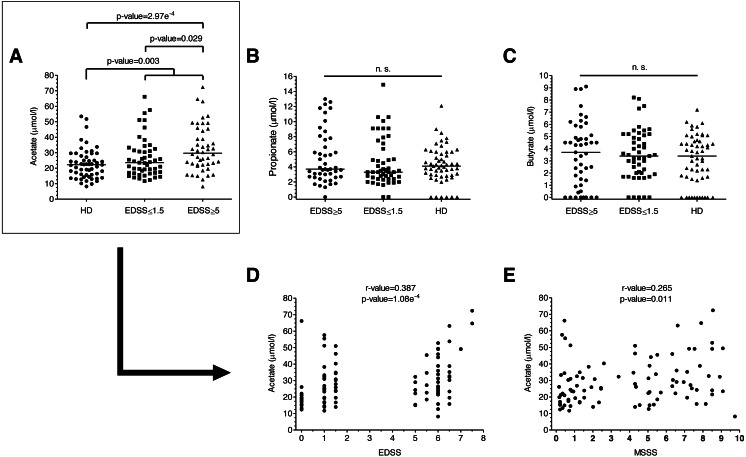
Plasma acetate levels were higher in patients than in HD ( = 0.003). Patients with EDSS ≥ 5.0 had higher acetate levels than those with EDSS≤ 1.5 ( = 0.029), and HD ( = 2.97e-4). Acetate levels correlated with EDSS ( = 0.387; = 1.08e-4) and MSSS ( = 0.265; = 0.011). In untreated MS patients, acetate levels correlated inversely with CD4+ naïve T cells ( = - 0.550, = 0.001) and directly with CD8+ IL-17+ cells ( = 0.557; = 0.001).
Plasma acetate levels are higher in MS patients than in HD. In MS there exists a correlation between plasma acetate levels, EDSS and increased IL-17+ T cells. Future studies will elucidate the role of SCFA in the disease.
肠道微生物群与多发性硬化症(MS)的发病机制有关。短链脂肪酸(SCFA)是微生物代谢产生的化合物,在肠-脑轴中发挥作用。
分析MS患者和健康供体(HD)血浆中的SCFA水平,以及这些水平与临床数据和免疫细胞群体之间的可能联系。
招募了95例MS患者和54名HD。根据患者的扩展残疾状态量表(EDSS)评分进行选择(49例EDSS≤1.5,46例EDSS≥5.0)。通过液相色谱-质谱法研究血浆样本中的SCFA。通过流式细胞术研究外周血单个核细胞。在招募时评估性别、年龄、治疗、EDSS和多发性硬化症严重程度评分(MSSS)。
患者血浆乙酸盐水平高于HD(P = 0.003)。EDSS≥5.0的患者乙酸盐水平高于EDSS≤1.5的患者(P = 0.029)和HD(P = 2.97e-4)。乙酸盐水平与EDSS(P = 0.387;P = 1.08e-4)和MSSS(P = 0.265;P = 0.011)相关。在未经治疗的MS患者中,乙酸盐水平与CD4+初始T细胞呈负相关(P = - 0.550,P = 0.001),与CD8+IL-17+细胞呈正相关(P = 0.557;P = 0.001)。
MS患者血浆乙酸盐水平高于HD。在MS中,血浆乙酸盐水平、EDSS和IL-17+T细胞增加之间存在相关性。未来的研究将阐明SCFA在该疾病中的作用。