Sambandam Sankar, Mukhopadhyay Krishnendu, Sendhil Saritha, Ye Wenlu, Pillarisetti Ajay, Thangavel Gurusamy, Natesan Durairaj, Ramasamy Rengaraj, Natarajan Amudha, Aravindalochanan Vigneswari, Vinayagamoorthi A, Sivavadivel S, Uma Maheswari R, Balakrishnan Lingeswari, Gayatri S, Nargunanathan Srinivasan, Madhavan Sathish, Puttaswamy Naveen, Garg Sarada S, Quinn Ashlinn, Rosenthal Josh, Johnson Michael, Liao Jiawen, Steenland Kyle, Piedhrahita Ricardo, Peel Jennifer, Checkley William, Clasen Thomas, Balakrishnan Kalpana
Department of Environmental Health Engineering, ICMR Center for Advanced Research on Air Quality, Climate and Health, Faculty of Public Health, Sri Ramachandra Institute of Higher Education and Research (Deemed University), Porur, Chennai, 600116, India.
Gangarosa Department of Environmental Health, Rollins School of Public Health, Emory University, Atlanta, GA, USA.
BMC Public Health. 2020 Nov 26;20(1):1799. doi: 10.1186/s12889-020-09865-1.
The Household Air Pollution Intervention Network (HAPIN) trial aims to assess health benefits of a liquefied petroleum gas (LPG) cookfuel and stove intervention among women and children across four low- and middle-income countries (LMICs). We measured exposure contrasts for women, achievable under alternative conditions of biomass or LPG cookfuel use, at potential HAPIN field sites in India, to aid in site selection for the main trial.
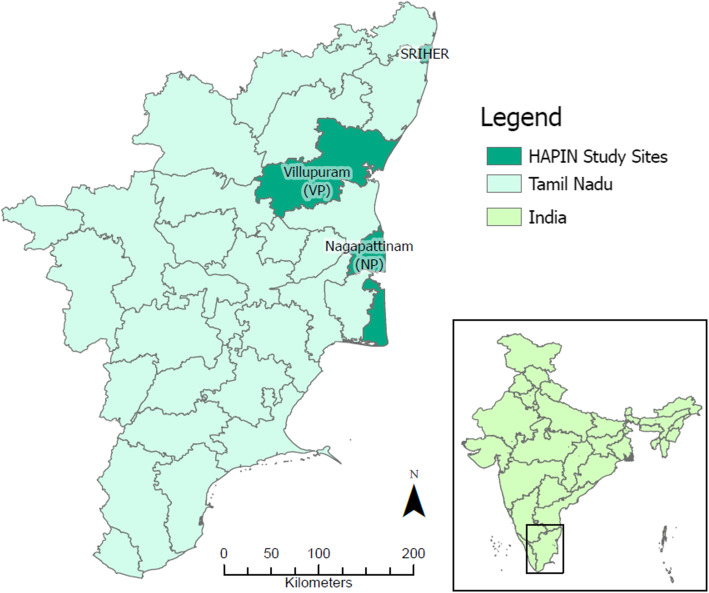
We recruited participants from potential field sites within Villupuram and Nagapattinam districts in Tamil Nadu, India, that were identified during a feasibility assessment. We performed. (i) cross-sectional measurements on women (N = 79) using either biomass or LPG as their primary cookfuel and (ii) before-and-after measurements on pregnant women (N = 41), once at baseline while using biomass fuel and twice - at 1 and 2 months - after installation of an LPG stove and free fuel intervention. We involved participants to co-design clothing and instrument stands for personal and area sampling. We measured 24 or 48-h personal exposures and kitchen and ambient concentrations of fine particulate matter (PM2.5) using gravimetric samplers.
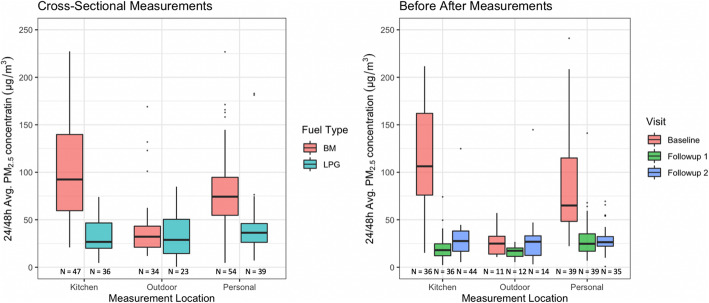
In the cross-sectional analysis, median (interquartile range, IQR) kitchen PM2.5 concentrations in biomass and LPG using homes were 134 μg/m3 [IQR:71-258] and 27 μg/m3 [IQR:20-47], while corresponding personal exposures were 75 μg/m3 [IQR:55-104] and 36 μg/m3 [IQR:26-46], respectively. In before-and-after analysis, median 48-h personal exposures for pregnant women were 72 μg/m3 [IQR:49-127] at baseline and 25 μg/m3 [IQR:18-35] after the LPG intervention, with a sustained reduction of 93% in mean kitchen PM2.5 concentrations and 78% in mean personal PM2.5 exposures over the 2 month intervention period. Median ambient concentrations were 23 μg/m3 [IQR:19-27). Participant feedback was critical in designing clothing and instrument stands that ensured high compliance.
An LPG stove and fuel intervention in the candidate HAPIN trial field sites in India was deemed suitable for achieving health-relevant exposure reductions. Ambient concentrations indicated limited contributions from other sources. Study results provide critical inputs for the HAPIN trial site selection in India, while also contributing new information on HAP exposures in relation to LPG interventions and among pregnant women in LMICs.
ClinicalTrials.Gov. NCT02944682 ; Prospectively registered on October 17, 2016.
家庭空气污染干预网络(HAPIN)试验旨在评估在四个低收入和中等收入国家(LMICs)的妇女和儿童中,使用液化石油气(LPG)烹饪燃料和炉灶干预措施对健康的益处。我们在印度潜在的HAPIN试验场地上,测量了在使用生物质燃料或LPG烹饪燃料的不同条件下,妇女可实现的暴露差异,以协助主要试验的场地选择。
我们从印度泰米尔纳德邦维鲁布尔姆和讷加帕蒂南地区的潜在试验场地招募参与者,这些场地是在可行性评估中确定的。我们进行了:(i)对使用生物质燃料或LPG作为主要烹饪燃料的妇女(N = 79)进行横断面测量;(ii)对孕妇(N = 41)进行前后测量,一次在基线时使用生物质燃料,另外两次在安装LPG炉灶并提供免费燃料干预后的第1个月和第2个月。我们让参与者共同设计用于个人和区域采样 的服装和仪器架。我们使用重量采样器测量了24或48小时的个人暴露以及厨房和环境中的细颗粒物(PM2.5)浓度。
在横断面分析中,使用生物质燃料和LPG的家庭中,厨房PM2.5浓度中位数(四分位间距,IQR)分别为134μg/m3 [IQR:71 - 258]和27μg/m3 [IQR:20 - 47],而相应的个人暴露分别为75μg/m3 [IQR:55 - 104]和36μg/m3 [IQR:26 - 46]。在前后分析中,孕妇的48小时个人暴露中位数在基线时为72μg/m3 [IQR:49 - 127],LPG干预后为25μg/m3 [IQR:18 - 35],在2个月的干预期内,厨房PM2.5平均浓度持续降低93%,个人PM2.5暴露平均降低78%。环境浓度中位数为23μg/m3 [IQR:19 - 27]。参与者的反馈对于设计确保高依从性的服装和仪器架至关重要。
在印度候选的HAPIN试验场地上进行LPG炉灶和燃料干预被认为适合实现与健康相关的暴露减少。环境浓度表明其他来源的贡献有限。研究结果为印度HAPIN试验的场地选择提供了关键信息,同时也提供了关于LPG干预以及LMICs中孕妇的HAP暴露的新信息。
ClinicalTrials.Gov. NCT02944682;于2016年10月17日前瞻性注册。