Lawrence Colleen E, Dunkel Leah, McEver Mark, Israel Tiffany, Taylor Robert, Chiriboga Germán, Goins Karin Valentine, Rahn Elizabeth J, Mudano Amy S, Roberson Erik D, Chambless Carol, Wadley Virginia G, Danila Maria I, Fischer Melissa A, Joosten Yvonne, Saag Kenneth G, Allison Jeroan J, Lemon Stephenie C, Harris Paul A
Vanderbilt Institute for Clinical and Translational Research (VICTR), Vanderbilt University Medical Center, Nashville, TN, USA.
Vanderbilt Institute for Medicine and Public Health, Vanderbilt University Medical Center, Nashville, TN, USA.
J Clin Transl Sci. 2020 Apr 3;4(4):345-353. doi: 10.1017/cts.2020.30.
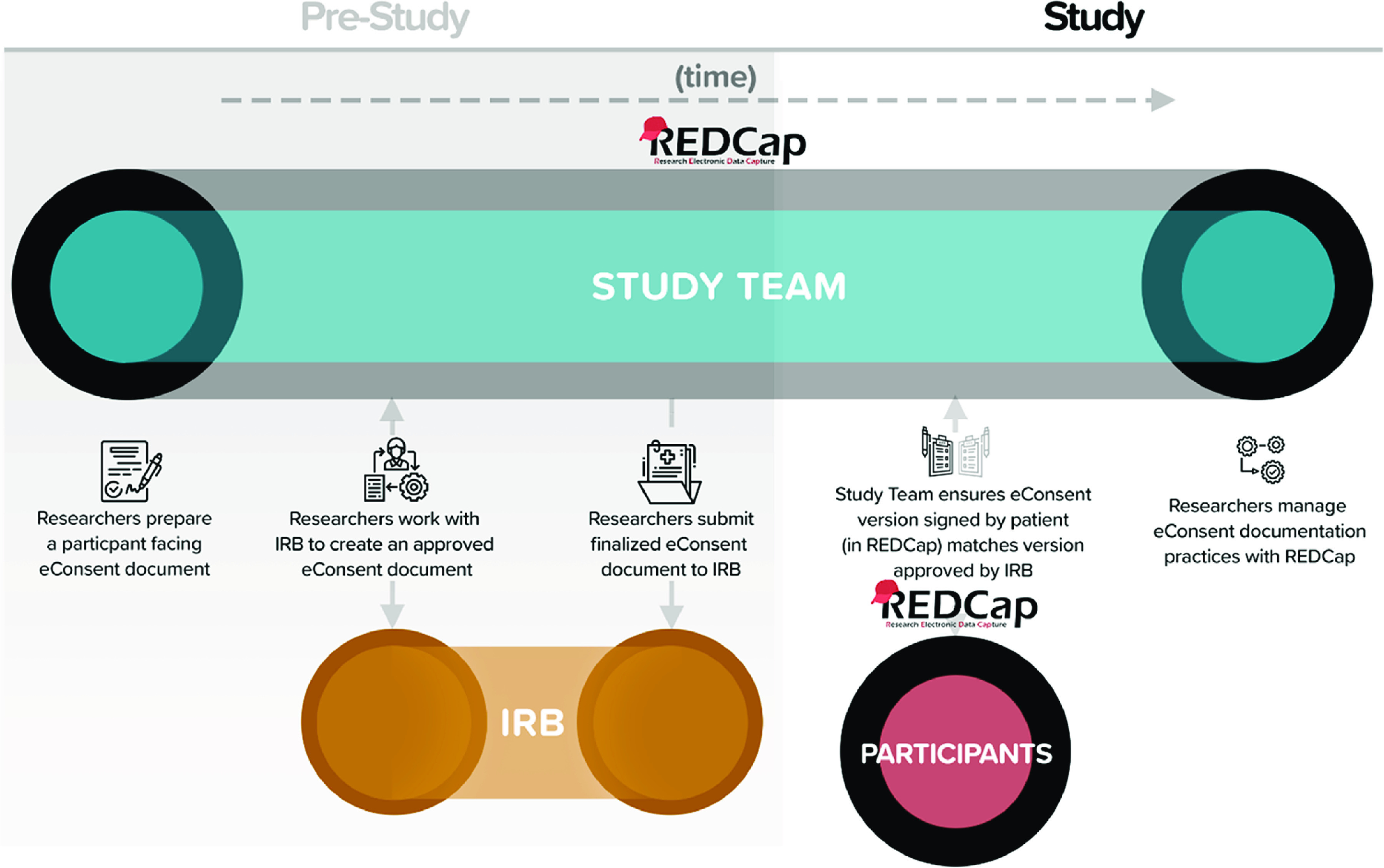
The updated common rule, for human subjects research, requires that consents "begin with a 'concise and focused' presentation of the key information that will most likely help someone make a decision about whether to participate in a study" (Menikoff, Kaneshiro, Pritchard. . 2017; (7): 613-615.). We utilized a community-engaged technology development approach to inform feature options within the REDCap software platform centered around collection and storage of electronic consent (eConsent) to address issues of transparency, clinical trial efficiency, and regulatory compliance for informed consent (Harris, et al. 2009; (2): 377-381.). eConsent may also improve recruitment and retention in clinical research studies by addressing: (1) barriers for accessing rural populations by facilitating remote consent and (2) cultural and literacy barriers by including optional explanatory material (e.g., defining terms by hovering over them with the cursor) or the choice of displaying different videos/images based on participant's race, ethnicity, or educational level (Phillippi, et al. . 2018; (4): 529-534.).
We developed and pilot tested our eConsent framework to provide a personalized consent experience whereby users are guided through a consent document that utilizes avatars, contextual glossary information supplements, and videos, to facilitate communication of information.
The eConsent framework includes a portfolio of eight features, reviewed by community stakeholders, and tested at two academic medical centers.
Early adoption and utilization of this eConsent framework have demonstrated acceptability. Next steps will emphasize testing efficacy of features to improve participant engagement with the consent process.
针对人类受试者研究的更新后的通用规则要求,同意书“应以‘简洁且重点突出’的方式呈现最有可能帮助某人决定是否参与研究的关键信息”(梅尼科夫、卡内希罗、普里查德……2017;(7):613 - 615)。我们采用了社区参与的技术开发方法,以确定REDCap软件平台中的功能选项,该平台围绕电子同意书(eConsent)的收集和存储展开,以解决透明度、临床试验效率和知情同意的法规合规性问题(哈里斯等人……2009;(2):377 - 381)。电子同意书还可以通过解决以下问题来提高临床研究中的招募和留存率:(1)通过促进远程同意来消除接触农村人口的障碍,以及(2)通过包含可选的解释性材料(例如,通过将光标悬停在术语上进行定义)或根据参与者的种族、民族或教育水平选择显示不同的视频/图像来消除文化和识字障碍(菲利普等人……2018;(4):529 - 534)。
我们开发并进行了电子同意书框架的试点测试,以提供个性化的同意体验,即引导用户浏览一份利用虚拟化身、上下文词汇表信息补充和视频的同意文件,以促进信息交流。
电子同意书框架包括一组由社区利益相关者审查并在两个学术医疗中心进行测试的八个功能。
该电子同意书框架的早期采用和使用已证明具有可接受性。下一步将着重测试功能的有效性,以提高参与者对同意过程的参与度。