Croff Raina, Gowen L Kris, Lindauer Allison, Shofner Sabrina, Brown Kim, Eckstrom Elizabeth
NIA-Layton Aging and Alzheimer's Disease Research Center, Oregon Health & Science University, Portland, OR, USA.
Oregon Clinical and Translational Research Institute, Oregon Health & Science University, Portland, OR, USA.
J Clin Transl Sci. 2020 Feb 13;4(5):431-436. doi: 10.1017/cts.2020.12.
The NIH Inclusion Across the Lifespan policy has implications for increasing older adult (OA) participation in research. This study aimed to understand influential factors and facilitators to rural OA research participation.
Thirty-seven rural adults aged ≥66 years participated in focus groups in community centers in four Oregon "non-metro" counties. Transcribed discussions were coded using open-axial coding by an interdisciplinary analytical team.
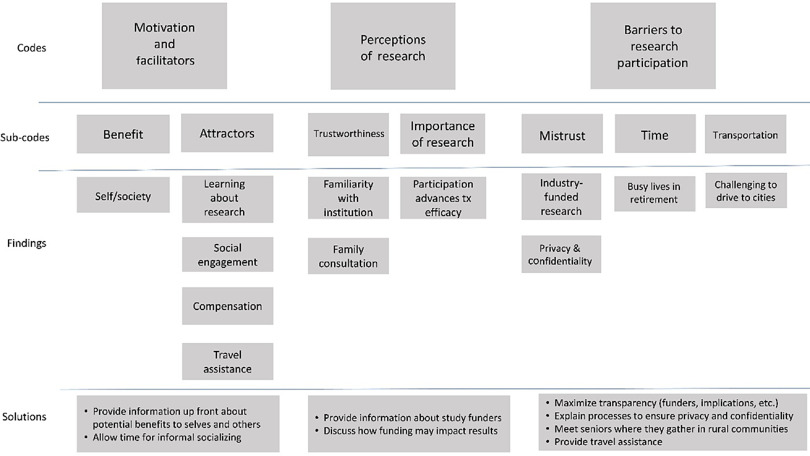
Ages were 66-96 (mean 82.2) years. Majority were women (64%) and white (86%). Primary, interrelated discussion themes were Motivation and Facilitators, Perceptions of Research, and Barriers to Research Participation. Participants were motivated to engage in research because they believed research had implications for improved longevity and quality of life and potentially benefited future generations. Motivational factors influencing participation included self-benefit and improving others' lives, opportunities to socialize and learn about current research, research transparency (funding, time commitment, and requirements), and financial compensation. Perceptions influencing trustworthiness in research included funding source (industry/non-industry) and familiarity with the research institution. Barriers to research participation included transportation and concern about privacy and confidentiality. Suggestions for making research participation easier included researchers coming to rural communities and meeting participants in places where OAs gather and providing transportation and hotel accommodations.
Lessons learned offer practical guidance for research teams as they address the new NIH Inclusion Across the Lifespan policy. Including OAs in research in ways that motivate and facilitate participation will be critical for a robust representation across the lifespan and in tailoring treatments to the specific needs of this population.
美国国立卫生研究院(NIH)的“全生命周期纳入”政策对增加老年人参与研究具有重要意义。本研究旨在了解影响农村老年人参与研究的因素和促进因素。
37名年龄≥66岁的农村成年人参加了俄勒冈州四个“非都市”县社区中心的焦点小组讨论。跨学科分析团队使用开放-轴心编码对转录的讨论进行编码。
年龄在66-96岁之间(平均82.2岁)。大多数为女性(64%)和白人(86%)。主要的、相互关联的讨论主题是动机与促进因素、对研究的看法以及参与研究的障碍。参与者参与研究的动机是他们认为研究对延长寿命和提高生活质量有影响,并且可能造福后代。影响参与的动机因素包括自我受益和改善他人生活、社交和了解当前研究的机会、研究透明度(资金、时间投入和要求)以及经济补偿。影响对研究可信度看法的因素包括资金来源(行业/非行业)和对研究机构的熟悉程度。参与研究的障碍包括交通以及对隐私和保密的担忧。关于使参与研究更容易的建议包括研究人员前往农村社区,在老年人聚集的地方与参与者见面,并提供交通和酒店住宿。
所吸取的经验教训为研究团队应对NIH新的“全生命周期纳入”政策提供了实用指导。以激励和促进参与的方式将老年人纳入研究,对于在整个生命周期中实现充分代表性以及根据该人群的特定需求定制治疗方法至关重要。