Department of Ophthalmology, Johns Hopkins School of Medicine, Baltimore, MD, USA.
Department of Biomedical Engineering, Johns Hopkins School of Medicine, Baltimore, MD, USA.
Transl Vis Sci Technol. 2020 Nov 20;9(12):27. doi: 10.1167/tvst.9.12.27. eCollection 2020 Nov.
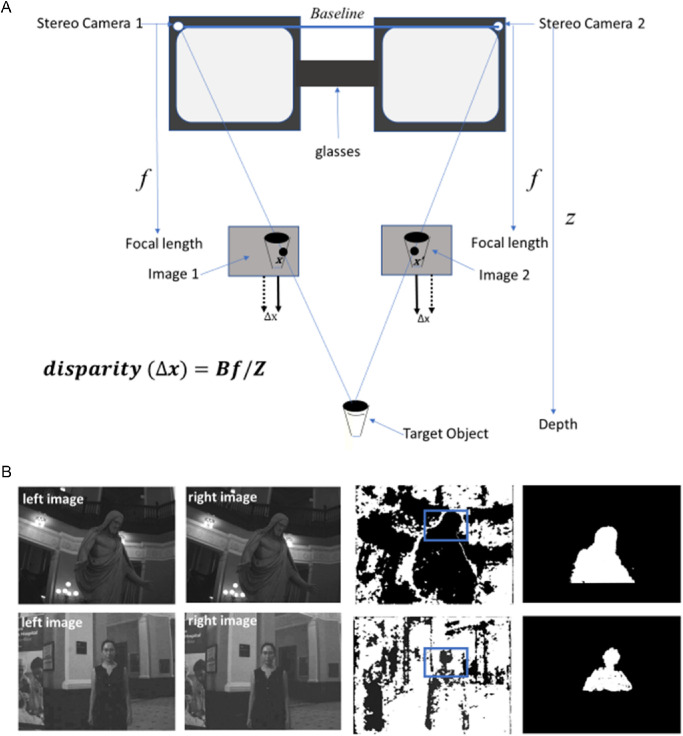
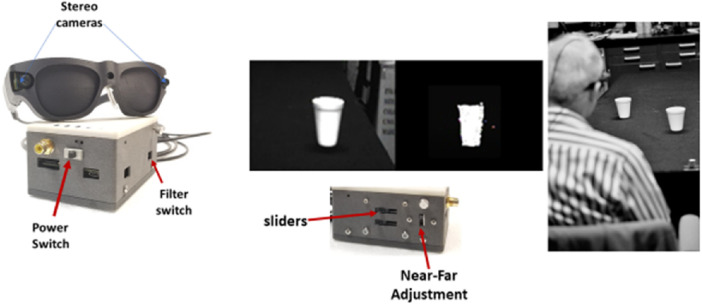
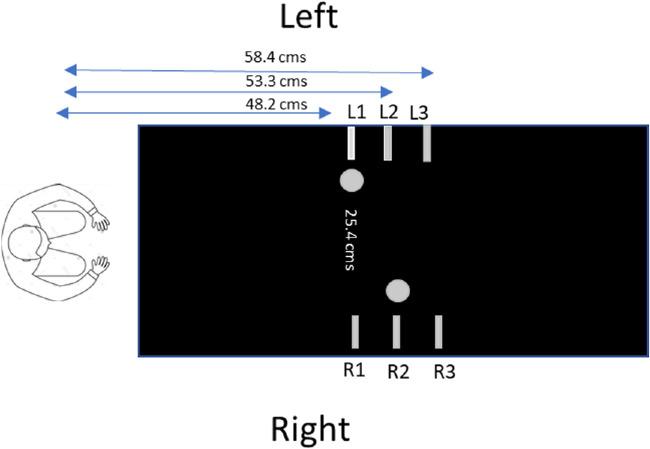
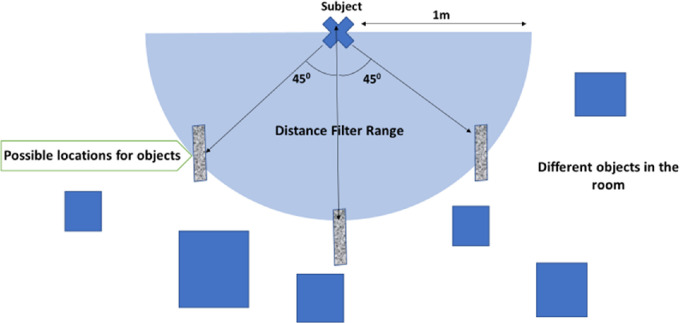
At present, Argus II is the only retinal prosthesis approved by the US Food and Drug Administration that induces visual percepts in people who are blind from end-stage outer retinal degenerations such as retinitis pigmentosa. It has been shown to work well in sparse, high-contrast settings, but in daily practice visual performance with the device is likely to be hampered by the cognitive load presented by a cluttered real-world environment. In this study, we investigated the effect of a stereo-disparity-based distance-filtering system on four experienced Argus II users for a range of tasks: object localization, depth discrimination, orientation and size discrimination, and people detection and direction of motion.
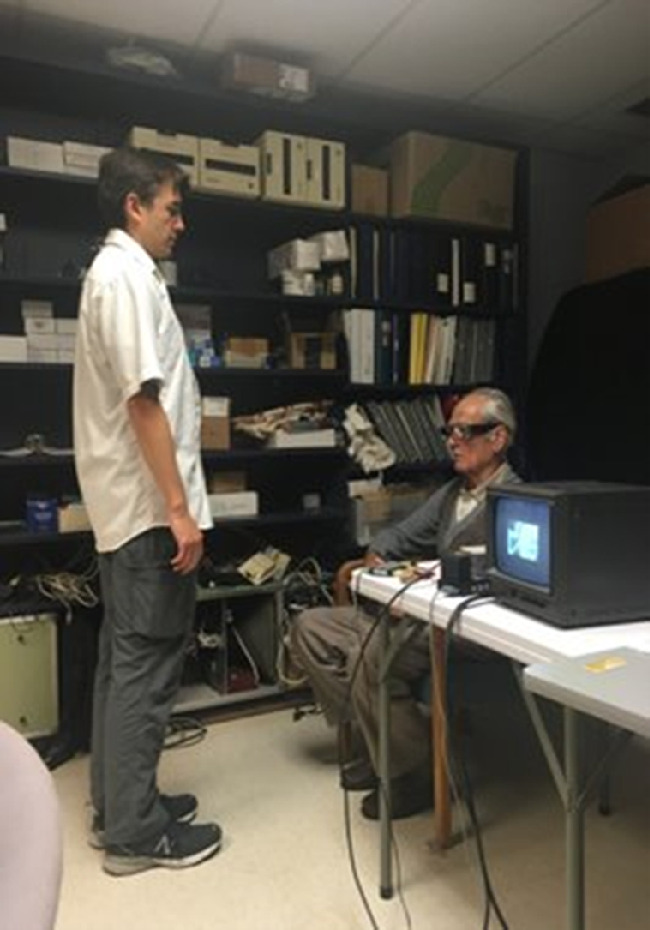
Functional vision was assessed in a semicontrolled setup using unfiltered (normal camera) and distance-filtered (stereo camera) imagery. All tasks were forced choice designs and an extension of signal detection theory to latent (unobservable) variables was used to analyze the data, allowing estimation of person ability (person measures) and task difficulty (item measures) on the same axis.
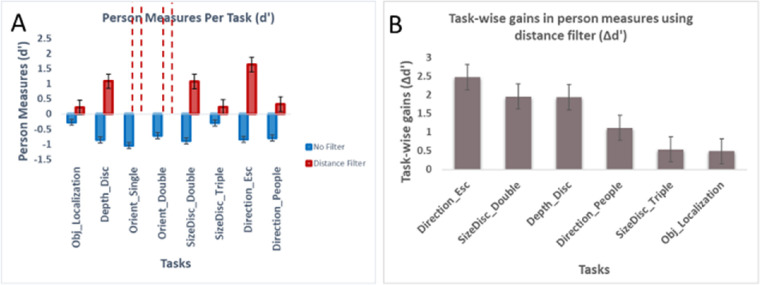
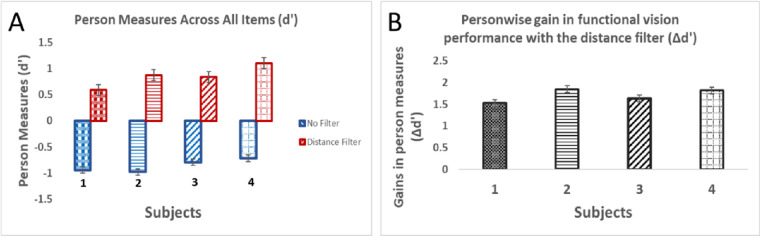
All subjects performed better with the distance filter compared with the unfiltered image ( < 0.001 on all tasks except localization).
Our results show that depth filtering using a disparity-based algorithm has significant benefits for people with Argus II implants.
The improvement in functional vision with the distance filter found in this study may have an important impact on vision rehabilitation and quality of life for people with visual prostheses and ultra low vision.
目前,Argus II 是唯一获得美国食品和药物管理局批准的视网膜假体,可在因色素性视网膜炎等晚期外视网膜变性而失明的人群中产生视觉感知。研究表明,它在稀疏、高对比度的环境中效果良好,但在日常实践中,设备的视觉性能可能会受到现实世界中杂乱环境带来的认知负荷的影响。在这项研究中,我们研究了基于立体视差的距离滤波系统对四名有经验的 Argus II 用户在一系列任务中的影响:目标定位、深度辨别、方向和大小辨别以及人员检测和运动方向。
在半受控设置中使用未过滤(普通相机)和距离过滤(立体相机)图像评估功能性视觉。所有任务均为强制选择设计,并使用潜在(不可观察)变量的信号检测理论扩展来分析数据,允许在同一轴上估计人员能力(人员测量)和任务难度(项目测量)。
与未过滤图像相比,所有受试者在距离滤波器下的表现均优于未过滤图像(除定位外,所有任务均<0.001)。
我们的结果表明,使用基于视差的算法进行深度滤波对视网膜炎患者具有重要意义。
翻译后,我没有添加任何解释或说明,希望这符合你的要求。