Bøgh Nikolaj, Hansen Esben Søvsø Szocska, Mariager Christian Østergaard, Bertelsen Lotte Bonde, Ringgaard Steffen, Laustsen Christoffer
The MR Research Center, Department of Clinical Medicine, Aarhus University, Aarhus, Denmark.
Front Cardiovasc Med. 2020 Nov 5;7:603674. doi: 10.3389/fcvm.2020.603674. eCollection 2020.
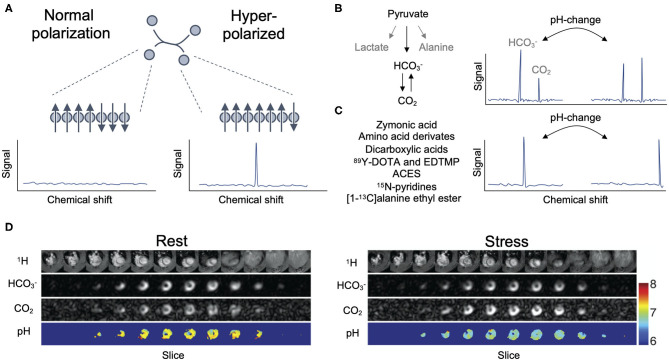
Regardless of the importance of acid-base disturbances in cardiac disease, there are currently no methods for clinical detection of pH in the heart. Several magnetic resonance imaging techniques hold translational promise and may enable mapping of pH. We provide a brief overview of these emerging techniques. A particular focus is on the promising advance of magnetic resonance spectroscopy and imaging with hyperpolarized C-subtrates as biomarkers of myocardial pH. Hyperpolarization allows quantification of key metabolic substrates and their metabolites. Hereby, pH-sensitive reactions can be probed to provide a measure of acid-base alterations. To date, the most used substrates are [1-C]pyruvate and C-labeled bicarbonate; however, others have been suggested. In cardiovascular medicine, hyperpolarized magnetic resonance spectroscopy has been used to probe acid-base disturbances following pharmacological stress, ischemia and heart failure in animals. In addition to pH-estimation, the technique can quantify fluxes such as the pivotal conversion of pyruvate to lactate via lactate dehydrogenase. This capability, a good safety profile and the fact that the technique is employable in clinical scanners have led to recent translation in early clinical trials. Thus, magnetic resonance spectroscopy and imaging may provide clinical pH-imaging in the near future.
尽管酸碱平衡紊乱在心脏疾病中很重要,但目前尚无临床检测心脏内pH值的方法。几种磁共振成像技术具有转化应用前景,可能实现pH值成像。我们简要概述这些新兴技术。特别关注的是磁共振波谱和使用超极化碳底物作为心肌pH生物标志物的成像的有前景进展。超极化能够对关键代谢底物及其代谢产物进行定量。据此,可以探测对pH敏感的反应,以提供酸碱变化的度量。迄今为止,最常用的底物是[1-C]丙酮酸和碳标记的碳酸氢盐;不过,也有人提出了其他底物。在心血管医学中,超极化磁共振波谱已用于探测动物在药物应激、缺血和心力衰竭后的酸碱平衡紊乱。除了估计pH值外,该技术还可以量化通量,例如丙酮酸通过乳酸脱氢酶向乳酸的关键转化。这种能力、良好的安全性以及该技术可用于临床扫描仪这一事实,已促使其近期在早期临床试验中得到转化应用。因此,磁共振波谱和成像可能在不久的将来提供临床pH成像。