Department of Statistics, Abdul Wali Khan University Mardan, Mardan, KP, Pakistan.
PLoS One. 2020 Nov 30;15(11):e0242762. doi: 10.1371/journal.pone.0242762. eCollection 2020.
Forecasting epidemics like COVID-19 is of crucial importance, it will not only help the governments but also, the medical practitioners to know the future trajectory of the spread, which might help them with the best possible treatments, precautionary measures and protections. In this study, the popular autoregressive integrated moving average (ARIMA) will be used to forecast the cumulative number of confirmed, recovered cases, and the number of deaths in Pakistan from COVID-19 spanning June 25, 2020 to July 04, 2020 (10 days ahead forecast).
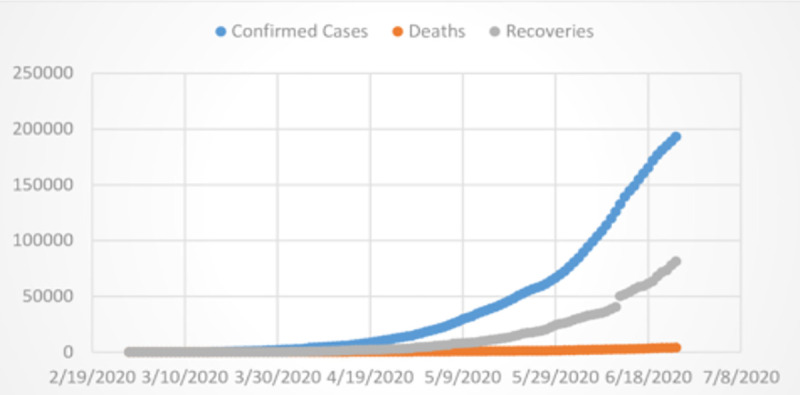
To meet the desire objectives, data for this study have been taken from the Ministry of National Health Service of Pakistan's website from February 27, 2020 to June 24, 2020. Two different ARIMA models will be used to obtain the next 10 days ahead point and 95% interval forecast of the cumulative confirmed cases, recovered cases, and deaths. Statistical software, RStudio, with "forecast", "ggplot2", "tseries", and "seasonal" packages have been used for data analysis.
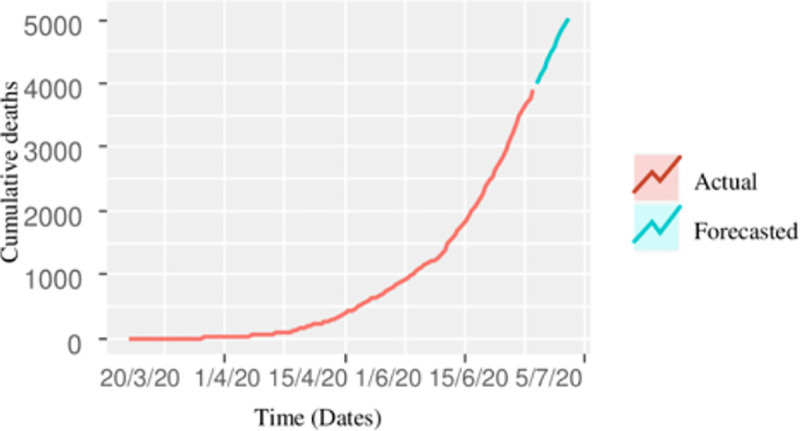
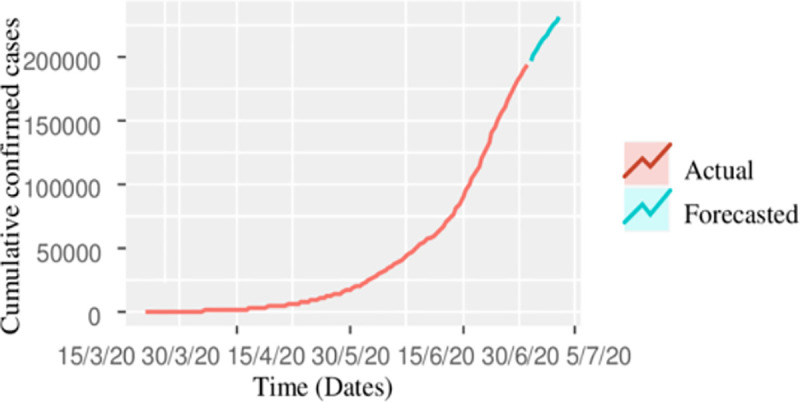
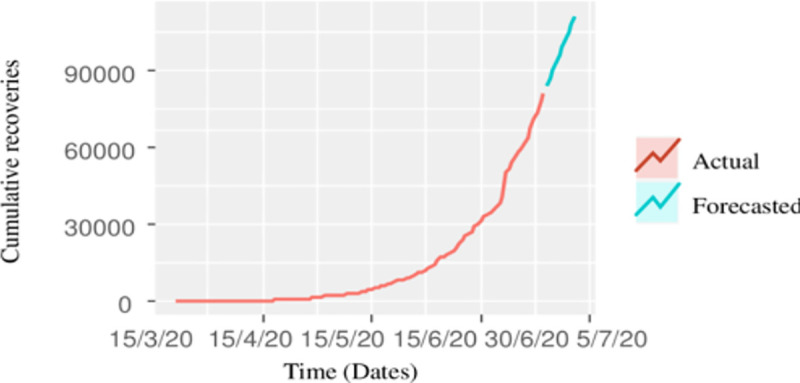
The forecasted cumulative confirmed cases, recovered, and the number of deaths up to July 04, 2020 are 231239 with a 95% prediction interval of (219648, 242832), 111616 with a prediction interval of (101063, 122168), and 5043 with a 95% prediction interval of (4791, 5295) respectively. Statistical measures i.e. root mean square error (RMSE) and mean absolute error (MAE) are used for model accuracy. It is evident from the analysis results that the ARIMA and seasonal ARIMA model is better than the other time series models in terms of forecasting accuracy and hence recommended to be used for forecasting epidemics like COVID-19.
It is concluded from this study that the forecasting accuracy of ARIMA models in terms of RMSE, and MAE are better than the other time series models, and therefore could be considered a good forecasting tool in forecasting the spread, recoveries, and deaths from the current outbreak of COVID-19. Besides, this study can also help the decision-makers in developing short-term strategies with regards to the current number of disease occurrences until an appropriate medication is developed.
预测像 COVID-19 这样的传染病至关重要,这不仅有助于政府,还有助于医疗从业者了解传播的未来轨迹,这可能有助于他们提供最佳的治疗、预防措施和保护。在这项研究中,将使用流行的自回归综合移动平均 (ARIMA) 模型来预测 2020 年 6 月 25 日至 7 月 4 日(10 天预测)期间在巴基斯坦 COVID-19 的确诊病例、康复病例和死亡人数的累计数量。
为了满足预期目标,本研究的数据来自巴基斯坦国家卫生服务部的网站,时间从 2020 年 2 月 27 日至 2020 年 6 月 24 日。将使用两种不同的 ARIMA 模型来获得未来 10 天的确诊病例、康复病例和死亡人数的点预测和 95%区间预测。数据分析使用了 RStudio 统计软件,其中包含了“forecast”、“ggplot2”、“tseries”和“seasonal”包。
截至 2020 年 7 月 4 日的预测累计确诊病例、康复病例和死亡人数分别为 231239 例,预测区间为(219648,242832);111616 例,预测区间为(101063,122168);5043 例,预测区间为(4791,5295)。采用均方根误差 (RMSE) 和平均绝对误差 (MAE) 等统计指标来衡量模型的准确性。分析结果表明,在预测准确性方面,ARIMA 和季节性 ARIMA 模型优于其他时间序列模型,因此建议将其用于 COVID-19 等传染病的预测。
本研究表明,ARIMA 模型在 RMSE 和 MAE 方面的预测精度优于其他时间序列模型,因此可以作为预测 COVID-19 传播、康复和死亡的良好预测工具。此外,本研究还可以帮助决策者制定短期策略,以应对当前疾病发生的数量,直到开发出适当的药物。