School of Health Sciences, Örebro University, 702 81 Örebro, Sweden.
Department of Experimental, Diagnostic and Specialty Medicine, Alma Mater Studiorum, University of Bologna, 40138 Bologna, Italy.
Nutrients. 2020 Nov 24;12(12):3601. doi: 10.3390/nu12123601.
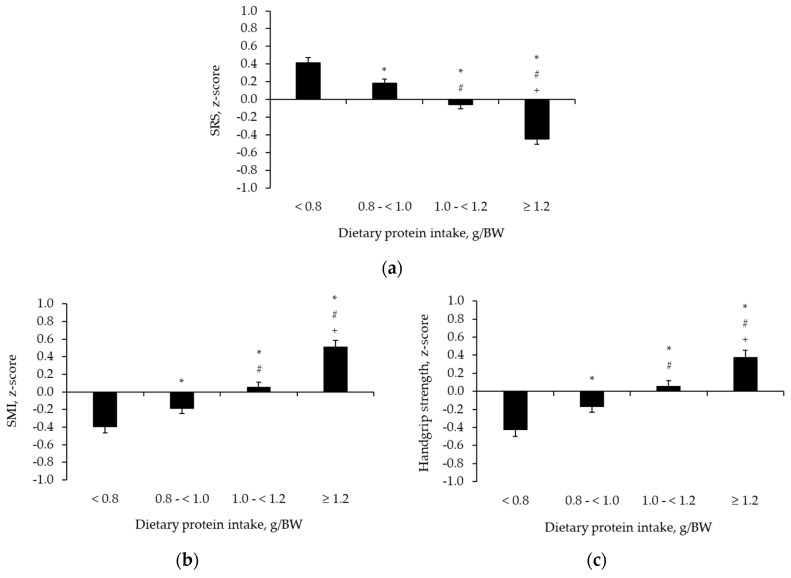
While an adequate protein intake is important for the maintenance of muscle mass during ageing, the amount and source of protein necessary for optimal prevention of sarcopenia remains to be determined. The present study aimed to investigate the influence of the amount and source of dietary proteins on sarcopenia risk in a cohort of 65-79-year-old European adults within the frame of the NU-AGE study. A total of 986 participants were included in the analysis. Skeletal muscle index (SMI), assessed by dual-energy X-ray absorptiometry (DXA), and handgrip strength (HG) were employed to create a continuous sex-specific sarcopenia risk score (SRS). Total amount together with animal- and plant-derived sources of proteins were obtained from a 7-day food record. Differences in SRS were analysed across groups of total protein intake (<0.8 g/body weight (BW); 0.8-<1.0 g/BW; 1.0-<1.2 g/BW; and ≥1.2 g/BW). The association between SRS and the different sources of protein was assessed using isocaloric substitution models adjusted by demographic, medical, and lifestyle factors. A significant linear dose-response relationship was observed, with a lower SRS linked to higher protein intakes. Based on the isocaloric substitution modelling, a reduced SRS was observed when increasing plant protein to the detriment of animal protein, while holding total protein intake constant. Further, this result remained significant after stratifying the analysis by adherence to different levels of protein intake. Our findings suggest that older adults may benefit from increasing protein intakes above current recommendations. Besides total amount, protein source should be considered when promoting health dietary habits in older adults for the prevention of sarcopenia.
虽然足够的蛋白质摄入对于维持老年人的肌肉质量很重要,但预防肌肉减少症所需的蛋白质的量和来源仍有待确定。本研究旨在调查在 NU-AGE 研究中,65-79 岁的欧洲成年人的饮食蛋白质的量和来源对肌肉减少症风险的影响。共有 986 名参与者被纳入分析。采用双能 X 射线吸收法(DXA)评估骨骼肌指数(SMI)和手握力(HG),以创建连续的性别特异性肌肉减少症风险评分(SRS)。总蛋白量以及动物和植物来源的蛋白质均从 7 天的食物记录中获得。通过比较总蛋白摄入量不同的组(<0.8 g/体重(BW);0.8-<1.0 g/BW;1.0-<1.2 g/BW;≥1.2 g/BW)来分析 SRS 的差异。使用调整了人口统计学、医学和生活方式因素的等热量替代模型来评估 SRS 与不同来源的蛋白质之间的关系。观察到显著的线性剂量反应关系,随着蛋白质摄入量的增加,SRS 降低。基于等热量替代模型,当在保持总蛋白摄入量不变的情况下,用植物蛋白代替动物蛋白时,SRS 降低。此外,在根据不同的蛋白质摄入量水平对分析进行分层后,该结果仍然具有统计学意义。我们的研究结果表明,老年人可能受益于增加蛋白质的摄入量超过目前的建议。除了总蛋白量外,在促进老年人健康饮食习惯以预防肌肉减少症时,还应考虑蛋白质来源。