School of Health Sciences, Örebro University, 702 81 Örebro, Sweden.
Epidemiology and Global Health, Umeå University, 901 87 Umeå, Sweden.
Nutrients. 2021 Aug 16;13(8):2813. doi: 10.3390/nu13082813.
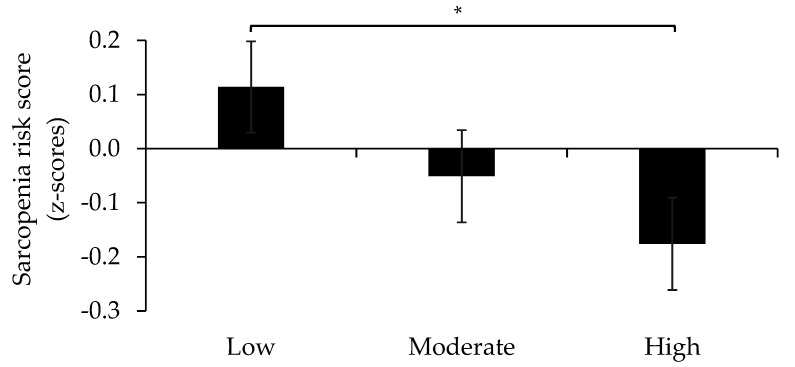
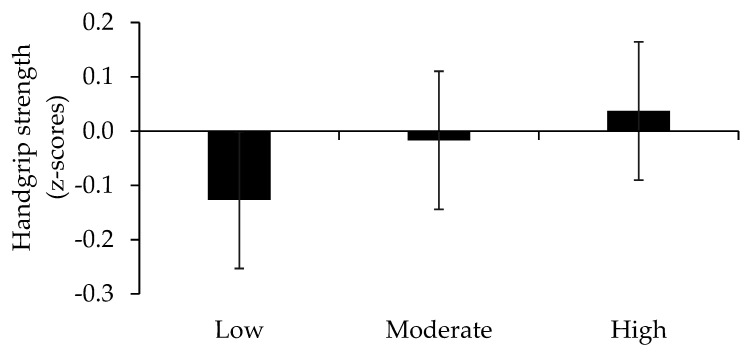
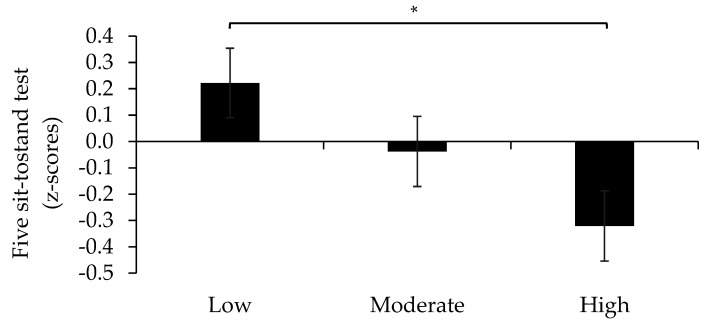
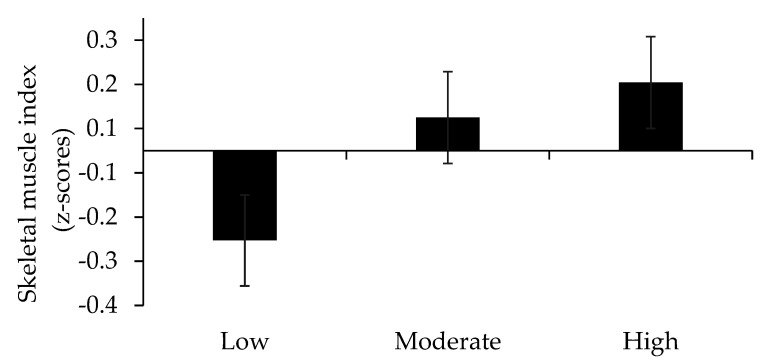
Healthy Diet and physical activity may play important roles in the maintenance of muscle health during aging. The aim of the present study was to explore the impact of adherence to healthy dietary patterns on sarcopenia risk in a sample of physically active older men and women, while considering adherence to guidelines on muscle strengthening activities (MSA) and protein intake. Based on a sample of 191 physically active men and women (65-70 years), dietary intake was assessed using a 90-items food-frequency-questionnaire (FFQ) and Healthy Diet Score (HDS) was calculated. Physical activity was assessed by accelerometry and self-report. A sarcopenia risk score (SRS) was derived based on three indicators of muscle health: muscle mass was assessed using bioelectrical impedance and handgrip strength and 5 times sit-to-stand (5-STS) were determined by standardized procedures. Analysis of covariance (ANCOVA) was used to examine differences in SRS and its components across sex-specific tertiles of HDS, with adjustments for covariates including total energy intake, protein intake and MSA. A significant main effect ( < 0.05) of HDS on SRS was observed, where those belonging to the highest HDS tertile had lower SRS compared to those in the lowest tertile. A corresponding significant effect was observed for 5-STS performance, with better performance in those with the highest HDS adherence compared to those with the lowest. The present study supports guidelines emphasizing diet quality beyond amounts of macro- and micronutrients in the prevention of age-related deterioration of muscle health. Importantly, the benefits from healthy dietary patterns are evident in older adults who already adhere to guidelines for health-enhancing physical activity.
健康饮食和身体活动可能在衰老过程中对维持肌肉健康发挥重要作用。本研究旨在探讨在考虑肌肉强化活动(MSA)和蛋白质摄入量指南的情况下,坚持健康饮食模式对活跃的老年男女肌肉减少症风险的影响。本研究基于 191 名活跃的男性和女性(65-70 岁)样本,使用 90 项食物频率问卷(FFQ)评估饮食摄入,计算健康饮食评分(HDS)。通过加速度计和自我报告评估身体活动。根据肌肉健康的三个指标得出肌肉减少症风险评分(SRS):使用生物电阻抗和握力评估肌肉质量,通过标准化程序确定 5 次坐站起(5-STS)。协方差分析(ANCOVA)用于检验 HDS 性别特异性三分位组之间 SRS 及其成分的差异,调整了总能量摄入、蛋白质摄入和 MSA 等协变量。HDS 对 SRS 有显著的主效应(<0.05),HDS 最高三分位组的 SRS 低于最低三分位组。5-STS 表现也存在相应的显著影响,与最低 HDS 依从性组相比,最高 HDS 依从性组的表现更好。本研究支持强调饮食质量而非宏量和微量营养素数量的指南,以预防与年龄相关的肌肉健康恶化。重要的是,健康饮食模式的益处在已经遵循健康促进身体活动指南的老年人中是显而易见的。