Department of Medical Biochemistry, Jessenius Faculty of Medicine in Martin, Comenius University in Bratislava, 036 01 Martin, Slovakia.
Biomedical Centre Martin, Jessenius Faculty of Medicine in Martin, Comenius University in Bratislava, 036 01 Martin, Slovakia.
Int J Mol Sci. 2020 Nov 24;21(23):8910. doi: 10.3390/ijms21238910.
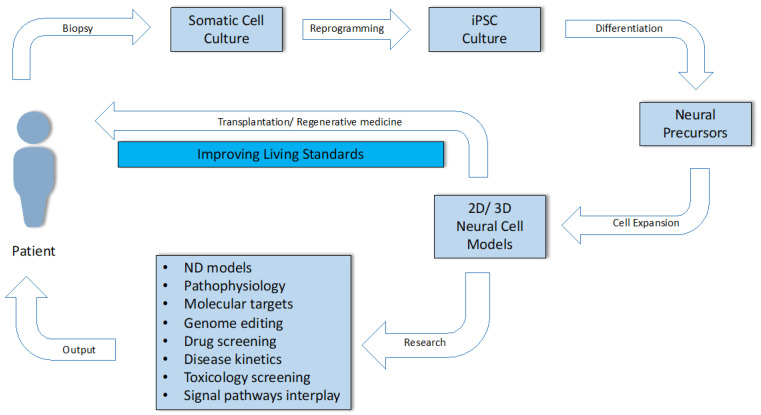
One of the greatest breakthroughs of regenerative medicine in this century was the discovery of induced pluripotent stem cell (iPSC) technology in 2006 by Shinya Yamanaka. iPSCs originate from terminally differentiated somatic cells that have newly acquired the developmental capacity of self-renewal and differentiation into any cells of three germ layers. Before iPSCs can be used routinely in clinical practice, their efficacy and safety need to be rigorously tested; however, iPSCs have already become effective and fully-fledged tools for application under in vitro conditions. They are currently routinely used for disease modeling, preparation of difficult-to-access cell lines, monitoring of cellular mechanisms in micro- or macroscopic scales, drug testing and screening, genetic engineering, and many other applications. This review is a brief summary of the reprogramming process and subsequent differentiation and culture of reprogrammed cells into neural precursor cells (NPCs) in two-dimensional (2D) and three-dimensional (3D) conditions. NPCs can be used as biomedical models for neurodegenerative diseases (NDs), which are currently considered to be one of the major health problems in the human population.
本世纪再生医学的最大突破之一是 2006 年山中伸弥(Shinya Yamanaka)发现诱导多能干细胞(iPSC)技术。iPS 细胞来源于终末分化的体细胞,这些体细胞新近获得了自我更新和分化为三个胚层任何细胞的发育能力。在 iPS 细胞常规应用于临床实践之前,需要对其疗效和安全性进行严格测试;然而,iPS 细胞已经成为在体外条件下应用的有效且成熟的工具。它们目前常用于疾病建模、难以获取的细胞系的制备、微观或宏观尺度下细胞机制的监测、药物测试和筛选、基因工程以及许多其他应用。本文简要综述了重编程过程以及随后在二维(2D)和三维(3D)条件下将重编程细胞分化和培养为神经前体细胞(NPC)的过程。NPC 可作为神经退行性疾病(NDs)的生物医学模型,这些疾病目前被认为是人类的主要健康问题之一。