PROmoting FITness and Health through Physical Activity Research Group (PROFITH), Sport and Health University Research Institute (iMUDS), University of Granada, 18007 Granada, Spain.
Department of Physical Education and Sport, Faculty of Sport Sciences, University of Granada, 18011 Granada, Spain.
Nutrients. 2020 Nov 29;12(12):3685. doi: 10.3390/nu12123685.
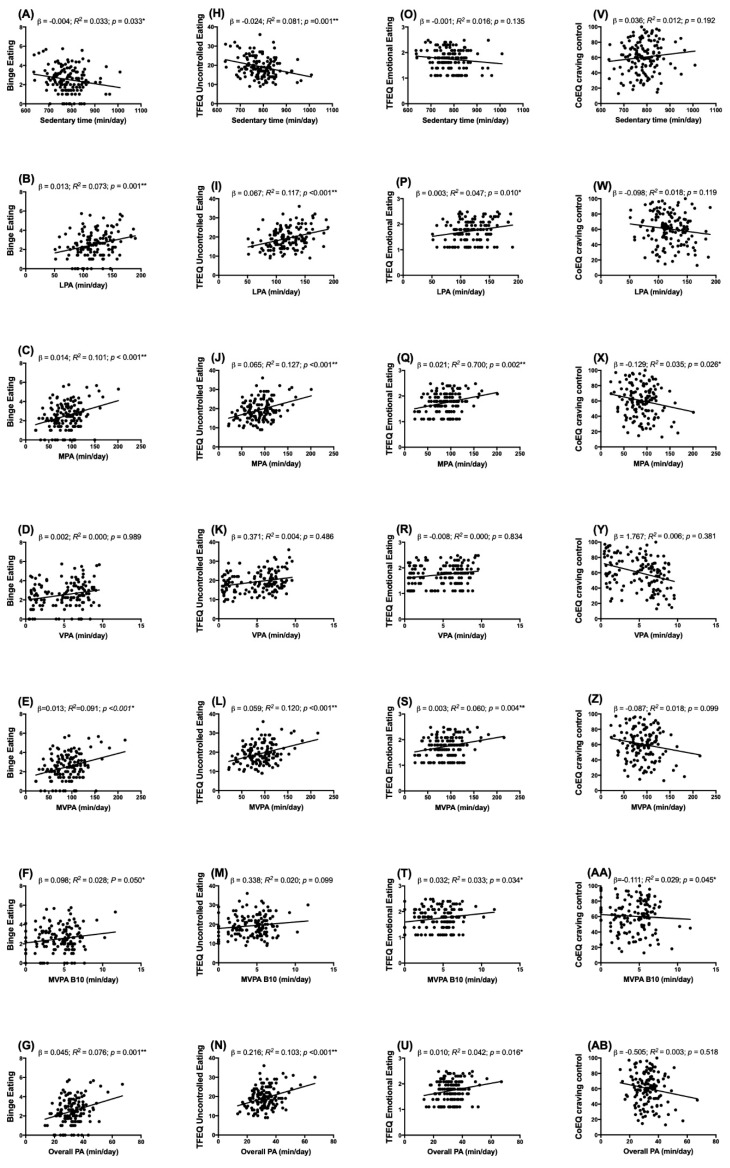
Regular physical activity (PA) is an important part of the treatment of several medical conditions, including overweight and obesity, in which there may be a weakened appetite control. Eating behaviour traits influence weight control and may be different in active and sedentary subjects. This paper reports the relationships between the time spent in sedentary behaviour and physical activity (PA) of different intensity, and eating behaviour traits in young, healthy adults. Additionally, it reports the results of a six-month-long, randomized, controlled trial to examine the effect of an exercise intervention on eating behaviour traits. A total of 139 young (22.06 ± 2.26 years) healthy adults (68.35% women) with a Body Mass Index (BMI) of 24.95 ± 4.57 kg/m were enrolled. Baseline assessments of habitual PA were made using wrist-worn triaxial accelerometers; eating behaviour traits were examined via the self-reported questionnaires: Binge Eating, Three-Factor Eating Questionnaire-R18 and Control of Eating Questionnaire. The subjects were then randomly assigned to one of three groups: control (usual lifestyle), moderate-intensity exercise (aerobic and resistance training 3¨C4 days/week at a heart rate equivalent to 60% of the heart rate reserve (HRres) for the aerobic component, and at 50% of the 1 repetition maximum (RM) for the resistance component), or vigorous-intensity exercise (the same training but at 80% HRres for half of the aerobic training, and 70% RM for the resistance training). At baseline, sedentary behaviour was inversely associated with binge eating ( -0.181, < 0.05) and with uncontrolled eating ( -0.286, = 0.001). Moderate PA (MPA) was inversely associated with craving control ( -0.188, < 0.05). Moderate-to-vigorous PA (MVPA) was directly associated with binge eating ( 0.302, < 0.001) and uncontrolled eating ( 0.346, < 0.001), and inversely associated with craving control ( -0.170, < 0.015). Overall, PA was directly associated with binge eating ( 0.275, = 0.001), uncontrolled eating ( 0.321, < 0.001) and emotional eating ( 0.204, < 0.05). Additionally, only emotional eating was modified by the intervention, increasing in the vigorous-intensity exercise group ( < 0.05). In summary, we observed that time spent in sedentary behaviour/PA of different intensity is associated with eating behaviour traits, especially binge eating in young adults. In contrast, the six-month exercise intervention did not lead to appreciable changes in eating behaviour traits.
定期进行身体活动(PA)是治疗超重和肥胖等几种医学病症的重要组成部分,这些病症可能存在食欲控制减弱的情况。进食行为特征会影响体重控制,并且在活跃和久坐的受试者中可能存在差异。本文报告了在年轻健康成年人中,不同强度的久坐行为和身体活动(PA)与进食行为特征之间的关系。此外,本文还报告了一项为期六个月的随机对照试验的结果,该试验旨在检查运动干预对进食行为特征的影响。共有 139 名年轻(22.06 ± 2.26 岁)健康成年人(68.35%为女性),BMI 为 24.95 ± 4.57 kg/m²,参与了本研究。使用佩戴在手腕上的三轴加速度计对习惯性 PA 进行了基线评估;通过自我报告的问卷评估了进食行为特征:暴食、三因素饮食问卷-R18 和饮食控制问卷。然后,将受试者随机分配到三个组之一:对照组(常规生活方式)、中等强度运动组(有氧运动和阻力训练,每周 3-4 天,运动强度相当于有氧成分心率储备的 60%(HRres),阻力成分的 50%的 1 次重复最大值(RM)),或高强度运动组(相同的训练,但有氧运动的一半为 80% HRres,阻力训练为 70% RM)。在基线时,久坐行为与暴食(-0.181,<0.05)和失控进食(-0.286,=0.001)呈负相关。中等 PA(MPA)与渴望控制呈负相关(-0.188,<0.05)。中等到剧烈的 PA(MVPA)与暴食(0.302,<0.001)和失控进食(0.346,<0.001)呈正相关,与渴望控制呈负相关(-0.170,<0.015)。总体而言,PA 与暴食(0.275,=0.001)、失控进食(0.321,<0.001)和情绪化进食(0.204,<0.05)呈正相关。此外,只有情绪化进食被干预改变,在高强度运动组中增加(<0.05)。总之,我们观察到,不同强度的久坐行为/PA 时间与进食行为特征有关,尤其是年轻人的暴食行为。相比之下,为期六个月的运动干预并没有导致进食行为特征的明显变化。