Starch-Jensen Thomas, Deluiz Daniel, Deb Sagar, Bruun Niels Henrik, Tinoco Eduardo Muniz Barretto
Department of Oral and Maxillofacial Surgery, Aalborg University Hospital, AalborgDenmark.
Department of Periodontology, Rio de Janeiro State University, Rio de JaneiroBrazil.
J Oral Maxillofac Res. 2020 Nov 30;11(3):e1. doi: 10.5037/jomr.2020.11301. eCollection 2020 Jul-Sep.
The aim of this systematic review was to test the hypothesis of no difference in complications and donor site morbidity following harvesting of autogenous bone graft from the ascending mandibular ramus compared with the chin region.
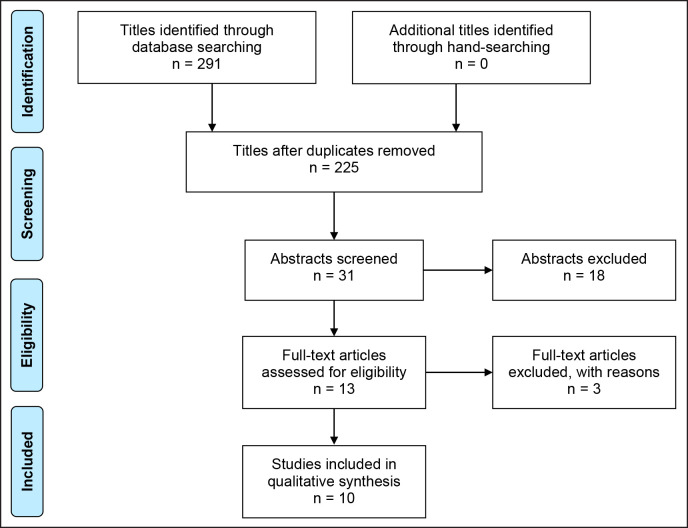
MEDLINE (PubMed), Embase and Cochrane Library search in combination with a hand-search of relevant journals was conducted including human studies published in English through June 26, 2020. Randomized and controlled trials were included. Outcome measures included pain, infection, mucosal dehiscence, altered sensation or vitality of adjacent tooth/teeth, neurosensory disturbances and patient-reported outcome measures. Risk of bias was assessed by Cochrane risk of bias tool and Newcastle-Ottawa Scale.
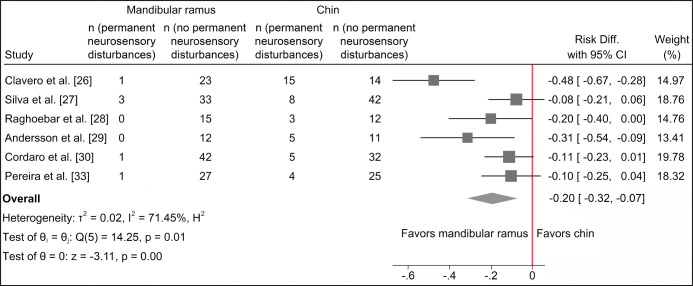
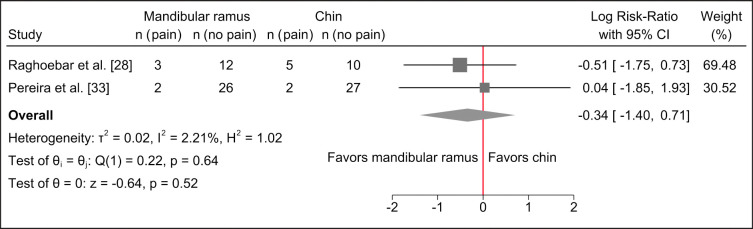
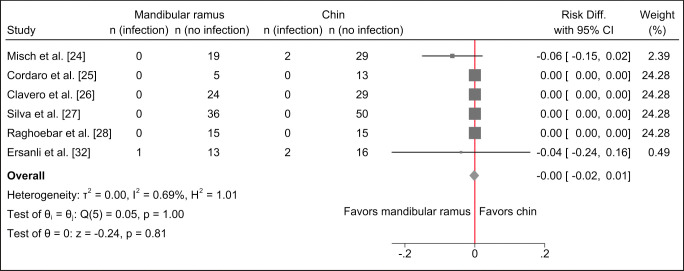
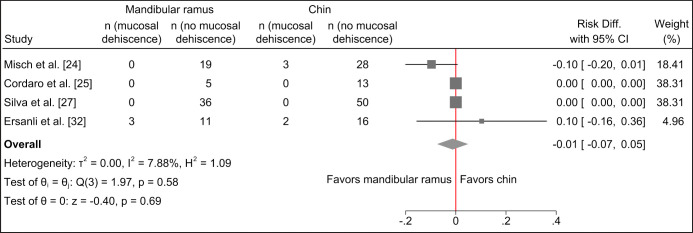
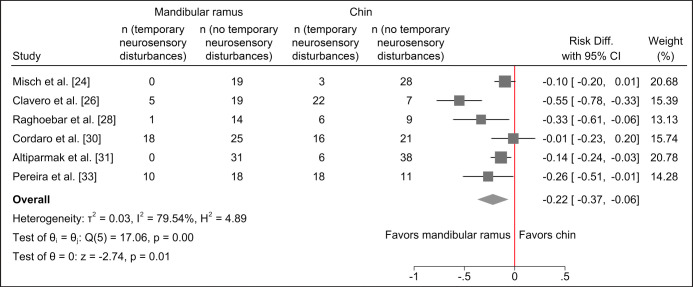
Ten controlled trials of high-quality fulfilled inclusion criteria. Risk of infection and mucosal dehiscence seems to be comparable with the two treatment modalities. However, harvesting from the chin seems to be associated with increased risk of pain, altered sensation or loss of tooth vitality, and neurosensory disturbances. Willingness to undergo the same treatment again was reported with both treatment modalities, but significant higher satisfaction, lower discomfort and acceptance of the surgical procedure was reported following harvesting from the ascending mandibular ramus.
The hypothesis was rejected due to higher prevalence and severity of complications and donor site morbidity following harvesting of autogenous bone graft from the chin region. Dissimilar evaluation methods and various methodological confounding factors posed serious restrictions for literature review in a quantitative systematic manner. Conclusions drawn from results of this systematic review should therefore be interpreted with caution.
本系统评价的目的是检验以下假设:与下颌升支相比,从颏部采集自体骨移植后的并发症和供区发病率无差异。
检索MEDLINE(PubMed)、Embase和Cochrane图书馆,并结合对相关期刊的手工检索,纳入2020年6月26日前发表的英文人体研究。纳入随机对照试验。观察指标包括疼痛、感染、黏膜裂开、相邻牙齿感觉或活力改变、神经感觉障碍以及患者报告的观察指标。采用Cochrane偏倚风险工具和纽卡斯尔-渥太华量表评估偏倚风险。
十项高质量的对照试验符合纳入标准。两种治疗方式的感染风险和黏膜裂开风险似乎相当。然而,从颏部采集似乎与疼痛风险增加、牙齿感觉改变或活力丧失以及神经感觉障碍有关。两种治疗方式均有再次接受相同治疗的意愿,但在下颌升支采集后,患者对手术的满意度显著更高,不适感更低,接受度更高。
由于从颏部采集自体骨移植后的并发症发生率和严重程度以及供区发病率更高,该假设被否定。不同的评估方法和各种方法学混杂因素对定量系统文献综述造成了严重限制。因此,应谨慎解释本系统评价结果得出的结论。