• 文献检索
  • 文档翻译
  • 深度研究
  • 学术资讯
  • Suppr Zotero 插件Zotero 插件
  • 邀请有礼
  • 套餐&价格
  • 历史记录
应用&插件
Suppr Zotero 插件Zotero 插件浏览器插件Mac 客户端Windows 客户端微信小程序
定价
高级版会员购买积分包购买API积分包
服务
文献检索文档翻译深度研究API 文档MCP 服务
关于我们
关于 Suppr公司介绍联系我们用户协议隐私条款
关注我们

Suppr 超能文献

核心技术专利:CN118964589B侵权必究
粤ICP备2023148730 号-1Suppr @ 2026

文献检索

告别复杂PubMed语法,用中文像聊天一样搜索,搜遍4000万医学文献。AI智能推荐,让科研检索更轻松。

立即免费搜索

文件翻译

保留排版,准确专业,支持PDF/Word/PPT等文件格式,支持 12+语言互译。

免费翻译文档

深度研究

AI帮你快速写综述,25分钟生成高质量综述,智能提取关键信息,辅助科研写作。

立即免费体验

遗传和表型评估与青少年饮食失调行为和共病精神健康问题发病的相关性。

Association of Genetic and Phenotypic Assessments With Onset of Disordered Eating Behaviors and Comorbid Mental Health Problems Among Adolescents.

机构信息

Section of Eating Disorders, Department of Psychological Medicine, King's College London, London, United Kingdom.

Centre for Population Neuroscience and Precision Medicine, Institute of Psychiatry, Psychology & Neuroscience, SGDP Centre, King's College London, London, United Kingdom.

出版信息

JAMA Netw Open. 2020 Dec 1;3(12):e2026874. doi: 10.1001/jamanetworkopen.2020.26874.

DOI:10.1001/jamanetworkopen.2020.26874
PMID:33263759
原文链接:https://pmc.ncbi.nlm.nih.gov/articles/PMC7711322/
Abstract

IMPORTANCE

Eating disorders are serious mental disorders with increasing prevalence. Without early identification and treatment, eating disorders may run a long-term course.

OBJECTIVE

To characterize any associations among disordered eating behaviors (DEBs) and other mental health disorders and to identify early associations with the development of symptoms over time.

DESIGN, SETTING, AND PARTICIPANTS: This multicenter, population-based, longitudinal cohort study used data from baseline (collected in 2010), follow-up 1 (collected in 2012), and follow-up 2 (collected in 2015) of the IMAGEN Study, which included adolescents recruited from 8 European sites. The present study assessed data from 1623 healthy adolescents, aged 14 years at baseline, recruited from high schools. Data analyses were performed from January 2018 to September 2019.

MAIN OUTCOMES AND MEASURES

Body mass index (BMI), mental health symptoms, substance use behaviors, and personality variables were investigated as time-varying associations of DEBs (dieting, binge eating, and purging) or change in BMI over time. Polygenic risk scores were calculated to investigate genetic contributions associated with BMI, attention-deficit/hyperactivity disorder (ADHD) and neuroticism to DEBs.

RESULTS

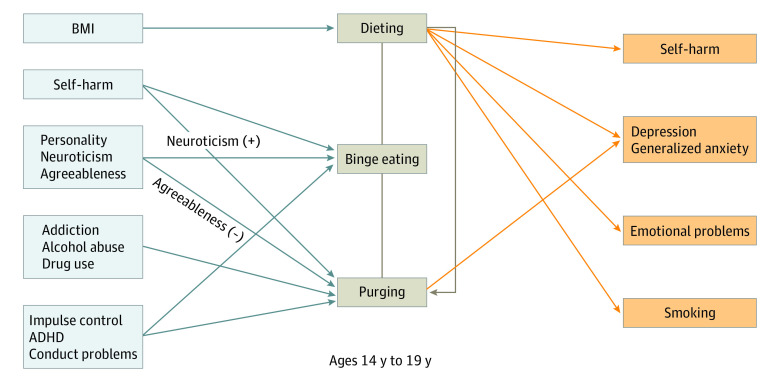
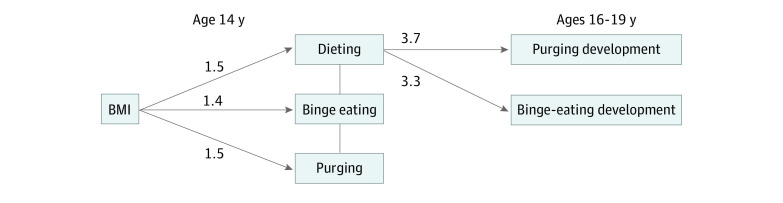
In this cohort study of 1623 adolescents (829 girls [51.1%]) recruited at a mean (SD) age of 14.5 (0.4) years and followed up at ages 16 and 19 years, 278 adolescents (17.1%) reported binge eating, 334 adolescents (20.6%) reported purging, and 356 adolescents (21.9%) reported dieting at 14, 16, or 19 years. Among the precursors of DEBs, high BMI was associated with future dieting (OR, 3.44; 95% CI, 2.09-5.65). High levels of neuroticism (OR, 1.04; 95% CI, 1.01-1.06), conduct problems (OR, 1.41; 95% CI, 1.17-1.69), and deliberate self-harm (OR, 2.18; 95% CI, 1.37-3.45) were associated with future binge eating. Low agreeableness (OR, 0.95; 95% CI, 0.92-0.97), deliberate self-harm (OR, 2.59; 95% CI, 1.69-3.95), conduct problems (OR, 1.42; 95% CI, 1.20-1.68), alcohol misuse (OR, 1.31; 95% CI, 1.10-1.54), and drug abuse (OR, 2.91; 95% CI, 1.78-4.74) were associated with future purging. Polygenetic risk scores for BMI were associated with dieting (at 14 years: OR, 1.27; lower bound 95% CI, 1.08; at 16 years: OR, 1.38; lower bound 95% CI, 1.17); ADHD, with purging (at 16 years: OR, 1.25; lower bound 95% CI, 1.08; at 19 years, OR, 1.23; lower bound 95% CI, 1.06); and neuroticism, with binge eating (at 14 years: OR, 1.32; lower bound 95% CI, 1.11; at 16 years: OR, 1.24; lower bound 95% CI, 1.06), highlighting distinct etiologic overlaps between these traits. The DEBs predated other mental health problems, with dieting at 14 years associated with future symptoms of depression (OR, 2.53; 95% CI, 1.56-4.10), generalized anxiety (OR, 2.27; 95% CI, 1.14-4.51), deliberate self-harm (OR, 2.10; 95% CI, 1.51-4.24), emotional problems (OR, 1.24; 95% CI, 1.08-1.43), and smoking (OR, 2.16; 95% CI, 1.36-3.48). Purging at 14 years was also associated with future depression (OR, 2.87; 95% CI, 1.69-5.01) and anxiety (OR, 2.48; 95% CI, 1.49-4.12) symptoms.

CONCLUSIONS AND RELEVANCE

The findings of this study delineate temporal associations and shared etiologies among DEBs and other mental health disorders and emphasize the potential of genetic and phenotypical assessments of obesity, behavioral disorders, and neuroticism to improve early and differential diagnosis of eating disorders.

摘要

重要性

饮食失调是一种日益普遍的严重精神障碍。如果不早期识别和治疗,饮食失调可能会长期存在。

目的

描述饮食障碍行为(DEB)与其他精神健康障碍之间的任何关联,并确定随着时间的推移与症状发展相关的早期关联。

设计、地点和参与者:这项多中心、基于人群的纵向队列研究使用了 IMAGEN 研究的基线(2010 年收集)、随访 1(2012 年收集)和随访 2(2015 年收集)的数据,该研究包括从 8 个欧洲地点招募的青少年。本研究评估了 1623 名年龄在 14 岁的健康青少年的数据,他们从高中招募。数据分析于 2018 年 1 月至 2019 年 9 月进行。

主要结果和措施

将 BMI、心理健康症状、物质使用行为和人格变量作为时间相关的 DEB(节食、暴食和催吐)或 BMI 随时间的变化进行研究。计算多基因风险评分以调查与 BMI、注意缺陷多动障碍(ADHD)和神经质相关的遗传贡献,以研究 DEB。

结果

在这项对 1623 名青少年(829 名女孩[51.1%])的队列研究中,平均(SD)年龄为 14.5(0.4)岁,随访年龄为 16 岁和 19 岁,278 名青少年(17.1%)报告暴食,334 名青少年(20.6%)报告催吐,356 名青少年(21.9%)在 14、16 或 19 岁时报告节食。在 DEB 的前身中,高 BMI 与未来节食有关(OR,3.44;95%CI,2.09-5.65)。高神经质(OR,1.04;95%CI,1.01-1.06)、品行问题(OR,1.41;95%CI,1.17-1.69)和故意自残(OR,2.18;95%CI,1.37-3.45)与未来暴食有关。低宜人性(OR,0.95;95%CI,0.92-0.97)、故意自残(OR,2.59;95%CI,1.69-3.95)、品行问题(OR,1.42;95%CI,1.20-1.68)、酒精滥用(OR,1.31;95%CI,1.10-1.54)和药物滥用(OR,2.91;95%CI,1.78-4.74)与未来催吐有关。BMI 的多基因风险评分与节食有关(14 岁:OR,1.27;95%CI,1.08-1.48;16 岁:OR,1.38;95%CI,1.17);ADHD 与催吐有关(16 岁:OR,1.25;95%CI,1.08-1.48;19 岁:OR,1.23;95%CI,1.06);神经质与暴食有关(14 岁:OR,1.32;95%CI,1.11-1.11;16 岁:OR,1.24;95%CI,1.06),突出了这些特征之间明显的重叠病因。DEB 先于其他精神健康问题,14 岁时的节食与未来抑郁(OR,2.53;95%CI,1.56-4.10)、广泛性焦虑(OR,2.27;95%CI,1.14-4.51)、故意自残(OR,2.10;95%CI,1.51-4.24)、情绪问题(OR,1.24;95%CI,1.08-1.43)和吸烟(OR,2.16;95%CI,1.36-3.48)有关。14 岁时的催吐也与未来的抑郁(OR,2.87;95%CI,1.69-5.01)和焦虑(OR,2.48;95%CI,1.49-4.12)症状有关。

结论和相关性

本研究的结果描绘了 DEB 与其他精神健康障碍之间的时间关联和共同病因,并强调了肥胖、行为障碍和神经质的遗传和表型评估对改善饮食失调的早期和鉴别诊断的潜力。
https://cdn.ncbi.nlm.nih.gov/pmc/blobs/6b77/7711322/7a9ca26f0bda/jamanetwopen-e2026874-g002.jpg
https://cdn.ncbi.nlm.nih.gov/pmc/blobs/6b77/7711322/c6be6ec1da95/jamanetwopen-e2026874-g001.jpg
https://cdn.ncbi.nlm.nih.gov/pmc/blobs/6b77/7711322/7a9ca26f0bda/jamanetwopen-e2026874-g002.jpg
https://cdn.ncbi.nlm.nih.gov/pmc/blobs/6b77/7711322/c6be6ec1da95/jamanetwopen-e2026874-g001.jpg
https://cdn.ncbi.nlm.nih.gov/pmc/blobs/6b77/7711322/7a9ca26f0bda/jamanetwopen-e2026874-g002.jpg

相似文献

1
Association of Genetic and Phenotypic Assessments With Onset of Disordered Eating Behaviors and Comorbid Mental Health Problems Among Adolescents.遗传和表型评估与青少年饮食失调行为和共病精神健康问题发病的相关性。
JAMA Netw Open. 2020 Dec 1;3(12):e2026874. doi: 10.1001/jamanetworkopen.2020.26874.
2
Development of Disordered Eating Behaviors and Comorbid Depressive Symptoms in Adolescence: Neural and Psychopathological Predictors.青少年饮食失调行为和共病抑郁症状的发展:神经和精神病理学预测因素。
Biol Psychiatry. 2021 Dec 15;90(12):853-862. doi: 10.1016/j.biopsych.2020.06.003. Epub 2020 Jun 10.
3
Night eating and night eating syndrome: associations with dysfunctional eating behaviors, mental health and quality-of-life measures in Australian adults.夜间进食与夜间进食综合征:与澳大利亚成年人功能失调的饮食行为、心理健康及生活质量指标的关联
Eat Weight Disord. 2025 Mar 13;30(1):24. doi: 10.1007/s40519-025-01732-5.
4
Disturbed eating behaviors in adolescents with type 1 diabetes. How to screen for yellow flags in clinical practice?1型糖尿病青少年的饮食行为紊乱。在临床实践中如何筛查警示信号?
Pediatr Diabetes. 2017 Aug;18(5):376-383. doi: 10.1111/pedi.12400. Epub 2016 Jun 30.
5
Adolescent Eating Disorders Predict Psychiatric, High-Risk Behaviors and Weight Outcomes in Young Adulthood.青少年饮食失调可预测青年期的精神疾病、高风险行为及体重状况。
J Am Acad Child Adolesc Psychiatry. 2015 Aug;54(8):652-659.e1. doi: 10.1016/j.jaac.2015.05.009. Epub 2015 Jun 5.
6
Distinct personality profiles associated with disease risk and diagnostic status in eating disorders.与进食障碍风险和诊断状况相关的不同人格特征。
J Affect Disord. 2024 Sep 1;360:146-155. doi: 10.1016/j.jad.2024.05.132. Epub 2024 May 27.
7
Polygenic risk for schizophrenia, disordered eating behaviours and body mass index in adolescents.青少年精神分裂症、饮食障碍和体重指数的多基因风险。
Br J Psychiatry. 2019 Jul;215(1):428-433. doi: 10.1192/bjp.2019.39. Epub 2019 Mar 6.
8
Disordered Eating Behaviors Among Italian Adolescents with Type 1 Diabetes: Exploring Relationships with Parents' Eating Disorder Symptoms, Externalizing and Internalizing Behaviors, and Body Image Problems.意大利 1 型糖尿病青少年的饮食失调行为:探讨与父母饮食失调症状、外化和内化行为以及身体意象问题的关系。
J Clin Psychol Med Settings. 2020 Dec;27(4):727-745. doi: 10.1007/s10880-019-09665-9.
9
Polygenic Scores and Networks of Psychopathology Symptoms.多基因分数与精神病理学症状网络。
JAMA Psychiatry. 2024 Sep 1;81(9):902-910. doi: 10.1001/jamapsychiatry.2024.1403.
10
Longitudinal associations between psychotic experiences and disordered eating behaviours in adolescence: a UK population-based study.青少年时期精神病体验与饮食失调行为之间的纵向关联:一项基于英国人群的研究。
Lancet Child Adolesc Health. 2018 Aug;2(8):591-599. doi: 10.1016/S2352-4642(18)30180-9. Epub 2018 Jun 22.

引用本文的文献

1
Eating behavior and sleep habit problems and their correlation with symptoms in children with ADHD comorbid with overweight or obesity.注意缺陷多动障碍合并超重或肥胖儿童的饮食行为、睡眠习惯问题及其与症状的相关性。
Child Adolesc Psychiatry Ment Health. 2025 Aug 31;19(1):99. doi: 10.1186/s13034-025-00954-w.
2
Measurement invariance of a brief disordered eating scale in a large sample of secondary school students in Canada.加拿大大量中学生中简短饮食失调量表的测量不变性
J Eat Disord. 2025 Jul 10;13(1):132. doi: 10.1186/s40337-025-01332-9.
3
Evaluating the Significance of Obesity or Excessive Weight in Various Mental Health Disorders: A Systematic Review.

本文引用的文献

1
Polygenic Score for Body Mass Index Is Associated with Disordered Eating in a General Population Cohort.体重指数的多基因评分与普通人群队列中的饮食失调有关。
J Clin Med. 2020 Apr 21;9(4):1187. doi: 10.3390/jcm9041187.
2
DSM-5 eating disorders among adolescents and young adults in Finland: A public health concern.《芬兰青少年和年轻成人的 DSM-5 饮食障碍:公共健康关注点》。
Int J Eat Disord. 2020 May;53(5):520-531. doi: 10.1002/eat.23236. Epub 2020 Jan 30.
3
The Association between ADHD and Obesity: Intriguing, Progressively More Investigated, but Still Puzzling.
评估肥胖或超重在各种精神健康障碍中的意义:一项系统综述。
Cureus. 2025 Jan 30;17(1):e78251. doi: 10.7759/cureus.78251. eCollection 2025 Jan.
4
Absent mindfulness: mediation analyses of the relationship between adverse childhood experiences and disordered eating among young adults.缺乏正念:对年轻人童年不良经历与饮食失调之间关系的中介分析。
Front Child Adolesc Psychiatry. 2023 May 26;2:1148273. doi: 10.3389/frcha.2023.1148273. eCollection 2023.
5
Relationships of eating behaviors with psychopathology, brain maturation and genetic risk for obesity in an adolescent cohort study.一项青少年队列研究中饮食行为与精神病理学、大脑成熟及肥胖遗传风险的关系
Nat Ment Health. 2025;3(1):58-70. doi: 10.1038/s44220-024-00354-7. Epub 2025 Jan 10.
6
Prevalence of Disordered Eating Behaviors Among Sexual and Gender Minority Youth Varies at the Intersection of Gender Identity and Race/Ethnicity.性取向和性别少数青年中饮食失调行为的患病率在性别认同与种族/族裔的交叉点上有所不同。
Int J Eat Disord. 2025 Mar;58(3):635-646. doi: 10.1002/eat.24352. Epub 2025 Jan 6.
7
Machine learning models for diagnosis and risk prediction in eating disorders, depression, and alcohol use disorder.用于饮食失调、抑郁症和酒精使用障碍诊断及风险预测的机器学习模型。
J Affect Disord. 2025 Jun 15;379:889-899. doi: 10.1016/j.jad.2024.12.053. Epub 2024 Dec 17.
8
The prospective relationship between anxiety symptoms and eating disorder symptoms among adolescents: a systematic review and meta-analysis of a bi-directional relationship.青少年焦虑症状与饮食失调症状之间的前瞻性关系:双向关系的系统评价和荟萃分析
Eur Child Adolesc Psychiatry. 2024 Nov 7. doi: 10.1007/s00787-024-02601-9.
9
Eating Problems Among Adolescent Boys and Girls Before and During the Covid-19 Pandemic.新冠疫情之前及期间青少年男孩和女孩的饮食问题
Int J Eat Disord. 2025 Jan;58(1):193-205. doi: 10.1002/eat.24314. Epub 2024 Oct 30.
10
Distinct personality profiles associated with disease risk and diagnostic status in eating disorders.与进食障碍风险和诊断状况相关的不同人格特征。
J Affect Disord. 2024 Sep 1;360:146-155. doi: 10.1016/j.jad.2024.05.132. Epub 2024 May 27.
注意力缺陷多动障碍与肥胖之间的关联:引人关注,研究日益深入,但仍令人困惑。
Brain Sci. 2019 Sep 27;9(10):256. doi: 10.3390/brainsci9100256.
4
Associations Between Attention-Deficit/Hyperactivity Disorder and Various Eating Disorders: A Swedish Nationwide Population Study Using Multiple Genetically Informative Approaches.注意缺陷多动障碍与各种饮食障碍之间的关联:一项使用多种遗传信息方法的瑞典全国性人群研究。
Biol Psychiatry. 2019 Oct 15;86(8):577-586. doi: 10.1016/j.biopsych.2019.04.036. Epub 2019 May 15.
5
Neural Correlates of Failed Inhibitory Control as an Early Marker of Disordered Eating in Adolescents.青少年饮食失调的早期标志物:抑制控制失败的神经相关性。
Biol Psychiatry. 2019 Jun 1;85(11):956-965. doi: 10.1016/j.biopsych.2019.01.027. Epub 2019 Mar 25.
6
Prevalence of eating disorders over the 2000-2018 period: a systematic literature review.2000-2018 年期间进食障碍的流行情况:系统文献回顾。
Am J Clin Nutr. 2019 May 1;109(5):1402-1413. doi: 10.1093/ajcn/nqy342.
7
Genetic risk, body mass index, and weight control behaviors: Unlocking the triad.遗传风险、体重指数和体重控制行为:解开三者之间的联系。
Int J Eat Disord. 2019 Jul;52(7):825-833. doi: 10.1002/eat.23083. Epub 2019 Apr 17.
8
Genetics of Eating Disorders: What the Clinician Needs to Know.饮食失调的遗传学:临床医生需要了解的内容。
Psychiatr Clin North Am. 2019 Mar;42(1):59-73. doi: 10.1016/j.psc.2018.10.007.
9
Examination of the shared genetic basis of anorexia nervosa and obsessive-compulsive disorder.神经性厌食症与强迫症共同遗传基础的研究
Mol Psychiatry. 2020 Sep;25(9):2036-2046. doi: 10.1038/s41380-018-0115-4. Epub 2018 Aug 7.
10
Meta-analysis of genome-wide association studies for neuroticism in 449,484 individuals identifies novel genetic loci and pathways.对 449484 个人的神经质进行全基因组关联研究的荟萃分析确定了新的遗传位点和途径。
Nat Genet. 2018 Jul;50(7):920-927. doi: 10.1038/s41588-018-0151-7. Epub 2018 Jun 25.