Department of Biological and Biochemical Sciences, Faculty of Chemical Technology, University of Pardubice, Studentská 573, 532 10 Pardubice, Czech Republic.
Department of Analytical Chemistry, Faculty of Chemical Technology, University of Pardubice, Studentská 573, 532 10 Pardubice, Czech Republic.
Molecules. 2020 Nov 30;25(23):5654. doi: 10.3390/molecules25235654.
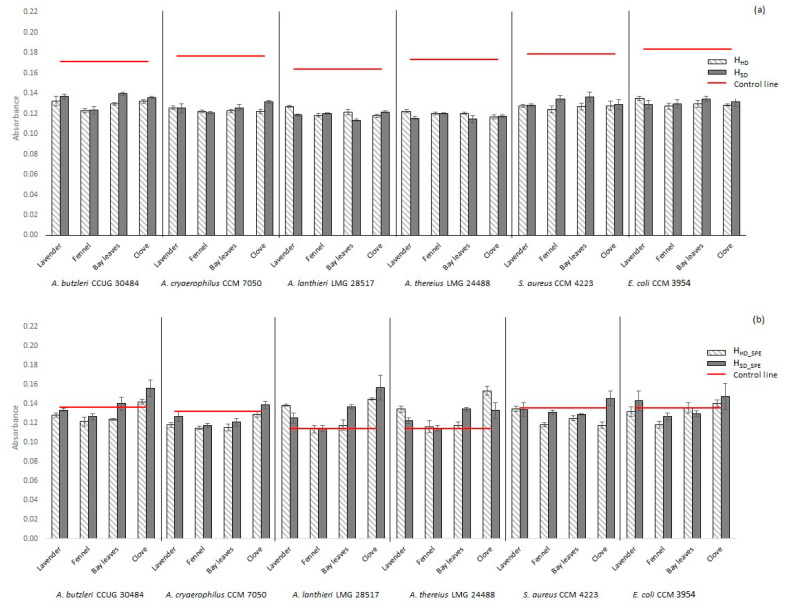
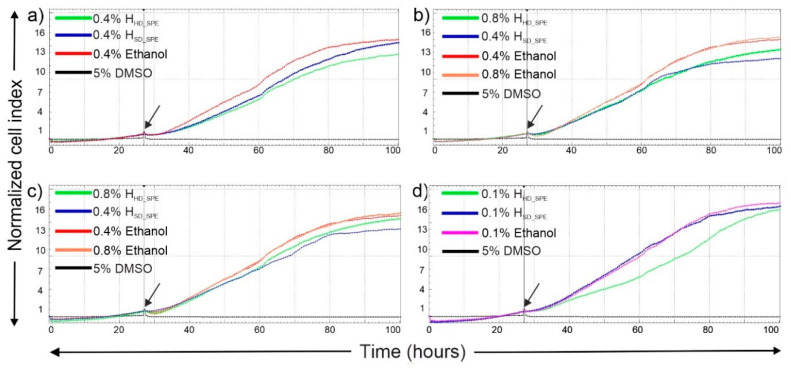
Hydrolates obtained via the hydrodistillation and steam distillation of Mill., L., Mill., and L. were analyzed by gas chromatography with flame ionization detector (GC-FID) and gas chromatography coupled to mass spectrometry (GC-MS). Additionally, the hydrolates were evaluated for antimicrobial activity (disk-diffusion and microdilution method), influence on biofilm formation (Christensen method) and cytotoxicity of concentrated hydrolates against human cell lines (A549) by xCELLigence system. Using chemical analysis, 48, 9, 13 and 33 different components were detected in lavender, clove, fennel and laurel hydrolates, respectively. Lavender hydrolate contained the largest proportion of 1,8-cineol, linalool furanoxide, and linalool. The main components of laurel hydrolate were 1,8-cineol, 4-terpineol and α-terpineol. Fenchone and estragole were the most abundant in fennel hydrolate, and eugenol and eugenyl acetate in clove hydrolate. Concentrated hydrolates showed significant antimicrobial activity. Clove hydrolate was among the most antimicrobially active agents, most preferably against . , with an inhibition zone up to 23.5 mm. Moreover, concentrated hydrolates did not show any cytotoxic effect again8 st human A549 cells. In the presence of the non-concentrated hydrolates, significantly reduced biofilm formation was observed; however, with concentrated clove hydrolate, there was an increase in biofilm formation, e.g., of . , . , and . . Research shows new findings about hydrolates that may be important in natural medicine or for preservation purposes.
通过水蒸气蒸馏和水蒸馏获得的薰衣草、丁香、茴香和月桂的水醇提物通过气相色谱-火焰离子化检测器(GC-FID)和气相色谱-质谱联用(GC-MS)进行分析。此外,还通过纸片扩散法和微量稀释法评估了水醇提物的抗菌活性,用 Christensen 法评估了其对生物膜形成的影响,并用 xCELLigence 系统评估了浓缩水醇提物对人肺腺癌细胞系(A549)的细胞毒性。通过化学分析,在薰衣草、丁香、茴香和月桂的水醇提物中分别检测到 48、9、13 和 33 种不同的成分。薰衣草水醇提物中含有最大比例的 1,8-桉叶素、芳樟醇呋喃氧化物和芳樟醇。月桂水醇提物的主要成分是 1,8-桉叶素、4-萜品醇和α-萜品醇。茴香水醇提物中含量最丰富的是葑酮和茴香脑,丁香水醇提物中含量最丰富的是丁香酚和乙酸丁香酯。浓缩水醇提物表现出显著的抗菌活性。丁香水醇提物是最具抗菌活性的物质之一,对 抑制效果最好,抑菌圈最大可达 23.5mm。此外,浓缩水醇提物对人 A549 细胞没有任何细胞毒性。在非浓缩水醇提物存在的情况下,观察到生物膜形成显著减少;然而,使用浓缩丁香水醇提物时,生物膜形成增加,例如 、 、 和 。研究表明,水醇提物具有新的发现,这可能对天然药物或保存目的很重要。