Medical Oncology 1, IRCCS Regina Elena National Cancer Institute, 00144 Rome, Italy.
Department of Diagnostics and Public Health, Section of Pathology, University and Hospital Trust of Verona, 37134 Verona, Italy.
Int J Mol Sci. 2020 Nov 22;21(22):8841. doi: 10.3390/ijms21228841.
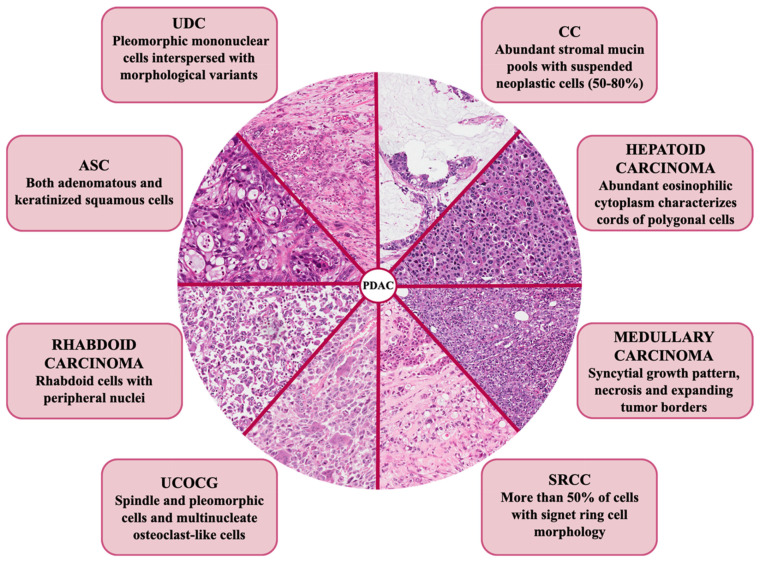
To date, pancreatic cancer is still one of the most lethal cancers in the world, mainly due to the lack of early diagnosis and personalized treatment strategies. In this context, the possibility and the opportunity of identifying genetic and molecular biomarkers are crucial to improve the feasibility of precision medicine. In 2019, the World Health Organization classified pancreatic ductal adenocarcinoma cancer (the most common pancreatic tumor type) into eight variants, according to specific histomorphological features. They are: colloid carcinoma, medullary carcinoma, adenosquamous carcinoma, undifferentiated carcinoma, including also rhabdoid carcinoma, undifferentiated carcinoma with osteoclast-like giant cells, hepatoid carcinoma, and signet-ring/poorly cohesive cells carcinoma. Interestingly, despite the very low incidence of these variants, innovative high throughput genomic/transcriptomic techniques allowed the investigation of both somatic and germline mutations in each specific variant, paving the way for their possible classification according also to specific alterations, along with the canonical mutations of pancreatic cancer (, , , ). In this review, we aim to report the current evidence about genetic/molecular profiles of pancreatic cancer variants, highlighting their role in therapeutic and clinical impact.
迄今为止,胰腺癌仍然是世界上最致命的癌症之一,主要是由于缺乏早期诊断和个性化治疗策略。在这种情况下,确定遗传和分子生物标志物的可能性和机会对于提高精准医学的可行性至关重要。2019 年,世界卫生组织根据特定的组织形态学特征,将胰腺导管腺癌(最常见的胰腺肿瘤类型)分为八种变体。它们是:胶样癌、髓样癌、腺鳞癌、未分化癌,包括横纹肌样癌、伴有破骨样巨细胞的未分化癌、肝样癌和印戒/黏附不良细胞癌。有趣的是,尽管这些变体的发病率非常低,但创新的高通量基因组/转录组技术允许对每种特定变体中的体细胞和种系突变进行研究,为根据特定的改变以及胰腺癌的经典突变(KRAS、TP53、CDKN2A、SMAD4)对其进行可能的分类铺平了道路。在这篇综述中,我们旨在报告关于胰腺肿瘤变体的遗传/分子特征的最新证据,强调它们在治疗和临床影响中的作用。