Lydia Becker Institute of Immunology and Inflammation University of Manchester and Royal Manchester Children's Hospital NHS Foundation Trust, Manchester, United Kingdom.
Food Allergy Pros LLC, Chicago, IL, United States of America.
PLoS One. 2020 Dec 3;15(12):e0241648. doi: 10.1371/journal.pone.0241648. eCollection 2020.
Food allergy is documented to result in considerable morbidity, negative impact on quality of life, and substantial medical care costs. Although anecdotal data suggest widely varying practices in the diagnosis and management of food allergies, the diversity and relative frequency of these practices have not been documented.
A questionnaire was developed evaluating allergists' management approaches of individuals with peanut allergy (PA) in Germany (DE), France (FR), and the United Kingdom (UK).
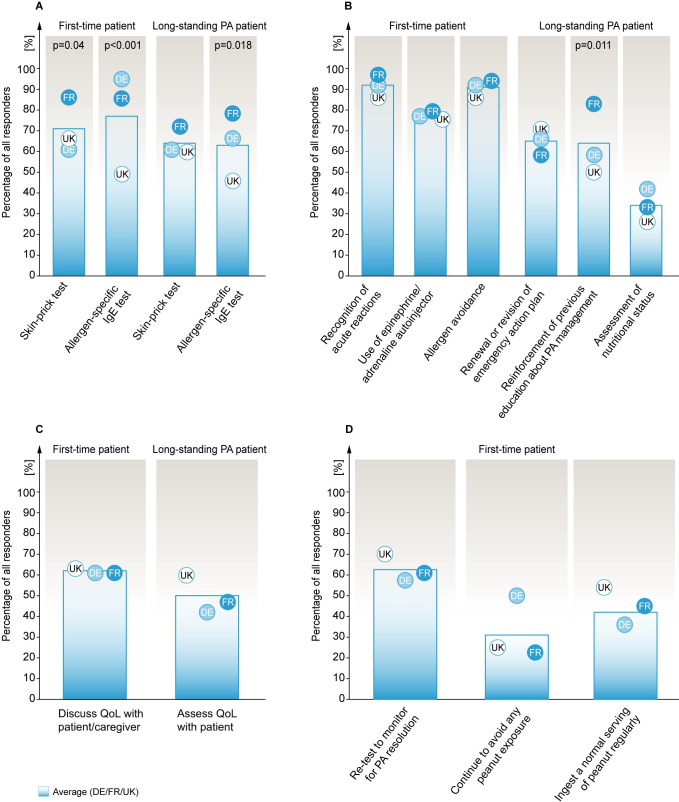
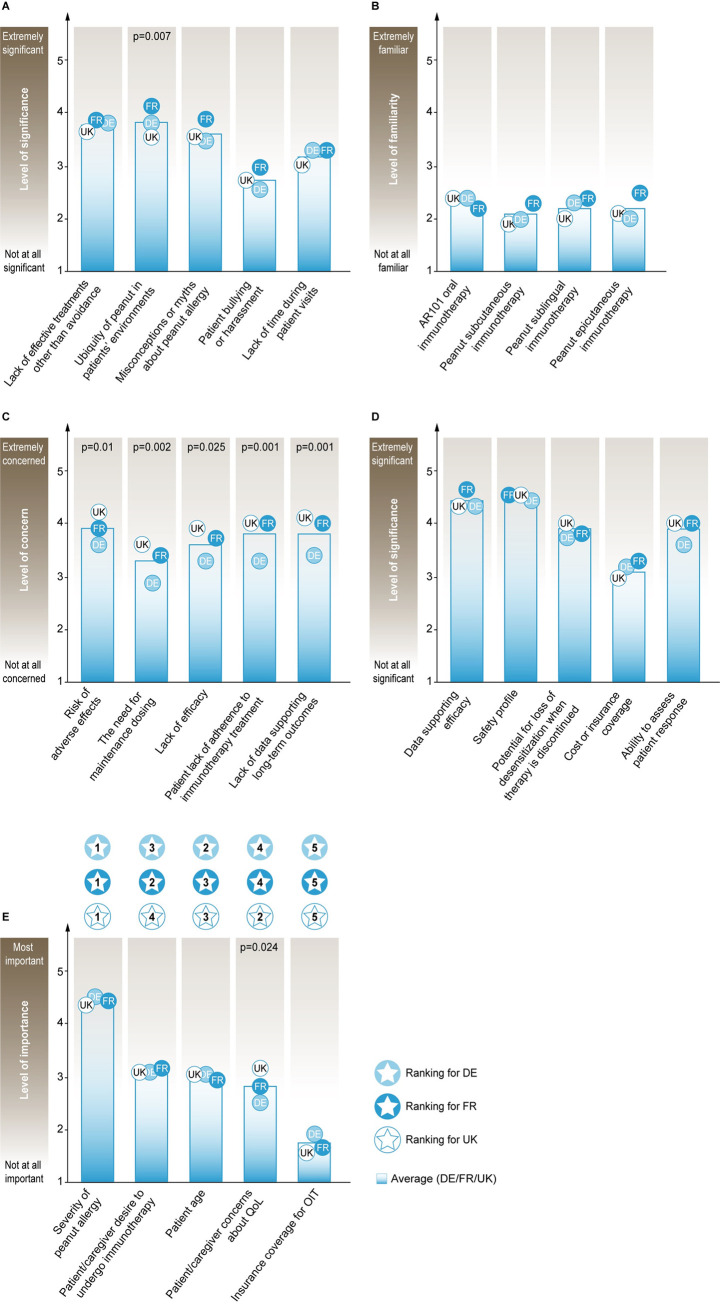
Here, we report the survey results from a total of 109 allergists from DE, FR and the UK. They reported to confirm PA at initial diagnosis using skin prick test (≥60%), while allergists from DE and FR reported using allergen-specific IgE testing more (>86%) compared to the UK (<50%). At initial diagnosis, oral food challenge was used less in DE (13%) and FR (14%) and very rarely in the UK (3%) to confirm diagnosis. Recognition of acute reactions, use of adrenaline auto-injectors and allergen avoidance were reported to be discussed with the patient/caregiver at the initial office visit by most allergists (>75%). Half of the responders reported assessing the patient's quality of life. 63% allergists reported retesting for PA resolution at a later date, with 45% allergists indicated to recommend ingestion of a normal serving of peanut regularly upon resolution. Lack of effective PA treatment was reported to be a 'very significant' barrier for optimal PA treatment, with allergists being less than 'moderately familiar' with data from clinical trials testing new treatments options for PA. Lastly, allergists stated that the severity of patient's PA ranked as the most important factor in their decision to recommend oral immunotherapy for PA treatment.
This survey provides essential insights into the practice of allergists and highlights some areas that would inform strategies for education and improving PA healthcare.
食物过敏会导致相当大的发病率、生活质量下降和大量医疗费用。尽管轶事数据表明,食物过敏的诊断和管理实践差异很大,但这些实践的多样性和相对频率尚未得到记录。
我们制定了一份问卷,评估德国(DE)、法国(FR)和英国(UK)的过敏专家对花生过敏(PA)患者的管理方法。
在此,我们报告了来自 DE、FR 和 UK 的 109 名过敏专家的调查结果。他们报告说,在初始诊断时使用皮肤点刺试验(≥60%)来确认 PA,而 DE 和 FR 的过敏专家报告说比 UK(<50%)更频繁地使用过敏原特异性 IgE 检测(>86%)。在初始诊断时,DE(13%)和 FR(14%)较少使用口服食物挑战,而 UK 则很少使用(3%)来确认诊断。大多数过敏专家(>75%)报告在首次就诊时与患者/照顾者讨论识别急性反应、使用肾上腺素自动注射器和过敏原回避的问题。一半的应答者报告评估患者的生活质量。63%的过敏专家报告在以后的日期重新测试 PA 是否缓解,45%的过敏专家表示在缓解后建议定期摄入正常份量的花生。缺乏有效的 PA 治疗被报告为最佳 PA 治疗的“非常重大”障碍,过敏专家对临床试验中测试新治疗 PA 选择的数据的熟悉程度低于“中度”。最后,过敏专家表示,患者 PA 的严重程度是他们决定是否推荐口服免疫疗法治疗 PA 的最重要因素。
这项调查提供了过敏专家实践的重要见解,并强调了一些可以为教育和改善 PA 医疗保健提供信息的领域。