Ecotron Européen de Montpellier, Univ Montpellier, CNRS, Montferrier sur Lez, France.
Environmental Biology, Centre for Environmental Sciences, Hasselt University, Diepenbeek, Belgium.
Glob Chang Biol. 2021 Apr;27(7):1387-1407. doi: 10.1111/gcb.15471. Epub 2021 Jan 28.
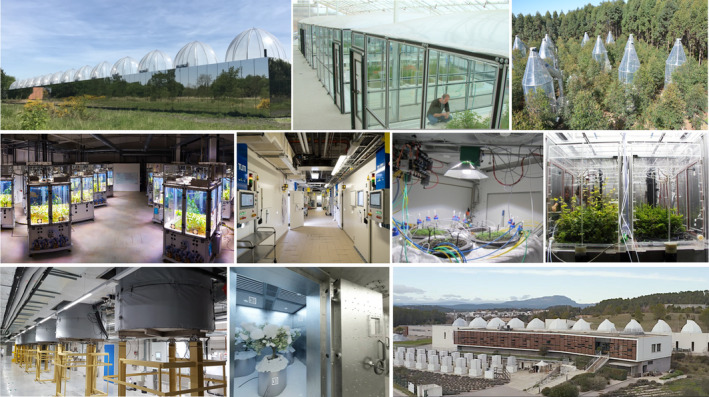
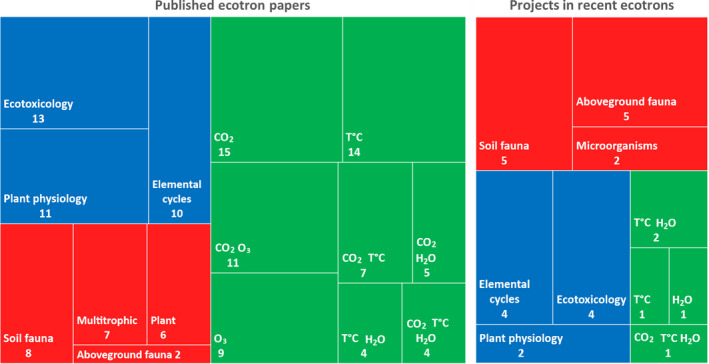
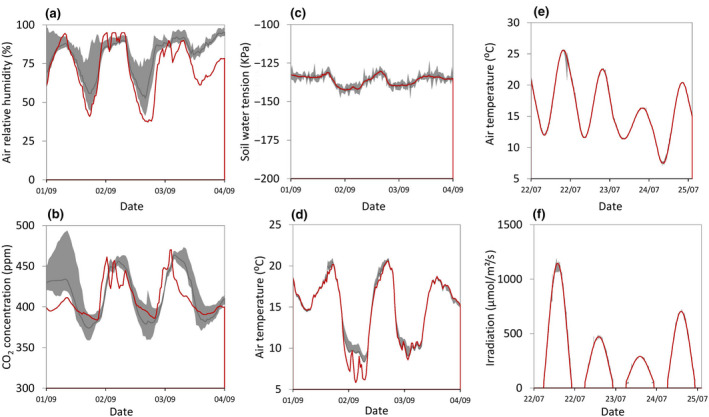
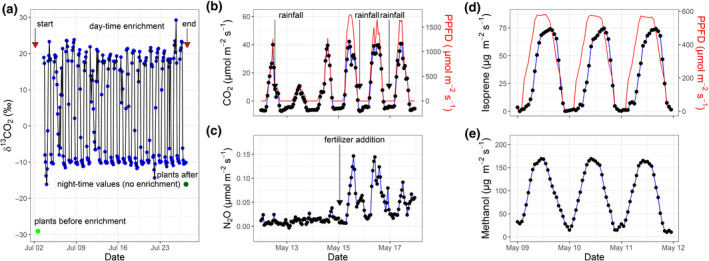
Ecosystems integrity and services are threatened by anthropogenic global changes. Mitigating and adapting to these changes require knowledge of ecosystem functioning in the expected novel environments, informed in large part through experimentation and modelling. This paper describes 13 advanced controlled environment facilities for experimental ecosystem studies, herein termed ecotrons, open to the international community. Ecotrons enable simulation of a wide range of natural environmental conditions in replicated and independent experimental units while measuring various ecosystem processes. This capacity to realistically control ecosystem environments is used to emulate a variety of climatic scenarios and soil conditions, in natural sunlight or through broad-spectrum lighting. The use of large ecosystem samples, intact or reconstructed, minimizes border effects and increases biological and physical complexity. Measurements of concentrations of greenhouse trace gases as well as their net exchange between the ecosystem and the atmosphere are performed in most ecotrons, often quasi continuously. The flow of matter is often tracked with the use of stable isotope tracers of carbon and other elements. Equipment is available for measurements of soil water status as well as root and canopy growth. The experiments ran so far emphasize the diversity of the hosted research. Half of them concern global changes, often with a manipulation of more than one driver. About a quarter deal with the impact of biodiversity loss on ecosystem functioning and one quarter with ecosystem or plant physiology. We discuss how the methodology for environmental simulation and process measurements, especially in soil, can be improved and stress the need to establish stronger links with modelling in future projects. These developments will enable further improvements in mechanistic understanding and predictive capacity of ecotron research which will play, in complementarity with field experimentation and monitoring, a crucial role in exploring the ecosystem consequences of environmental changes.
人为的全球变化威胁着生态系统的完整性和服务功能。减轻和适应这些变化需要了解生态系统在预期新环境中的功能,这在很大程度上需要通过实验和建模来实现。本文介绍了 13 个先进的受控环境生态系统实验设施,称为生态室,向国际社会开放。生态室能够在复制和独立的实验单元中模拟广泛的自然环境条件,同时测量各种生态系统过程。这种真实控制生态系统环境的能力用于模拟各种气候情景和土壤条件,包括自然光或广谱照明。使用大型生态系统样本,无论是完整的还是重建的,都可以最大限度地减少边界效应并增加生物和物理复杂性。大多数生态室都可以测量温室痕量气体的浓度及其与大气之间的净交换,通常是准连续的。物质的流动通常使用碳和其他元素的稳定同位素示踪剂进行追踪。设备可用于测量土壤水分状况以及根系和冠层生长。到目前为止,已经进行了强调研究多样性的实验。其中一半涉及全球变化,通常涉及一种以上驱动因素的操纵。约四分之一涉及生物多样性丧失对生态系统功能的影响,四分之一涉及生态系统或植物生理学。我们讨论了如何改进环境模拟和过程测量的方法,特别是在土壤方面,并强调了未来项目中需要与建模建立更强联系的必要性。这些发展将使生态室研究的机制理解和预测能力得到进一步提高,并在探索环境变化对生态系统的影响方面,与野外实验和监测相辅相成,发挥至关重要的作用。