Marcus Tobey Ann, Jeyapaul Shalini, David Sam Marconi, Jamkhandi Dimple, Cherian Anne George
Department of Obstetrics and Gynaecology, Christian Medical College and Hospital, Vellore, India
Department of Community Medicine, Christian Medical College and Hospital, Vellore, India
J Turk Ger Gynecol Assoc. 2020 Dec 4;21(4):236-242. doi: 10.4274/jtgga.galenos.2020.2020.0140.
Breech presentation is the most common fetal malpresentation at term, with an incidence of 3-4%. External cephalic version (ECV) is a procedure that can be offered to women with breech presentation beyond 36 weeks of gestation to convert it to cephalic presentation, reducing the risks of a vaginal breech delivery and the morbidities associated with caesarean section.
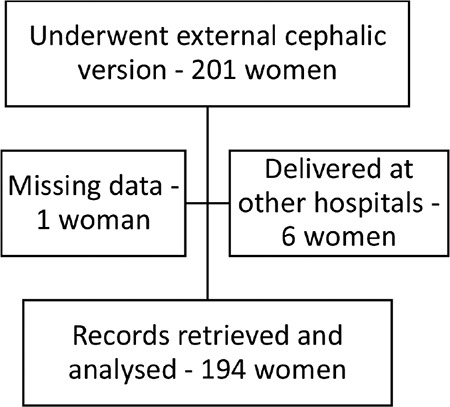
We retrospectively reviewed the records of women who underwent ECV between October 2012 and June 2020 with the objectives of determining the success rate of the procedure, the mode of delivery, the maternal and neonatal outcomes, periprocedural complications and their management.
Among the 200 women who underwent the procedure with a 64% success rate (128 women), there were 110 vaginal deliveries (56.7%) including five vaginal breech deliveries, and 84 women (43.2%) underwent caesarean section, which included 24 women who had successful ECV but needed emergency caesarean for other indications. There was no significant difference in the neonatal APGAR scores in those who had a successful ECV and those who did not. Only three women (1.5%) experienced any significant periprocedural complication.
These results suggest that ECV improves the possibility of a vaginal delivery with an overall low complication rate, reducing the neonatal risks associated with vaginal breech delivery and the maternal morbidity of a caesarean section. It may thus contribute to reducing the primary caesarean section rate, making it a useful intervention, especially in limited resource settings.
臀位是足月妊娠最常见的胎位异常,发生率为3%-4%。外倒转术(ECV)是一种可用于妊娠36周后臀位孕妇的操作,将臀位转为头位,降低阴道臀位分娩风险及剖宫产相关并发症。
我们回顾性分析了2012年10月至2020年6月期间接受外倒转术的孕妇记录,目的是确定该操作的成功率、分娩方式、母婴结局、围手术期并发症及其处理。
200例接受该操作的孕妇中,成功率为64%(128例),其中110例经阴道分娩(56.7%),包括5例阴道臀位分娩,84例(43.2%)接受剖宫产,其中24例外倒转术成功但因其他指征需急诊剖宫产。外倒转术成功与未成功的新生儿阿氏评分无显著差异。仅3例(1.5%)孕妇出现任何明显的围手术期并发症。
这些结果表明,外倒转术提高了阴道分娩的可能性,总体并发症发生率低,降低了阴道臀位分娩相关的新生儿风险及剖宫产的母体并发症。因此,它可能有助于降低首次剖宫产率,成为一种有用的干预措施,尤其是在资源有限的环境中。