Section of Hematology/Oncology, Department of Medicine and The University of Chicago Comprehensive Cancer Center and.
Department of Human Genetics, The University of Chicago, Chicago, IL.
Hematology Am Soc Hematol Educ Program. 2020 Dec 4;2020(1):219-227. doi: 10.1182/hematology.2020006910.
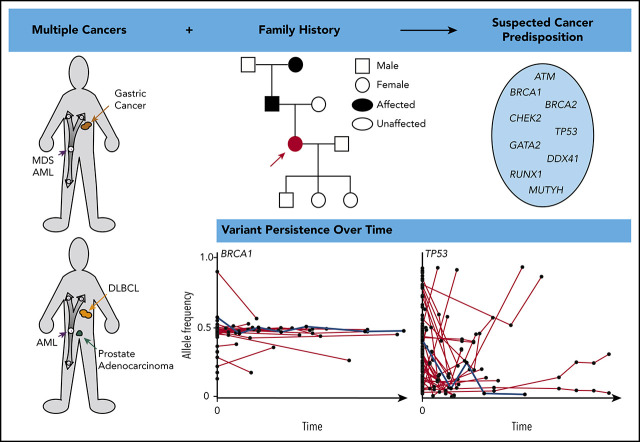
Next-generation sequencing (NGS) of bone marrow and peripheral blood increasingly guides clinical care in hematological malignancies. NGS data may help to identify single nucleotide variants, insertions/deletions, copy number variations, and translocations at a single time point, and repeated NGS testing allows tracking of dynamic changes in variants during the course of a patient's disease. Tumor cells used for NGS may contain germline, somatic, and clonal hematopoietic DNA alterations, and distinguishing the etiology of a variant may be challenging. We describe an approach using patient history, individual variant characteristics, and sequential NGS assays to identify potential germline variants. Our current criteria for identifying an individual likely to have a deleterious germline variant include a strong family history or multiple cancers in a single patient, diagnosis of a hematopoietic malignancy at a younger age than seen in the general population, variant allele frequency > 0.3 of a deleterious allele in a known germline predisposition gene, and variant persistence identified on clinical NGS panels, despite a change in disease state. Sequential molecular testing of hematopoietic specimens may provide insight into disease pathology, impact patient and family members' care, and potentially identify new cancer-predisposing risk alleles. Ideally, individuals should give consent at the time of NGS testing to receive information about potential germline variants and to allow future contact as research advances.
下一代测序(NGS)技术在血液系统恶性肿瘤的临床治疗中得到了广泛应用。NGS 数据可以帮助识别单个核苷酸变异、插入/缺失、拷贝数变异和易位,而且可以在单次检测中进行,重复的 NGS 检测可以跟踪患者疾病过程中变异的动态变化。用于 NGS 的肿瘤细胞可能包含胚系、体细胞和克隆性造血 DNA 改变,区分变异的病因可能具有挑战性。我们描述了一种使用患者病史、个体变异特征和连续 NGS 检测来识别潜在胚系变异的方法。我们目前识别个体可能具有有害胚系变异的标准包括:强烈的家族史或单个患者中的多种癌症、比一般人群更早诊断为造血恶性肿瘤、已知胚系易感性基因中有害等位基因的变异等位基因频率>0.3、以及在临床 NGS 面板上检测到的变异持续性,尽管疾病状态发生了变化。对造血标本进行连续分子检测可以深入了解疾病的病理机制,影响患者和家庭成员的治疗,并可能发现新的癌症易感风险等位基因。理想情况下,个体在接受 NGS 检测时应同意接受有关潜在胚系变异的信息,并允许在研究进展时进行未来的联系。