Weiss Dar, Cavinato Cristina, Gray Authia, Ramachandra Abhay B, Avril Stephane, Humphrey Jay D, Latorre Marcos
Department of Biomedical Engineering, Yale University, New Haven, CT, USA.
Mines Saint-Etienne, Centre CIS, INSERM, U 1059 Sainbiose University of Lyon, Univ Jean Monnet, Saint-Etienne, France.
Sci Adv. 2020 Dec 4;6(49). doi: 10.1126/sciadv.abd3574. Print 2020 Dec.
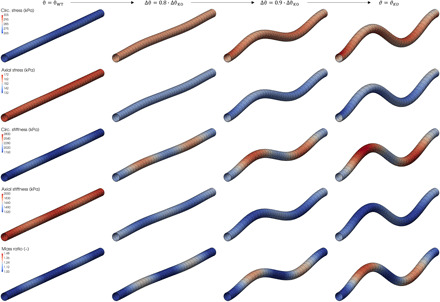
Arterial tortuosity manifests in many conditions, including hypertension, genetic mutations predisposing to thoracic aortopathy, and vascular aging. Despite evidence that tortuosity disrupts efficient blood flow and that it may be an important clinical biomarker, underlying mechanisms remain poorly understood but are widely appreciated to be largely biomechanical. Many previous studies suggested that tortuosity may arise via an elastic structural buckling instability, but the novel experimental-computational approach used here suggests that tortuosity arises from mechanosensitive, cell-mediated responses to local aberrations in the microstructural integrity of the arterial wall. In particular, computations informed by multimodality imaging show that aberrations in elastic fiber integrity, collagen alignment, and collagen turnover can lead to a progressive loss of structural stability that entrenches during the development of tortuosity. Interpreted in this way, microstructural defects or irregularities of the arterial wall initiate the condition and hypertension is a confounding factor.
动脉迂曲在多种情况下都会出现,包括高血压、易患胸主动脉病变的基因突变以及血管老化。尽管有证据表明迂曲会扰乱有效血流,并且它可能是一个重要的临床生物标志物,但潜在机制仍知之甚少,不过人们普遍认为其主要是生物力学方面的。许多先前的研究表明,迂曲可能是通过弹性结构屈曲不稳定性产生的,但这里使用的新颖实验 - 计算方法表明,迂曲源于对动脉壁微观结构完整性局部异常的机械敏感、细胞介导的反应。特别是,由多模态成像提供信息的计算表明,弹性纤维完整性、胶原蛋白排列和胶原蛋白更新的异常会导致结构稳定性的逐渐丧失,这种丧失在迂曲发展过程中会进一步加剧。如此解释的话,动脉壁的微观结构缺陷或不规则引发了这种情况,而高血压是一个混杂因素。